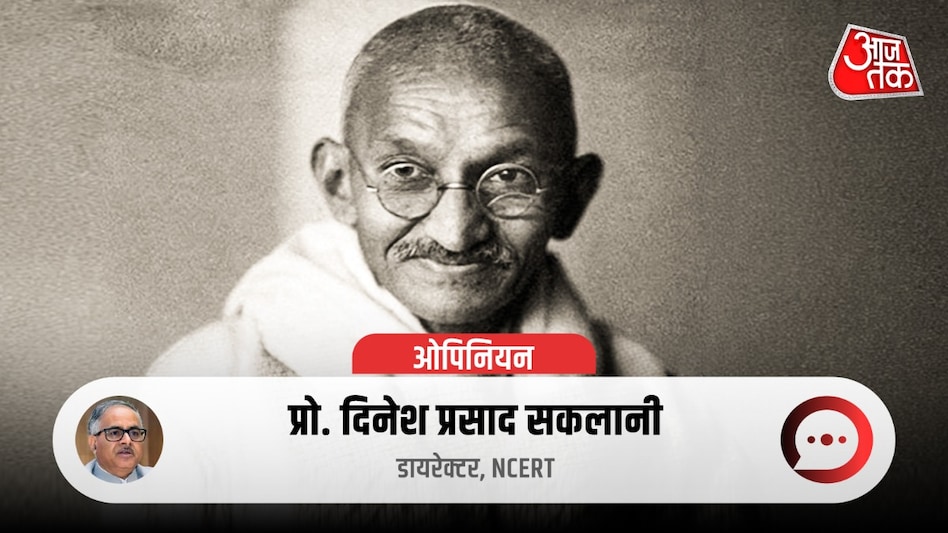
As October 2 approaches, it is natural to remember Mahatma Gandhi, but he must be viewed not only as a hero of the independence movement but also as the founder of a comprehensive life philosophy. This day also serves as a reminder of the India Gandhi envisioned: a nation connected to its roots, proud of its linguistic and cultural identity, while maintaining its distinctiveness by embracing modernity.
Gandhi's philosophy on education holds immense significance. Approximately 95 years ago, on October 20, 1931, at Chatam House in London, while speaking about the Indian education system, Gandhi presented an analogy that later became widely known in the history of Indian education. He stated that British administrators, instead of understanding and developing the Indian education system, began to destroy its roots. According to him, they had 'ploughed up the soil, looked at the roots, left the root in place, and the 'beautiful tree' perished.'
From this arose the image of 'The Beautiful Tree,' which expressed his views on education. Later, the renowned historian Dharmapal used this metaphor in the title of his famous book on indigenous Indian education. He conducted documentary research on the Indian education system based on various British records and educational reviews from the 18th and 19th centuries. Gandhi's question was broader than just counting the number of schools in India; his core question was whether education was connected to the needs, languages, traditions, and way of life of society?
Today, when examining the National Education Policy 2020, this question arises again in a new context. The main message of the National Education Policy 2020 is that India must connect its education system with its social and cultural realities. The policy provides for the inclusion of Indian languages, local contexts, Indian traditional wisdom, art, culture, vocational education, and holistic development at the center of the educational process.
Special attention is given to instruction in the mother or local language in primary classes, and where possible, instruction in the mother tongue is provided for at least until the fifth grade, and ideally—until the eighth grade and beyond. This change is not only about language. A change in language changes the learning experience. If the language in which a child expresses their feelings at home becomes the first step of their education, then education can become more natural and meaningful for them.
For this reason, the National Education Policy 2020 also promotes multilingualism. The flexibility of the trilingual formula has been increased, and emphasis has been placed on studying Indian languages and familiarizing oneself with their literature.
A second important aspect connecting Gandhi's 'beautiful tree' and the modern National Education Policy is the localization of education. The colonial system aimed to fit education into a unified administrative structure. However, Gandhi insisted on education connected to the local community and rural needs, considering the vital role of villages and local teachers. The National Education Policy 2020 also does not limit education only to exams and certificates; it speaks of ending the rigid separation between vocational education, arts, sports, science, humanities, and skills. The goal is to give students greater freedom in choosing subjects according to their interests and abilities. The task of education is not just to prepare a person for a job, but to nurture a thoughtful, competent, and responsible citizen.
The third, and perhaps most important, connection is the move towards modernity through connection with roots. Connecting Indian education with its traditions does not mean returning to the past. It means that Indian traditional wisdom should be considered a legitimate field of study alongside modern sciences and technologies. It is necessary to convey India's intellectual traditions to students—be it mathematics, medicine, astronomy, agriculture, philosophy, language, or art—through evidence and critical analysis.
This is why Indian traditional wisdom finds its place in the new curricula. Students get the opportunity to learn that the Indian path of knowledge is not just a collection of old stories, but a vast tradition connected with thought, logic, experience, experimentation, and social life. In the era of independence, Indian education faces precisely this greatest challenge and opportunity. We need an educational tree whose roots are Indian, whose trunk is strong, and whose branches extend throughout the world.
The National Education Policy 2020 is the first significant step in this direction. It does not set tradition and modernity against each other but establishes a dialogue between them. Mother tongue alongside global languages, Indian knowledge alongside modern science, local experience alongside global vision, and culture alongside skills—this is the holistic image of new education.
Therefore, it is important to remember the 'beautiful tree' analogy on Gandhi's birthday: the roots of education are invisible, but they are what give life to the entire tree of knowledge. Education whose roots are connected to society, language, culture, and life...