Brazil records 547 cases of Creutzfeldt-Jakob disease in 17 years; São Paulo concentrates 37% of diagnoses
Read more
Grupo Globo
g1.globo.com

Brazil records 547 cases of Creutzfeldt-Jakob disease in 17 years; São Paulo concentrates 37% of diagnoses

Creutzfeldt-Jakob disease (CJD), responsible for the death of influencer Lito Sousa from the Aviões e Música channel, was confirmed in 547 individuals in Brazil between 2005 and 2021. This record covers the first seventeen years since the illness became mandatory for notification.

During this period, the Ministry of Health received a total of 1,576 suspected notifications through the Notification Disease Information System (Sinan), of which only slightly more than a third received a definitive diagnosis. Lito's wife, Mila, had disclosed the diagnosis in a video on August 21, mentioning that the diagnosis took time and that in the preceding weeks, the influencer had lost some of his mobility.

Five states account for almost 70% of cases

The South, Southeast, and Northeast regions were the areas where the disease confirmations were concentrated. São Paulo leads the ranking with 202 cases, representing 37% of the national total. Minas Gerais follows in second place with 57 cases, followed by Paraná (44), Rio de Janeiro (38), and Rio Grande do Sul (35). Together, these five states are responsible for 376 of the 547 confirmed cases, totaling approximately 69%.

The elderly are the most affected group, and the progression of the disease is rapid. The age group of 55 to 74 years accounted for 60.2% of notifications, and the average age among suspected cases was 66 years. This profile is consistent with the sporadic form, which is the most common and generally occurs between the ages of 60 and 80.

According to medical literature adopted by the ministry, the evolution is fast: about 90% of patients die within six months to one year after the onset of symptoms, showing an average survival of five months. The official bulletin counts 290 deaths among the analyzed notifications, although it notes inconsistencies in data filling and monitoring.

More notifications do not mean more sick people

An increase in the volume of notifications was observed over the historical series, with a sharper growth starting in 2012. The peak was recorded in 2019, with 174 records, corresponding to 11% of the total. In 2020 and 2021, during the Covid-19 pandemic, the numbers showed a decline.

The ministry assesses that this increase may be a reflection of more thorough sanitary surveillance, capable of identifying and registering suspicions that previously went unnoticed, and not necessarily an increase in the actual cases of the disease.

It is important to note that no Brazilian case has been linked to the new variant of CJD, the one associated with the consumption of beef contaminated by bovine spongiform encephalopathy, popularly known as 'mad cow disease'. Since 2005, the ministry has not registered any case or death related to this variant in the country. Although confusion between the two diseases is frequent when a case gains great visibility, the sporadic form, which has no food link, is responsible for the majority of clinical presentations.

Disease caused by proteins that change shape

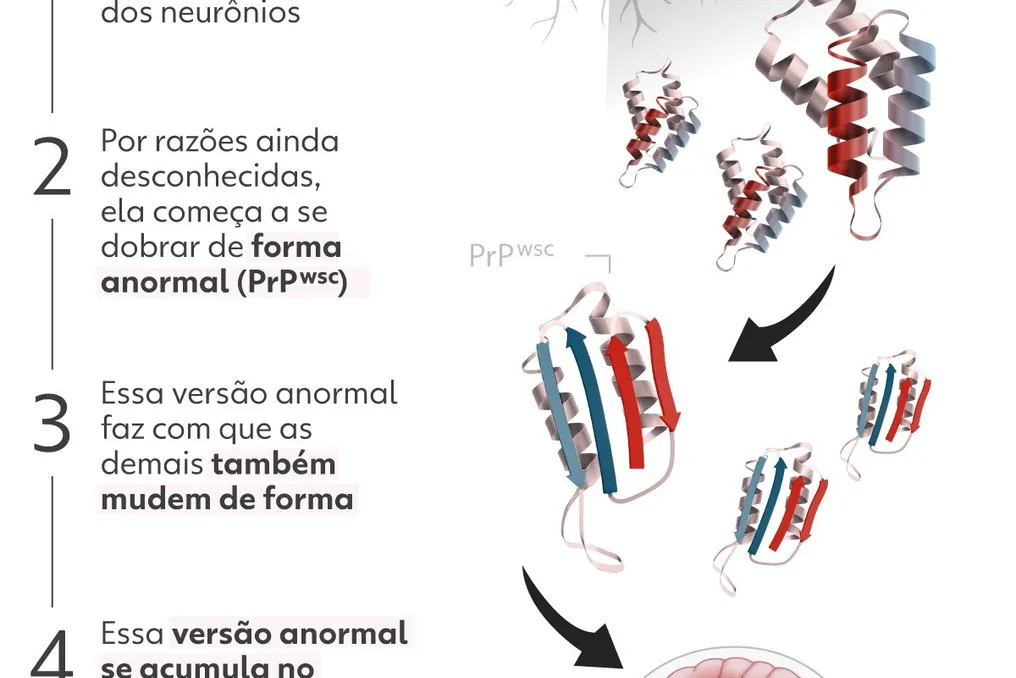
CJD is part of the group of prion diseases. Prions are proteins that acquire an anomalous configuration and cause healthy brain proteins to transform in the same way. This cycle replicates in a chain, leading to the accumulation of modified versions and causing progressive damage to brain cells. This mechanism explains why symptoms such as memory loss, behavioral changes, and impairments in coordination and movement can worsen in just a few months, a pace considerably faster than other neurodegenerative pathologies.

In the sporadic form, the most common, scientists still do not know the factor that initiates the first transformation or the reason why it affects certain people and not others. There are other, even rarer, prion diseases, such as Gerstmann-Sträussler-Scheinker syndrome and fatal insomnia, which prevents the patient from sleeping. Estimates used by entities such as the UK's National Health Service (NHS) suggest an incidence of one to two cases per million inhabitants annually, even in nations with well-established monitoring systems.

Symptoms are confused with those of other diseases

There is no exclusive initial sign of CJD. The clinical picture can begin with forgetfulness, changes in behavior, difficulty walking, imbalance, or involuntary movements, all signs common to much more prevalent conditions. Professor Marcio Luiz Figueredo Balthazar, from the Department of Neurology at the Faculty of Medical Sciences of the State University of Campinas (Unicamp), clarifies that Alzheimer's, the best-known dementia, progresses over years or decades, while CJD manifests rapidly, resulting in a much shorter survival.

The speed of development is an indicator that aids suspicion but does not confirm the diagnosis. CJD falls into the group of rapidly progressing dementias, which have multiple etiologies, including encephalitis, autoimmune diseases, other neurodegenerative problems, and metabolic alterations. Since some of these conditions are treatable, it is imperative that the doctor rules them out before confirming a CJD diagnosis.

Combined exams and test still restricted access

No single exam can resolve the investigation in all patients. The neurologist integrates the clinical history with brain magnetic resonance imaging, which can show strong patterns that reinforce suspicion, in addition to performing a lumbar puncture for cerebrospinal fluid analysis, electroencephalogram, and blood and CSF tests to exclude other causes.

A recent advance is RT-QuIC, an acronym for real-time quaking-induced conversion. This test uses cerebrospinal fluid to indirectly detect the characteristic activity of prions: the sample is placed in contact with normal proteins, and if prions are present, they alter their shape, allowing the reaction to be measured. In certain studies, the test achieved a specificity close to 100%, implying that a positive result indicates the disease with very high probability. However, sensitivity varies, and some cases may go unnoticed.

According to neurologist Jerusa Smid, from the Hospital das Clínicas of the University of São Paulo (USP), the Emílio Ribas Institute of Infectology, and the Albert Einstein Israeli Hospital, the test helps in closing the diagnosis in most cases, but it is not yet widely available in Brazil.

What the Brazilian numbers do not show

Of the 1,576 suspected cases reported between 2005 and 2021, 457 were ruled out and 572, or 36.3%, did not receive a final classification. The report also does not detail the clinical evolution of more than half of the examined notifications. This data demonstrates limitations in disease surveillance, preventing conclusions about how many cases do not end up being diagnosed.

For Jerusa, CJD is not as rare as national records suggest. The low frequency itself helps explain the difference between the occurrence observed in other countries and the Brazilian one: a neurologist may see thousands of patients with memory complaints and find very few cases throughout their career, making it difficult to remember the disease in time, and the necessary tests require centers with greater infrastructure. The survey ends in 2021, which makes it impossible to know if the increase in notifications persisted after the pandemic period.

Similar stories

Aviation Influencer Lito Sousa Diagnosed with Rare Neurodegenerative Disease
Read more
g1.globo.com

Aviation Influencer Lito Sousa Diagnosed with Rare Neurodegenerative Disease

Joselito Geraldo de Sousa, known by his artistic name Lito Sousa, is a prominent Brazilian influencer focused on aviation. He built significant recognition through the YouTube channel Aviões e Músicas, where he presented technical information about aircraft operation, safety procedures, turbulence, and air accidents in an understandable manner.

His channel has reached over 3.5 million followers, and he also has 2.5 million followers on Instagram. With a career spanning over 36 years in the sector, Lito Sousa accumulated experience as an aircraft mechanic, working in maintenance and safety roles at airlines such as Varig, Transbrasil, and United Airlines.

After dedicating decades to maintenance, he fulfilled his desire to become a pilot, obtaining his license in 2021. Furthermore, Lito worked as a writer, speaker, and consultant, using his aviation knowledge to discuss topics such as risk management, safety, and human factors. Among his published works is the book Onde Morrem os Aviões (Where Planes Die), based on professional experiences lived in the former Zaire, now the Democratic Republic of Congo.

Together with his wife, businesswoman Mila Seidl, he founded Lito Academy, a company that manages his courses, consulting, and lectures. Lito Sousa is also the owner of the 'Aviões e Músicas' YouTube channel, which offers accessible explanations about aircraft, safety, turbulence, and air accidents. His company is responsible for the course Sem Medo de Voar (Fearless Flying), aimed at individuals with aerophobia, seeking to reduce passenger anxiety by detailing the technical aspects of aircraft and situations like turbulence.

The couple married in 2014, starting their relationship in 2015 and getting married five months later. They have one 7-year-old son. Mila Seidl was instrumental in encouraging Lito to turn his technical knowledge into YouTube content, assisting in structuring the business that evolved into Lito Group.

Series of Illnesses

Lito reappeared in the news in 2026 after disclosing serious health problems. In July, he announced a diagnosis of prostate cancer, followed by a nervous system inflammation. Subsequently, in August, Mila informed fans that he had been diagnosed with Creutzfeldt-Jakob disease, a rare and progressive neurodegenerative condition.

In the state of São Paulo, where he resides with his family, only 202 confirmed cases were registered over a period of 16 years. This state leads the number of confirmations in Brazil, according to data from an agency, followed by Minas Gerais and Paraná. He remained hospitalized at Albert Einstein Hospital, located in South Zone of São Paulo, for several days to monitor his condition, although he reported that the circumstances were not favorable.

Experts point out that Creutzfeldt-Jakob Disease (CJD) is an extremely rare, severe, and rapidly deteriorating brain illness, manifesting as memory loss, mobility difficulties, and tremors. In the final weeks, the influencer showed a significant loss of movement but maintained mental lucidity, deciding to return home to continue treatment. At that time, it was stated: 'In the last few weeks he lost a lot of movement, but his head is lucid. (...) I can't even walk with him. His mind is intact. That in itself is a miracle. It's just the physical body that is becoming weaker day by day.'

Influencer Lito Sousa dies after receiving experimental compound against Creutzfeldt-Jakob disease
Read more
g1.globo.com

Influencer Lito Sousa dies after receiving experimental compound against Creutzfeldt-Jakob disease

The influencer Lito Sousa died this Thursday, the 1st, due to complications from Creutzfeldt-Jakob disease. Approximately two weeks before his death, he received a substance that had never been tested in humans: ALN-6457.

This compound, developed by the American pharmaceutical company Regeneron in collaboration with Alnylam Pharmaceuticals, represents an attempt to combat Creutzfeldt-Jakob disease, for which there is currently no treatment capable of stopping its progression. Lito's wife, Mila Seidl, disclosed in a video on September 14th that he had been hospitalized in the ICU due to complications from the disease when he received the compound the previous weekend, and that there were no signs of adverse reactions, an inherent risk in testing novel molecules in humans.

The medical team was awaiting results from tests conducted six weeks after administration to check for any changes in his clinical condition. Since the compound has not yet completed clinical trial phases, few detailed pieces of information about it are publicly available, and g1 compiled existing clues to clarify what is known about the substance.

What is compassionate use

Lito's access to ALN-6457 occurred through a regulatory procedure called compassionate use. This mechanism allows patients facing serious, debilitating, or life-threatening illnesses to receive medications, biological products, or devices that are still in experimental phase and lack sanitary registration, provided there is no other effective therapeutic option.

The granting of this permission for Lito's case was done by the National Health Surveillance Agency (Anvisa). The prefix 'ALN' in the compound's name refers to Alnylam, a company that, in partnership with Regeneron, focuses on drugs for the central nervous system. Publicly accessible documents from Alnylam show that prion diseases, a group that includes Creutzfeldt-Jakob and others caused by the same protein, were targets of the collaboration from the beginning, alongside Alzheimer's and Parkinson's.

A brake on the protein factory

Lito's disease originates from a protein known as a prion. In its natural configuration, this protein is present in the brain without causing problems. However, in Creutzfeldt-Jakob, a variant with abnormal folding acts as a template: by interacting with healthy proteins, it forces them to adopt the same shape, allowing the damage to spread through the brain tissue.

The treatment aims to intervene before this stage. It uses a small interfering RNA (siRNA) molecule, which activates a natural cellular process, causing the cells to cease producing a specific protein. Inside the cell, this molecule is processed by a protein complex that acts as a search system, identifying copies of messenger RNA containing the instruction for the prion protein and destroying them before the protein is synthesized. With fewer copies of the recipe, the cell produces a reduced amount of prion.

The underlying logic is that with less healthy protein available, there is less material susceptible to deformation. It is important to note that this approach does not reverse established damage nor correct proteins that have already folded incorrectly, but theoretically, it may slow the progression of the disease by decreasing the generation of new vulnerable proteins.

The challenge of reaching and surviving in the brain

Delivering the molecule to the correct location is the most challenging step. The brain is protected by the blood-brain barrier, which acts as a natural filter and prevents most intravenously or orally administered drugs from entering.

Daniel Dahis, a doctor in Biomedical Engineering and specialist in clinical research, explains that the difficulty of these types of medications goes beyond just reaching the organ. After penetrating the cell, the molecule can be directed to acidic compartments used by the cell for digestion, where, if it is not resistant, it will be destroyed before performing its function.

To overcome these impediments, Alnylam's platform uses chemical modifications that maintain the integrity of the siRNA by associating it with a lipid chain called C16. This chain acts as a fatty anchor attached to the molecule, facilitating its passage across the cell membrane, a barrier that would block molecules with siRNA characteristics without this aid.

What the documents show

Currently, there are no clinical studies on ALN-6457, meaning its effects in humans are unknown. However, g1 managed to locate Alnylam's patent application regarding a C16-conjugated siRNA targeted at the prion protein, whose description corresponds to the substance authorized by Anvisa, as well as presentation materials of the same technology applied to Alzheimer's.

Patents generally cover an entire set of chemical variants developed over years, and it is likely that ALN-6457 belongs to this group. One document presents a test conducted in mice, where, at the lowest dose evaluated, a decrease of approximately 15% in the messenger RNA responsible for producing the prion protein was observed. According to Dahis, this data represents a positive biological signal but does not allow predicting whether a patient would notice any difference.

The experiment did not confirm whether the reduction in normal protein led to a decrease in the formation of the deformed version, nor did it demonstrate survival gain in animals, much less in humans. The specialist concludes that the body of evidence suggests the strategy warrants investigation, especially considering a disease with no treatment capable of interrupting its progression, provided safety uncertainties are considered and an individual risk-benefit assessment is performed.

Safety: initial, still short tests

Presentations made by Alnylam to investors in 2021 detailed tests conducted in rats and primates using the same C16 conjugation technology applied to the central nervous system. Clinical, neurological, and vital organ tests such as the brain, spinal cord, liver, and kidney showed no alterations attributable to the substance.

However, these tests were preliminary and short-term. The most complete safety protocol, required by regulatory bodies before starting human studies, was finalized by the company only for another program focused on Alzheimer's, and not for the candidate intended for the prion protein. The path to obtaining a definitive answer depends on clinical trials, a phase that ALN-6457 has not yet reached. Only with complete safety data and a comparative analysis among various patients will it be possible to determine if reducing the prion protein modifies the course of a disease that, until today, lacks an interruptive treatment.

Popular