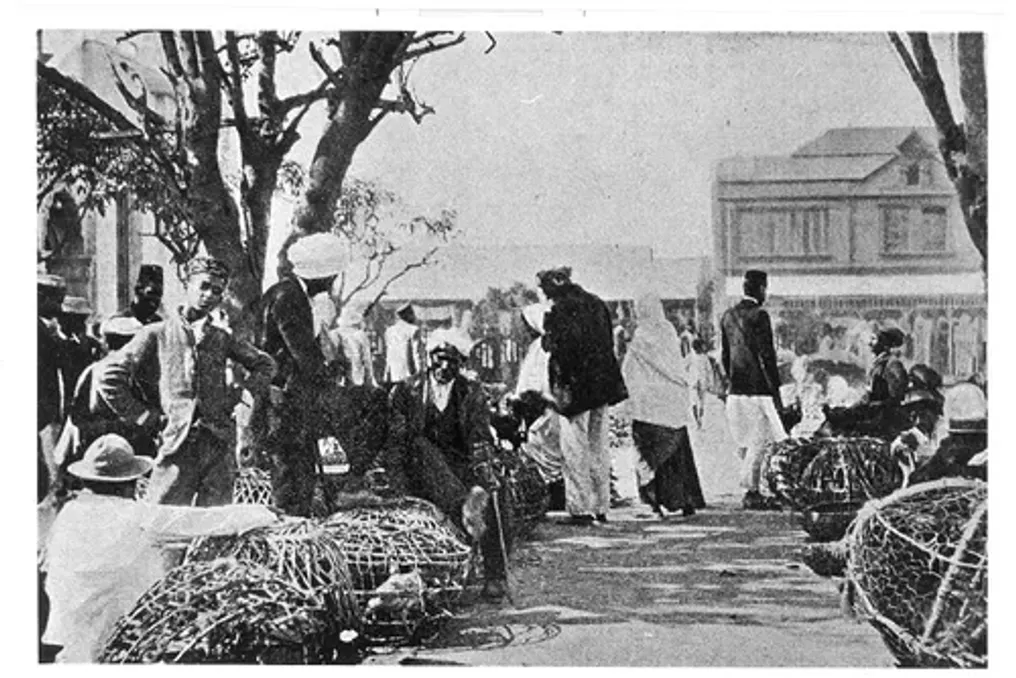
Under the colonial administration, poor farmers and landless peasants in India faced high land taxes and crop failures. Desperate families borrowed money or grain from moneylenders, called Sahukars or Kandan Koduppavars, at very high interest rates to ensure survival or hold weddings. Often, unpayable compound interest led borrowers into perpetual poverty, stripping them of their land and livestock.
Financing and rural debt in 19th-century India forced vulnerable village residents to leave their homelands and enter indentured labor systems across the colonial world.
On colonial plantations in Mauritius, Trinidad and Tobago, Guyana, Suriname, Fiji, and Natal, contract workers often remained trapped in cycles of debt and low wages long after crossing the Kala Pani. In colonial Natal, even after contracts ended, contract workers were coerced into signing two or three more agreements to avoid eternal debt slavery.
Sirdars or Kanganis, Indian foremen, overseers, and labor recruiters, acted as key intermediaries between plantation owners and contract workers across all colonial empires. A study by Marina Carter and Crispin Bates titled 'Sirdars as Intermediaries in Indian Ocean Labour Migration in the Nineteenth Century' notes that 'Sirdars functioned not only as collectors and agents of labour in the village, on the ship, and at the warehouse, but also as foremen, as representatives of work groups, and as settlement pioneers. They acted as mahajans (moneylenders), played a key role in re-recruiting groups upon the completion of their labour contracts, and resisted and helped planters maintain discipline and order on the plantations.'
'The provision of money and pooling of resources became an important aspect of the Sirdar's functions on the estate... The Sirdar could also give money (for a fee) for special purposes, such as a wedding, or even help a worker who needed to return to relatives in India for funerals or in case of other emergencies.'
On the plantations, the agreement became an inevitable shackle of slavery when workers were forced to stay, as absence from work or minor infractions resulted in fines and imprisonment, turning five-year contracts into ten years of service.
The scale of desperation among former contract workers was demonstrated by Mr. Richardson, a plantation owner, in his testimony to the Uregg Commission in 1885. He stated: 'There are many Indian moneylenders in the Colony who make a business out of it. They charge a very exorbitant interest rate, sometimes two shillings and six pence per pound per month. Money given to an Indian under contract cannot be legally repaid; it is obtained from him only under threat; in many cases, it is not repaid at all.' He continued: 'This often leads to assaults. A man here receives ten shillings a month as wages; he borrows five shillings from a person, mortgaging his future salary; within a few months, the interest exceeds the loan amount, and at the end of the contract, the person may find themselves in the hands of the moneylender: this sometimes leads to the person escaping (from the plantation).' In his view, 'I believe this lending cannot be stopped; consequently, a great deal of misery and suffering arises, as the person cannot acquire any small luxuries they might enjoy.'
In addition to debt dependence on the contract system, contract workers released from the agreement were forced to borrow from moneylenders for survival. Moneylending also affected Indian passengers arriving in Natal. Indian immigration files held in the KwaZulu-Natal Archive in Pietermaritzburg contain an interesting protocol regarding the movements of Daiya Purbhau, who resided at 26 Doornfontein, Johannesburg.
Purbhau reported that he was born in Uttarakhand, where he owned 20–25 agricultural plots of stray animals in the village. He first arrived in Durban with his cousin Ram Bhan in 1906. Upon his first arrival in South Africa, Purbhau did not report to the immigration service in Durban. Two years later, he boarded a ship, escaping to Delagoa Bay to travel to Transvaal in 1908, during Mahatma Gandhi's mass protests against the burning of travel documents.
A year later, Purbhau traveled to Volksrust, the border between Newcastle and Transvaal, to meet his cousin Ram Bhan. From there, Purbhau was able to send money to India. The land he owned in India was ancestral family property, but it belonged to moneylenders to whom he paid while living in Natal. He could not say how much he owed, as no record existed.
Morin Swan's study in the book 'Gandhi, South African Experience' focuses on the relationships between classes within the Indian community living in South Africa. Her work speaks of the predatory relationships existing within the network of traders and their connection to the indenture system and former contract workers.
'In Durban, trading merchants were connected to each other and to small traders in an extensive network of trade, credit expansion, and lending. Large traders rented out property to small traders and provided loans. For example, around 400 Latin American sellers in Natal owed MG Kamruddin over 25,000 pounds in 1898.'
The vicious cycle of moneylending was often very difficult to overcome. In many cases, traders established slave-like relationships with recently freed Indian workers, employing them on small plots under conditions as strict as the indenture contract.
In 1911, a magistrate's report noted that some lease agreements included a clause stipulating that the farmer's harvest must be sold to the landowner at essentially unfavorable prices. An important study by Professor Ghulam Wahed in the article 'Unhappily Ruined by Disputes and Litigation: Memon Mosque in Durban, 1880–1930' emphasizes that the ties between the former contract community and the commercial elite were clearly defined.
'An important point of contact was the trade of Indian produce by merchants. Between the early 1890s and 1910, most Indian vegetable growers and small farmers sold their produce at the Grey Street Mosque market. Leading Indian traders in Durban approached delegations of producers complaining about the lack of market opportunities. Part of the land belonging to Porbandar Madrasa was then allocated by its trustees as a marketplace. The fee for using this land was a voluntary donation to the school.' He added: 'At some point after this, a mandatory fee was established, and by 1909, the annual income of the Madrasa from the market was estimated at 1,400 or 1,500 pounds sterling. Ironically, the main Muslim school in Durban had to receive such generous patronage from Indian farmers, many of whom were not Muslims, and whose children suffered from a lack of educational institutions.' 'The question of directing market revenues to the community became the main problem used by Swami Shankaranand to mobilize popular support during his brief involvement in Indian politics between 1909 and 1910.'
There is insufficient evidence to definitively determine how and why moneylenders came to dominate Indian commerce in Natal, and later in Transvaal. Morin Swan's research shows that traders, especially those who arrived earlier, apparently arrived in Natal with relatively larger sums of capital, making it increasingly difficult for former contract workers to compete.