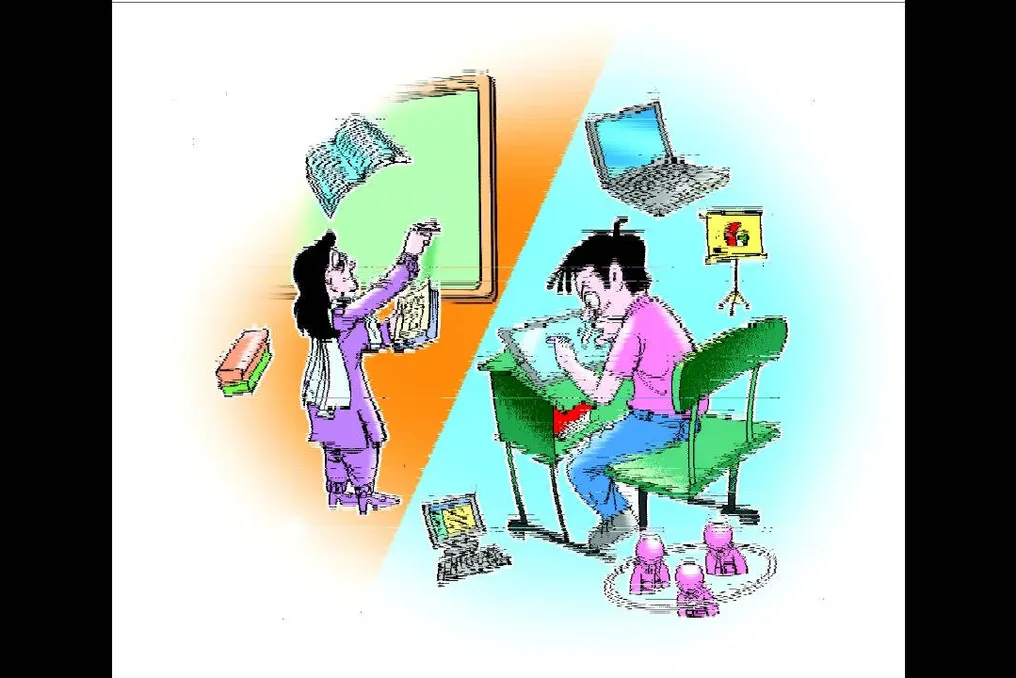
In some regions of India, educational institutions are facing a fundamental problem that cannot be solved by simply changing curricula. Students accustomed to instant food delivery, constant social media viewing, and receiving answers from artificial intelligence are struggling with maintaining concentration, tolerance for boredom, or the pursuit of rewards that are not immediate.
As a result, teachers are increasingly working with a generation that demonstrates significantly less attentiveness compared to previous cohorts. A recent nationwide survey conducted by the National Council of Schools CBSE showed that nearly 70% of teachers across the country reported a sharp decline in student focus and attention in the classroom.
This survey covered about 6.3 lakh respondents—teachers, students under 18, and their parents. It also revealed that 74% of students spend more than two hours daily in front of screens for non-academic purposes. Furthermore, educators reported an increase in anxiety, irritability, and a decrease in personal interaction among children.
Teacher Parmeshwar Dattaro Bhurke notes that this trend is evident in daily classroom work. He stated that many children have lost the ability to concentrate long enough to listen to a one-hour lesson or read an excerpt without distraction.
This has prompted many educators to experiment with new teaching methods. Bhurke added that the old practice of one student reading a chapter aloud while others listened no longer works; the goal now is to maintain active mental engagement during the lesson.
Priya, a middle school teacher, observed a deterioration in students' memory retention. She says that even when children appear attentive, their minds are occupied with something else. They are also less willing to put in effort to solve complex problems, which negatively affects both academic performance and behavior, as they avoid any difficulty or discomfort.
For 15-year-old Chinmay Sona, this shift is visible in how her classmates study. She mentioned that instead of working with textbooks or internalizing ideas, many of her peers seek an easier path, whether through AI-generated summaries or explanatory videos. While this method allows for faster review and saves time, it leads to a lower level of information absorption.
Psychologists explain that such habits reflect a behavioral shift caused by constant access to instant gratification. They activate dopamine, causing a brief rush of pleasure that reinforces the behavior and motivates repetition. This differs from real-life achievements, where satisfaction only comes after significant effort and patience, noted psychologist Rashi Bhatnagar.
These consequences manifest in the learning process. Bhatnagar explained that when rewards come almost effortlessly, the brain begins to prefer them. Like an unused muscle, our ability to wait, tolerate boredom, and sustain attention gradually weakens, making us restless when tasks require patience.
Therefore, in her view, there is a downside to schools trying to make every lesson engaging. Education cannot always provide immediate pleasure if its purpose is to foster deep thinking. Schools need to consciously create opportunities for children to reflect and generate new ideas.
The habit of expecting immediate results also affects resilience. Bhatnagar emphasized that because children have not developed the ability to wait for outcomes, many give up too quickly. They need to be taught not to quit at the first sign of difficulty.
Psychiatrist Nisha Singhal, speaking about the digital ecosystem, asserts that it is intentionally designed to reinforce immediate satisfaction. She believes that social media apps, notifications, and quick commerce services create dependency, and the brain starts demanding them. Reading or learning something new also brings a sense of accomplishment, but the reward is delayed, and that is the entire difference.
Singhal argues that restoring patience begins by giving children the opportunity to slow down. They must be allowed to experience boredom, as there is a tendency to fill every moment of the day with something. Parents and schools must consciously encourage delayed gratification.
Another challenge related to classroom adaptation is the large class sizes and low teacher-to-student ratios. Priya noted that this leaves little room for developing curiosity and meeting each child's individual needs. At the same time, schools are under pressure to ensure high scores and pass rates, which forces them to focus on testing outcomes rather than rethinking education to meet changing children's needs.
While educators await national policy on mental health and well-being for schools, they believe it should help students find meaning in the learning process, whose greatest rewards cannot be a sprint or a quick fix.