The Museum of Tibetan Medical Culture of Qinghai Province, located in the Sinin city biotechnology industrial park, is considered the only comprehensive collection dedicated to Tibetan medicine. This healing tradition is based on the belief that water, along with four other elements, forms the basis of the human body and its balance.
Historically, Tibetan medicine officially dates back to the 8th century. According to legends, King Trisong Detsen convened the first international medical symposium at Samye Monastery, inviting physicians from India, China, Persia, and other lands. Traditionally, the court physician Yutok Yongten Gonpo systematized the results of these discussions in the 'Four Tantras' (Gyüshi), which remain the foundation of Tibetan medical theory.
It is important to note that two individuals feature with this name in the tradition: the 'elder,' associated with the 8th century, and the 'younger,' who lived from 1126 to 1202, who is more reliably associated with the authorship of the 'Four Tantras.' Some researchers suggest that the figure of the 'elder' was created posthumously by the descendants of the younger Yutok to lend greater antiquity to the medical lineage. This serves as a reminder that part of the museum's foundational narrative combines documented history with religious traditions.
Philosophy Based on Five Elements
The medical exhibition is based on the concept that the universe, and with it the human body, consists of five elements: earth, water, fire, wind, and space. In this system, water is linked to bodily fluids, one of several characteristics that determine health or illness. Tibetan doctors, known as amchi, diagnose imbalances among the three nyepa—wind, bile, and phlegm—each representing a combination of the five elements.
This theory has direct practical application extending far beyond metaphor. Traditional Tibetan medicine prescribes specific types of hydrotherapy in hot springs, depending on their mineral composition: carbon and calcite-enriched springs are used for chronic fever; sulfur springs for chronic colds, and mixtures containing bitumen or realgar are applied for more complex, mixed disorders.
Diagnosis by Pulse, Urine, and Tangy Art
Medical tangas—painted scrolls that served as a kind of visual textbook—play a key role in shaping visitors' understanding of historical diagnostic methods. The museum's collection is based on a tradition dating back to the late 17th century, when Desi Sangye Gyatso, regent of the Fifth Dalai Lama, commissioned a series of paintings to illustrate his commentary, known as the 'Blue Beryl,' on the 'Four Tantras.'
The initial set consisted of 79 paintings. In the 20th century, Khenrab Norbu, head of the Lhasa school of medicine and astrology, added eighty, depicting 13 prominent Tibetan medical masters. These tangas illustrate pulse and urine diagnosis, the anatomical structure of the body, points for moxibustion, and the preparation of medicines. Twenty-one paintings from the original series are dedicated separately to large-scale anatomical depictions of the human figure.
Beyond the Scalpel: A Spectrum of External Treatments
Although surgery attracts the most attention, museum specialists note that it is only part of the broader system of 'external therapies' described in the 'Four Tantras.' Traditionally, these methods are divided by intensity. Milder procedures include heating, baths with medicinal mineral water, and oil massage. More intensive methods include moxibustion, i.e., applying smoking herbs to the body, and bloodletting. The most radical methods are cauterization and applying heated stones, wood, or animal horns to specific points on the body.
Later, golden acupuncture—cauterizing with a heated gold needle at precisely defined points—and cupping, including cup-based bloodletting, were also incorporated into practice. According to experts in the field, most surgical practices outside this spectrum of external therapies have ultimately been lost, with the exception of cataract removal, which has survived as a documented surgical skill.
Surgical Instruments Dating Back Two Millennia
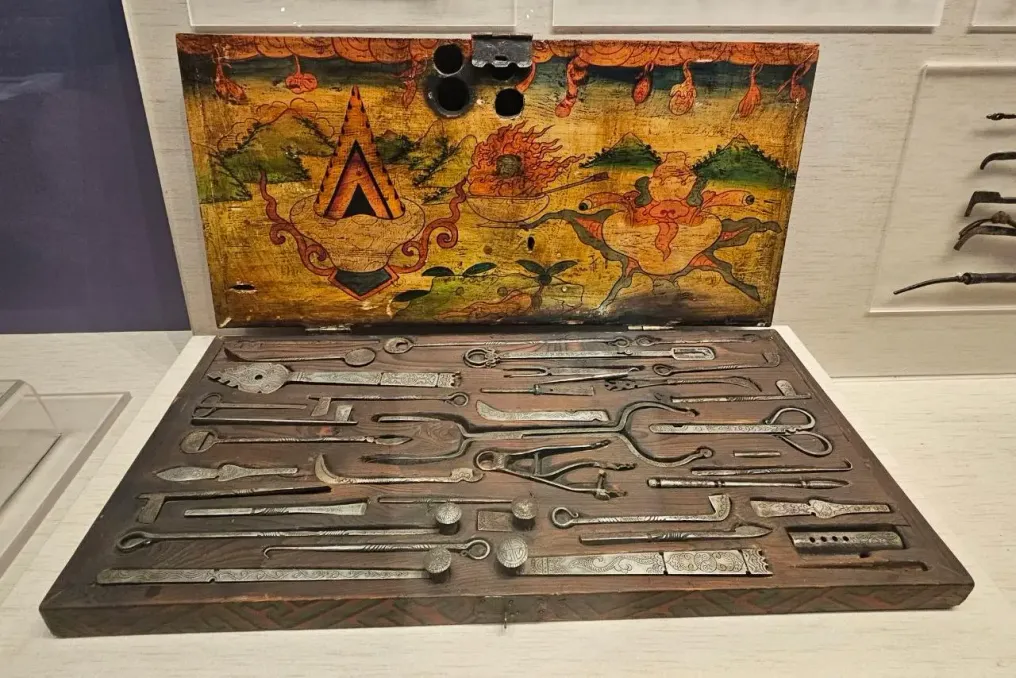
One of the most impressive parts of the museum's collection is a group of over 180 traditional Tibetan surgical instruments displayed alongside tangas depicting historical operations. According to museum materials, Tibetan doctors used surgical instruments over 2000 years ago, while surviving records indicate that Tibetan healers performed craniotomies—a highly complex procedure for that time—several millennia ago.
The preserved sets of such instruments usually include forceps, hooks of various depths of grip, leaf-shaped knives and lancets, forks, needles, and probes, which are believed to have been used for scraping tissues or cauterization. Many of them are decorated with engravings.
Specimens and Texts as a Record of Living Pharmacopoeia
In the museum's specimen halls, there are over 2000 examples of plants, animals, and minerals collected in the Qinghai-Tibet plateau. They reflect a pharmacological tradition based on the Tibetan medical belief that virtually any natural substance can possess healing properties. A separate literature hall houses over 1000 classical texts on Tibetan medicine, as well as several hundred works on modern practice.
Overall, the museum's collection, encompassing both medical and broader cultural materials, amounts to 40,000 to 50,000 exhibits, according to various official data. Among them, 158 items are classified as national first-category cultural artifacts.