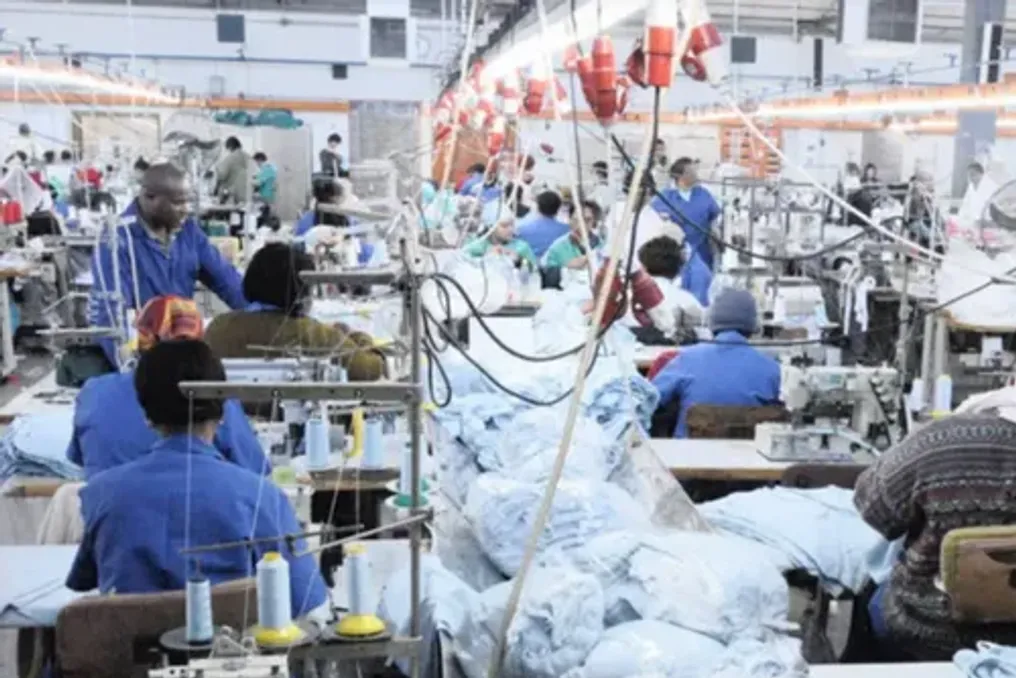
The manufacturing sector in South Africa is experiencing a trend of job reductions. According to Stats SA data, 35,000 jobs were lost over the past year, representing an annual decrease of 2.7 percent. These cuts affected industries such as food and beverage production, textiles, chemicals, metallurgy, and transport equipment. Furthermore, business services lost 13,000 positions, trade lost 8,000, and transport lost 5,000.
The only sector that helped prevent a further deterioration of the overall picture was public services, which added 29,000 jobs. A slight growth was also recorded in the electricity, mining, and construction sectors, where the increase amounted to 1,000 people each.
Structural changes within production
An analysis of the internal structure of production shows that something more significant than simple staff reduction has occurred. The number of full-time employees decreased by 10,000, but part-time jobs in manufacturing plummeted by 12.2 percent, equivalent to the loss of 10,000 positions from a much smaller base. Such a sequence of events usually indicates that companies are not just optimizing costs, but completely scaling down production capacity.
The overall picture is worse than quarterly reports suggest
Current losses in the second quarter follow a revised estimate of 109,000 job losses in the first quarter. This leads to a total loss of 123,000 people in the formal sector for the first half of 2026, according to an analysis of Stats SA data conducted by Xinhua. Year-on-year, the formal sector shrank by 95,000 jobs. This decline coincided with South Africa's GDP shrinking by 0.2 percent in the same quarter, and the official unemployment rate rising to 33.6 percent from 32.7 percent in the first quarter. Meanwhile, youth unemployment reached a staggering 47.4 percent, leaving five million young people jobless.
There is also a qualitative aspect that is easily overlooked when looking at aggregate figures. While full-time employment across the entire formal sector decreased by 40,000 jobs, part-time employment increased by 26,000. The average monthly wage rose by 4.1 percent year-on-year to 30,611 South African Rand, but the total gross income paid to employees fell by 4.8 billion Rand in the quarter. Workers are being forced into less stable work with fewer hours, even despite modest wage increases for those who retained full-time employment. This demonstrates a quiet structural shift in the labor market that the unemployment rate itself does not reflect.
A familiar story with a modern trigger
The South African manufacturing sector has been declining as a share of the economy long before 2026. If it accounted for nearly a quarter of GDP in the 1980s, its share today is about 12 percent. Over three decades, the sector's competitiveness has been undermined by cheaper imports and electricity supply constraints. However, the distinguishing feature of the current episode is the reason cited by Stats SA: higher raw material costs related to fluctuations in global energy prices, rather than power outages, which dominated the narrative for most of the last decade. This serves as a reminder that the South African manufacturing sector has not escaped its energy vulnerability, but has merely replaced one energy problem with another.
Nigerian manufacturers faced almost identical pressure prior to 2025, when the removal of fuel subsidies led to increased production costs, resulting in similar outcomes: workers moved to informal or part-time employment instead of returning to full-time employment. A structural question arises: will the economy create jobs in the next quarter? Or does the manufacturing base, which continues to lose full-time positions even without power outages, have a real path to growth, or is it shrinking due to reasons that cannot be solved by infrastructure improvements alone?