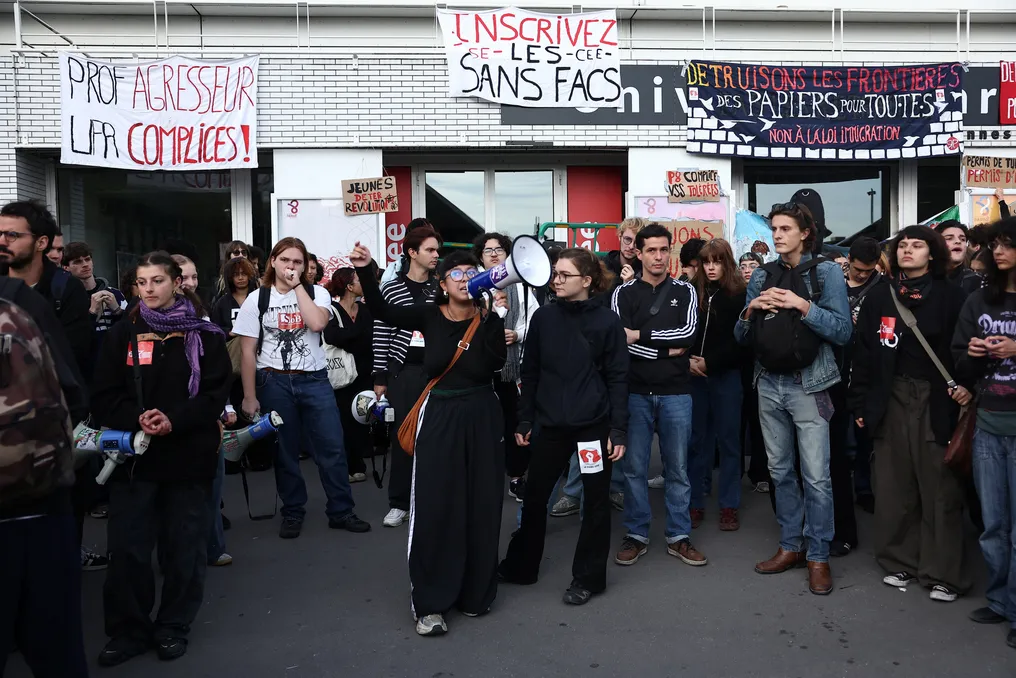
Around thirty higher education institutions joined the secondary school blockade movement spreading across France this Thursday, the 1st, extending a mobilization that began about a week ago. According to the Student Union, campuses are blocked in several locations, including Paris, Strasbourg, Marseille, Lyon, Reims, Poitiers, and Nanterre. The union described this adherence as a historic achievement, although access is barred, universities have the possibility of maintaining teaching activities remotely.
High school students are primarily demanding the replacement of absent teachers and an increase in resources allocated to education. Student unions present the participation of university students as the 'second act' of this mobilization, which recently gained momentum and was accompanied by incidents of violence.
The movement reached 356 schools on Wednesday (30), an increase from the 338 schools registered on Tuesday. On that day, 625 people were detained, and 83 police officers and gendarmes were injured. Furthermore, the French Minister of Education, Édouard Geffray, released a report indicating that 119 students and school staff have been injured since the start of the blockades.
On Thursday, the blockades persisted in Paris, Marseille (South), Strasbourg (East), and Rennes (Northwest). Lola, a second-year high school student, told AFP that 'they don't listen to us, we are forced onto the streets,' citing long working hours, the lack of teacher substitutes, and classes without responsible teachers as reasons for the mobilization.
Increase in social tension, strike, and student protest
France is currently experiencing a series of protests involving public sector strikes and clashes between students and police forces. The situation reached its peak shortly before the budget presentation and just a few months before a presidential election, where the far-right is considered the favorite.
On Tuesday (29), approximately 200,000 demonstrators took to the streets across the country, with nearly 30,000 in Paris, according to data from the Ministry of the Interior. More than 170 demonstrations were called to demand salary adjustments for civil servants, whose wages have been eroded by inflation, and 'adequate budgetary resources' for public administration demands.
A sign displayed at the march in Lyon read: 'Even with 40°C, our salaries remain frozen.' Nicolas March, a 52-year-old firefighter, participated in the demonstration at the Bastille Square in Paris, stating: 'We are protesting today because we need to be heard by the minister.' Civil servant demands include loss of purchasing power, insufficient staffing levels, degradation of working conditions, and, in some cases, precariousness due to budget cuts.
Clashes in the student mobilization
High school students, who have been protesting since last week for better educational conditions, led a day of violent confrontations on Tuesday. Groups of young people set fire to garbage containers and threw objects at the police, who responded using batons and tear gas.
The Ministry of the Interior reported that the clashes resulted in the detention of 440 people, in addition to injuries, including ten staff members and several students. The Minister of Education, Édouard Geffray, announced that legal action will be taken as a result of the acts of violence.
Geffray wrote on his X network: 'This violence is indescribable (...) To legitimize it or ask, in this context, for the blockades to be expanded is to endanger both our students and public servants.' Students maintained blockades and protests in hundreds of secondary schools across the country, alleging problems with scheduling organization, class sizes, teacher shortages, and overheated classrooms during recent heatwaves.
Violence and investigations
Several episodes of violence recorded during the blockades led to the initiation of three investigations by the IGPN, the body responsible for investigating police conduct. According to the Minister of the Interior, Laurent Nuñez, these investigations relate to incidents that occurred in Sevran, in the Paris region, Saint-Ouen-l'Aumône, in Val-d'Oise, north of Paris, and in the city of Tours, in the west-central part of France.
In Tours, a student suffered a head injury on Wednesday and required hospitalization. The Public Prosecutor's Office considered his injuries to be 'consistent' with shots fired by French security forces to control the protests. Authorities also documented, in different municipalities, the burning of bins, the throwing of mortars, and the construction of barricades, in addition to arrests related to the protests. Nuñez assured that the security forces acted 'with great proportionality.'
Ryad Rani, president of the High School Student Union (USL), and Eloïse Lefebvre-Milon, secretary-general of the Student Union, called for the intensification of the mobilization for this Thursday and Tuesday, October 6th. These organizations demand, among other things, 'massive funding for high schools and universities.' Unef, the third largest student organization, also called on university students to participate in demonstrations across the country, pleading, among other points, against the reduction of university places and the freezing of housing allowances.
In response to the expansion of protests, the government announced on Wednesday the creation of a 'consultation platform' open to all high school students, allowing them to present their concerns and demands in a regionalized manner. Geffray mentioned that a 'national debriefing' would subsequently be organized to provide 'structured answers.'