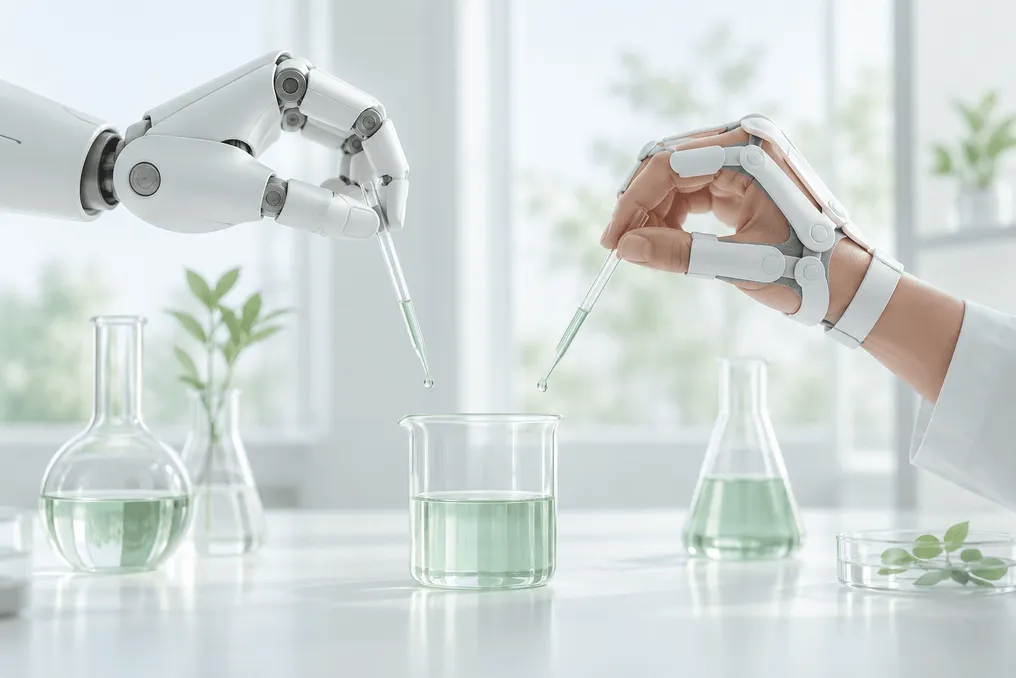
X Square Robot, a company based in Shenzhen, has demonstrated the ability of its agile robot to perform a complete standardized chemical experiment consisting of 24 sequential actions in one continuous run. This result was achieved using a policy trained exclusively on data collected without the robot's involvement.
The demonstration is based on the TwinDEX system, which the company introduced in September. This system combines a wearable exoskeleton for data collection with a high-precision robotic gripper for task execution.
During the experiment, the robot performed a series of complex manipulations: opening a reagent bottle, scooping powder with a fine spatula, squeezing a pipette with a rubber bulb, transferring liquids and solids, and holding a translucent glass rod near a beaker to guide the pouring process, constantly changing tools and coordinating the work of both hands.
The company asserts that this policy was developed from scratch based on several hundred episodes collected without the robot, without any intervention or teleoperation of the robot at any stage.
Challenges Solved by Technology
The Chinese tech resource Leiphone highlighted tasks that cannot be solved solely with vision: turning a cap requires lateral finger movement rather than wrist rotation; squeezing a pipette requires force adjustment after contact; and tracking a transparent rod with cameras presents a difficulty.
The core concept is eliminating the discrepancy between how humans collect data and how robots act. Both TwinDEX devices have a similar configuration of three fingers with nine degrees of freedom and seven active joints, as well as identical joint axes, link proportions, contact materials, and tactile sensors located in the same places, making them almost indistinguishable externally.
Images from multi-angle cameras, wrist poses, finger joint states, and fingertip touch signals are time-synchronized, allowing direct comparison of recorded finger states with the robot without the need for re-calibration. Leiphone reports that for two-handed operation, the model learns the relative position of the hands, not absolute coordinates, ensuring coordination is maintained regardless of whether the table or operator changes.
X Square states that on a multi-task benchmark, policies trained on robot-free data improved at the same rate as those trained on teleoperated data, episode by episode. The company estimates the efficiency of TwinDEX data collection to be 5.3 times higher than teleoperation on the robot, measured across five tasks, including cap twisting and syringe use. Since one data collection unit includes one operator, one table, and one exoskeleton, data collection can be conducted in parallel in offices and kitchens.
According to Leiphone, the data pipeline operates using the company's open-source WALL-OSS model and can be adapted for other base models such as pi0.5. The company also lists limitations: tasks are restricted to one table with a limited set of objects, the ergonomics of long sessions in the exoskeleton have not yet been studied, and more complex tasks may require more fingers or joints. A technical paper is in preparation, and X Square plans to expand data collection to open environments and long-tail tasks.