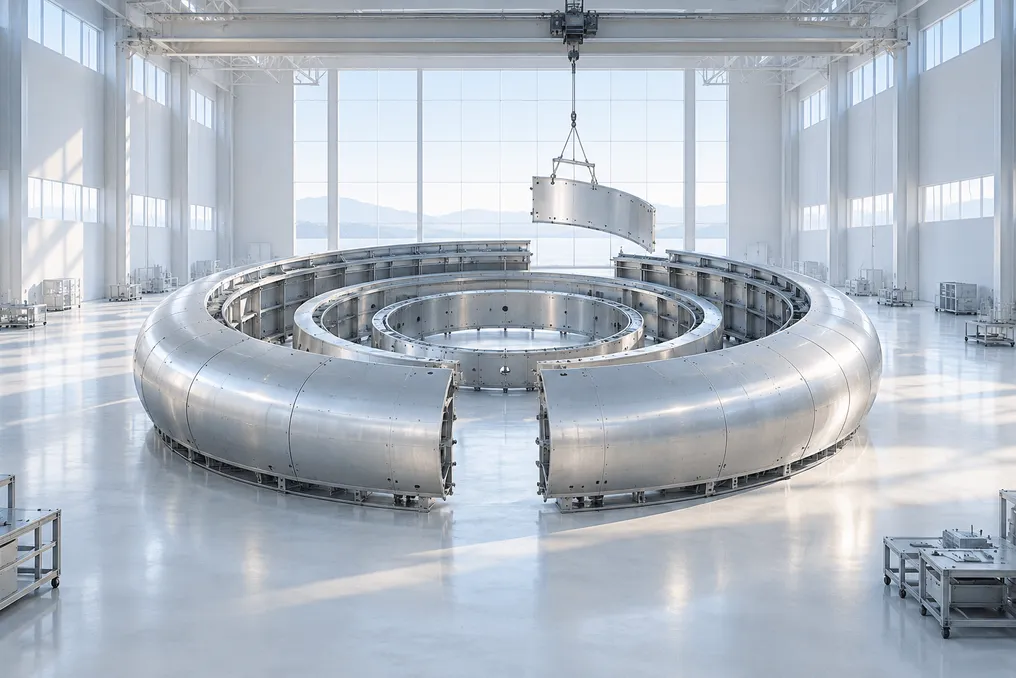
The experimental superconducting tokamak campus for hot plasma research (BEST), being built in Hefei, Anhui Province, was completed and commissioned ahead of the planned schedule, according to Xinhua agency on October 1. Simultaneously, the construction of the main device unit has entered the four-ring assembly stage, which Chinese engineers refer to as a key mounting phase.
Starting in July, major components, including the thermal shield, vacuum vessel, and toroidal field magnets, began arriving at the site in Hefei's Future Science City. According to Xinhua, four sections of the vacuum vessel assembly have been installed, and the first toroidal field magnet has successfully passed all tests. The state broadcaster CCTV noted that the overall assembly is more than half complete.
Principle of Operation and Structure of the Facility
The four-ring system assembles the main elements from inside out. At the very center is the vacuum vessel—the chamber where fusion reactions occur. Surrounding it is the thermal shield, which functions as a powerful insulating layer, followed by the toroidal field magnets. These magnets create a strong magnetic field that confines the hot plasma away from the vessel walls. Internal high-precision components are then installed. CCTV compared this configuration to a set of giant insulated drums.
The BEST project is overseen by the Institute of Plasma Physics at the Hefei Institutes of Physical Sciences, Chinese Academy of Sciences (ASIPP). Xinhua describes it as China's proprietary development for the next generation of fusion experiments, designed to study deuterium-tritium burning under conditions simulating a long-term reactor, as well as to verify the scientific and engineering feasibility of tokamaks. Unlike previous experimental setups, BEST is intended to demonstrate actual deuterium-tritium plasma burning.
The project demonstrates rapid progress since reaching its first major milestone. In October 2025, ASIPP installed a Dewar base weighing over 400 tons, which is the heaviest single component of the main machine. The following month, the institute presented the BEST Research Plan and launched an international plasma burning science program, signing the Hefei Declaration with partners, including the ITER Organization.
According to the current plan, BEST is scheduled for completion by the end of 2027, with the demonstration of energy generation from deuterium-tritium fusion planned around 2030. This will allow verification of whether controlled fusion can become a viable source of commercial electricity.