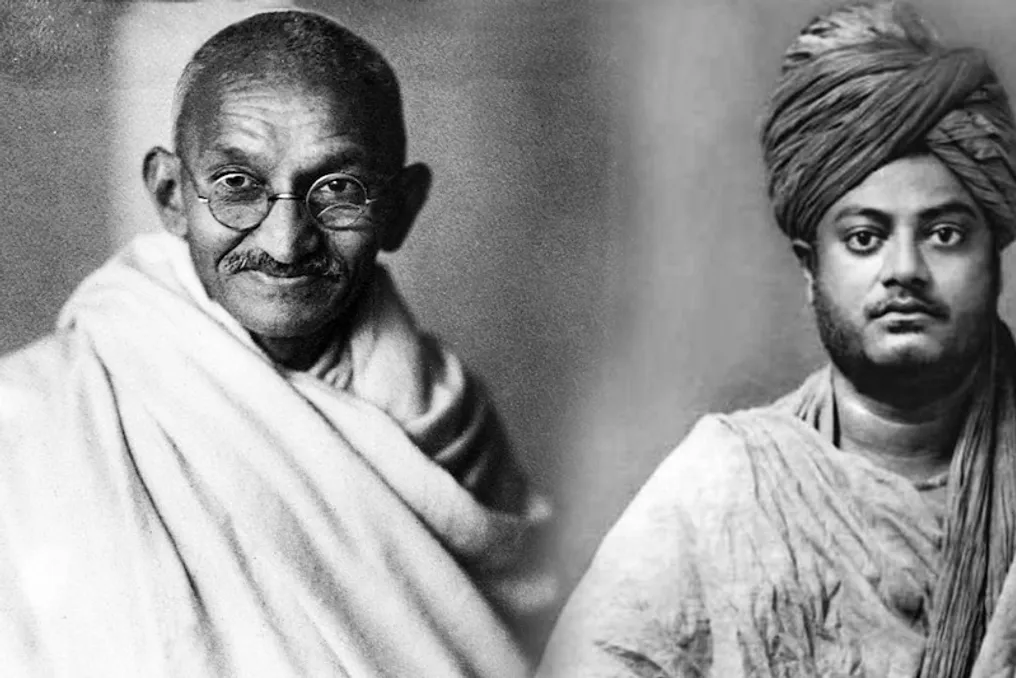
Two outstanding figures—one chose the path of truth, the other, spirituality. Both aimed to awaken in India the realization of its inner strength. One presented Vedanta and Indian spirituality to the Western world, while the other used truth and non-violence as a weapon to mobilize the Indian people against British rule. They did not belong to different eras but were two voices of the same era that played a huge role in awakening India's confidence.
This concerns Mahatma Gandhi and Swami Vivekananda. There was only a six-year gap between their birth years: Swami Vivekananda was born in 1863, and Mahatma Gandhi in 1869. Today marks Gandhi's birthday, yet their fields of activity and methods differed. Vivekananda presented Indian philosophy and Vedanta to the global public, whereas Gandhi transformed truth, non-violence, and popular participation into the force of the Indian independence movement.
Nevertheless, their ideas were connected by a common thread—spirituality and service to humanity. For Vivekananda, religion was not merely rituals or philosophy; he linked it with helping the weakest members of society. He insisted that God should be seen in the poor and suffering. Serving people was also an integral part of Gandhi's spiritual life. For him, politics was not just a means to power but a path to the moral elevation of society and the individual. Gandhi paid great attention to the purity of the means, not just the ends.
The question arose whether these two great men ever met personally. In 1901, Gandhi arrived in Calcutta to participate in a Congress session. At that time, Gandhi was not widely known in national politics, and few in India knew about his struggle in South Africa. However, Vivekananda's fame had already spread across the country and the world, as his famous speech in Chicago took place in 1893.
Gandhi wished to meet Swami Vivekananda in Calcutta to get closer to his thoughts and spiritual knowledge. Gandhi later mentioned this episode in his autobiography, 'My Experiments with Truth.' However, for a number of reasons, this meeting did not happen. Mahatma Gandhi himself writes in his autobiography: 'I read a lot about Kali Puja, sacrifices, the Brahma Samaj. Since I was in Calcutta, I was curious to learn about local life. I managed to understand a lot about the life of Bengal, its music, and the work of numerous Brahma Samaj organizations, such as Pratap Chandra Majumdar, Keshavendra Sen, Debendranath Tagore, and Pandit Shivnath Shastri. But it seemed impossible to leave Calcutta without meeting Swami Vivekananda. To benefit from his spiritual knowledge, I went to Belur Math early in the morning. I walked.'
'The desire to meet such a scholar as Vivekananda was so strong that I walked almost two miles, about 3.2 kilometers, to the monastery. But upon arriving there, I was disappointed because Swamiji was not present. From conversations with his disciples, it turned out that Swami Vivekananda was ill at home in Calcutta at the time and could not meet. Due to health problems, the meeting was impossible.'
It was sad that just a few months later, in July 1902, Swami Vivekananda passed away. Gandhi subsequently continued to engage with Vivekananda's ideas and tried to embody the essence of his works in the country and society. In 1921, when Gandhi visited Belur Math on Vivekananda's birthday, he spoke extensively about Swami Vivekananda's thoughts. Gandhi stated: 'I have studied the works of Swami Vivekananda very deeply, and after reading them, the love I felt for my country increased a thousandfold.'
Although they never met face-to-face, the dialogue of their ideas continued for a long time in Indian history. This is the most interesting story of this unfinished encounter. The two great men did not meet, but their aspiration to awaken India merged in history. Both these great figures introduced the spiritual strength of India to the Western world and taught the Indian people to be proud of their civilization and culture.