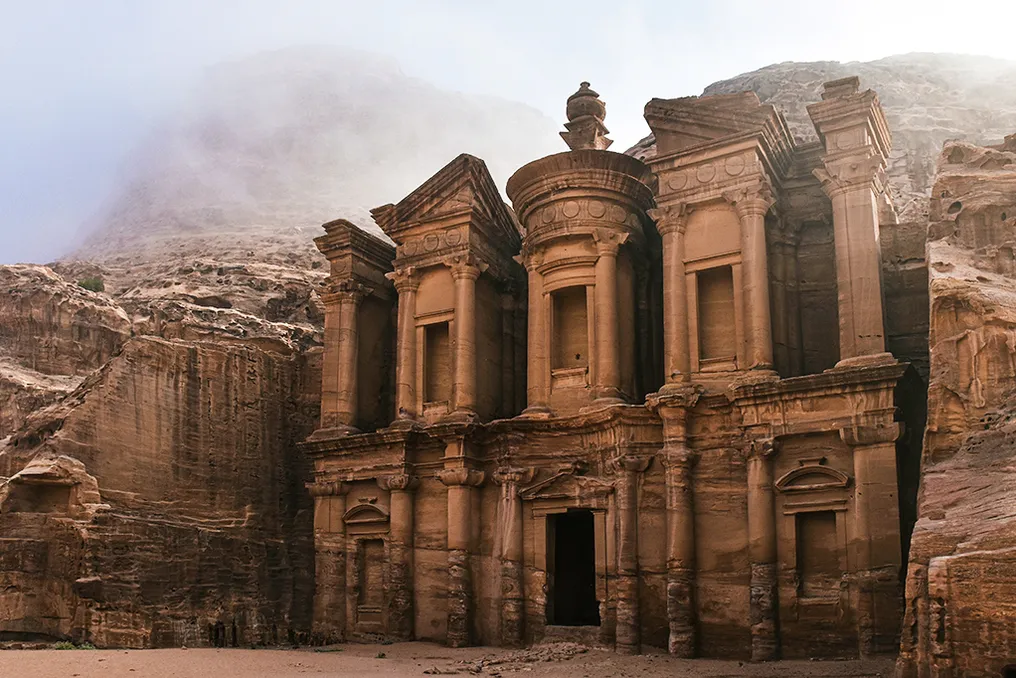
The city of Petra, located in modern-day Jordan, is one of the most impressive attractions of the ancient world and is recognized today as a World Heritage site. It was founded by the Nabataean people around 312 BCE.
This metropolis is literally carved into sandstone, which gave it its Greek name 'stone'. Known as the 'Rose City' or the 'Lost City', Petra flourished as a vital hub of trade routes connecting China and India with great civilizations such as Greece and Rome. Silk, frankincense, and spices were transported through this city.
The Nabataeans were a group of nomadic Arabs who developed a unique architecture combining Greco-Roman and Eastern influences directly on rock surfaces. Despite interest from empires such as the Roman Empire, Petra fell around 130 CE under the rule of Emperor Hadrian. Later, around the 5th century, severe earthquakes caused serious damage to the city, leading the Nabataeans to abandon it.
Petra remained forgotten in the desert, known only to nomadic Bedouins, until its rediscovery in 1812 by Swiss explorer Johann Ludwig Burckhardt. The city impresses with an extensive collection of royal tombs, temples, colonnaded streets, and obelisks, all elegantly carved into the rock.
Among the most magnificent structures is Ad Deir, or the Monastery, accessible by a staircase of 843 steps carved directly into the mountain. The main buildings, including the Monastery, were constructed from bottom to top. Nabataean craftsmen first installed large ladders with steps up to 6 meters high to create a stable working base before working with the sandstone, avoiding the need to hang from ropes.
Recent archaeological findings, made using 3D scanners, have revealed intriguing details about the Monastery, suggesting that its entrance had a branching staircase and a structure of six columns on the ground, possibly a place for rituals. This indicates that the Monastery may have been an important center of worship.
One of the most iconic monuments of Petra is the Treasury, or Al-Khazneh, which majestically opens after passing through the Siq—a narrow canyon 1.5 km long, flanked by 80-meter-high cliffs. This 40-meter-high temple was originally conceived as a tomb for a Nabataean king, although popular legend links it to an Egyptian pharaoh who hid treasures there. It is believed that artisans from Alexandria, known for the architecture of that era, participated in its construction, lending it a unique beauty.
There is still much to be studied in Petra, as only about 1% of its 264 square kilometers has been uncovered. The city, recognized as a UNESCO World Heritage site and one of the New Seven Wonders of the World, continues to inspire. Its natural beauty is emphasized by the play of sunlight, which transforms the colors of the stones from pale in the morning to bright pink and red at noon.
The strong earthquakes that destroyed the city in the past contributed not only to its abandonment but also shaped its landscape, with 95% of its curves being natural formations. Petra has also appeared in pop culture, serving as a set for films such as 'Indiana Jones and the Last Crusade', 'Transformers', and 'Mortal Kombat'.