While many associate the Volkswagen Beetle with the company's beginning due to its charisma and effectiveness, the VW Kombi, launched in 1950, is equally revolutionary and important for demonstrating the versatility of its mechanical setup.
Based on the Beetle, the Kombi received a new loaf-shaped monocoque body. Despite its short wheelbase of 2.40 m, it utilized the dimensions remarkably. The engine was positioned at the rear, freeing up space for upper cargo, and the driver sat over the front axle.
The original Kombi remained in use for several decades. In Europe, it was succeeded by generations with liquid-cooled engines (introduced at the front starting from the fourth generation in 1990), but it remained strong in Brazil until the last decade. Its success lay in fulfilling its function as an accessible and robust cargo vehicle, without excesses of luxury or comfort.
Furthermore, its charismatic appeal was notable. If Volkswagen had implemented modern features like airbags and ABS brakes, mandatory in Brazil since 2014, it is likely it would still be in production.
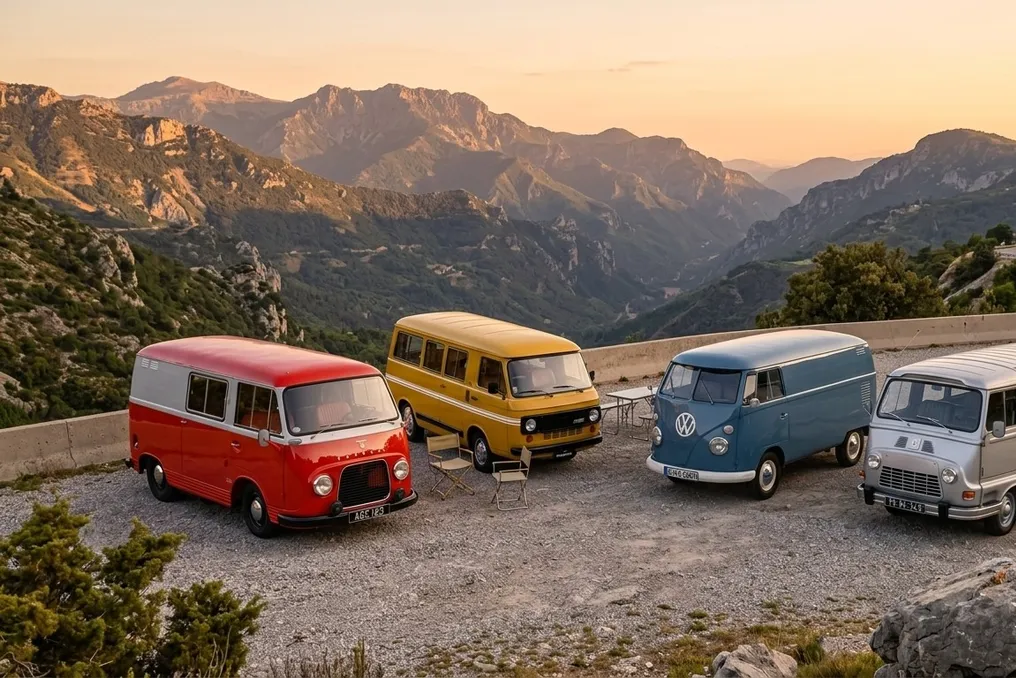
However, the Kombi was not the only utility van built with components available at the time. The great success of the German utility vehicle triggered a cascade effect in the global industry, leading various manufacturers to launch models inspired by or created specifically to compete with the sales of the Wolfsburg model.
Although not all shared the air-cooled rear engine or the same legendary status, all were based on this source and entered intense commercial battles against the Wolfsburg utility vehicle. Below are these rivals.
Citroën HY Van
Three years before the Kombi, in 1947, the French developed something quite advanced for the time, such as the Citroën HY Van, which can be seen as the 'Citroën Kombi'. Like the VW wagon, it had a monocoque body and offered no luxuries. However, it featured front engine and drive, following the model of the 1934 Citroën Traction Avant.
The HY Van used the same mechanical assembly as the Traction Avant, which was originally equipped with a two-liter, four-cylinder, 57 hp engine coupled to a three-speed manual gearbox, whose first gear was unsynchronized. It also inherited independent suspension on all four wheels, with torsion bars and superimposed arms in the front, and semi-elliptical spring assemblies with a Panhard rod at the rear. The engine was positioned over the front axle.
The HY Van gained a reputation for its good handling, comparable to the Citroën 2CV, even using the same headlights. Its corrugated steel body was not elegant, but that was not its purpose. Nevertheless, its appearance did not prevent it from remaining on sale until 1981 with few modifications, and those who observe closely can consider it charming.
DKW Schnellaster “Kombi”
Introduced a year before the Kombi, in 1949, the DKW Schnellaster van can be considered a step forward from the VW concept. In addition to a more refined look, with a sloped and more aerodynamic front end, it featured a longitudinally mounted, water-cooled front engine and front-wheel drive. Initially, it had a two-stroke, two-cylinder, 0.7-liter, 22 hp engine, which was replaced by a three-cylinder, 0.9-liter, 32 hp engine in 1955.
With everything placed at the front, the DKW allowed for a completely flat floor behind the cabin, making the area configurable: seats could be removed to prioritize passengers or cargo. For this reason, the Schnellaster is often seen as a precursor to modern vans.
Another point linking the Schnellaster to the Volkswagen van is that it was one of the first products of the newly formed Auto Union, a conglomerate comprising Audi, DKW, Horch, and Wanderer. This group would be acquired by Volkswagen in 1964 and transformed into today's Audi. The project proved to be so good that it evolved internationally. In Spain, the bodybuilder IMOSA produced the F1000 L starting in 1963, maintaining the robust architecture of the DKW line, which later came under the control of Mercedes-Benz, giving rise to the MB100 van decades later.
Alfa Romeo Romeo
The utility van from Alfa Romeo, called Alfa Romeo Romeo, was presented at the Turin Motor Show in 1954 under the name Alfa Romeo Autotutto, competing directly with the Kombi. Visually, it resembles a Kombi with the characteristic Alfa Romeo grille.
Initially, the Autotutto was sold as a passenger van and panel van. Starting in 1957, when it was renamed Romeo, it also received a pickup version, with a single or double cab, similar to the Kombi. The main distinction lay in the engine: besides being front-mounted, it was a water-cooled four-cylinder engine, a moderate version of the famous Alfa Romeo Twin Cam, which would later become legendary in the Alfa Romeo Giulia coupé and in 1970s racing cars.
Fiat 238
Years later, Fiat created a more conventional version of the idea, after Alfa Romeo had made the 'sporty Kombi'. The Turin brand had already explored the miniaturization of the concept with the 600 Multipla, but in 1967, it launched its utilitarian masterpiece: the Fiat 238. Developed specifically to challenge the Kombi, the 238 used the mechanical assembly of the Autobianchi Primula, with a transverse front engine and front-wheel drive.
This provided generous usable volume for the size of the body and a low, flat floor from end to end. The 238 exposed the major mechanical weakness of the T1 and dominated the Italian market, proving that front-wheel drive was the future of cargo utilities. Mechanically, it started with a 1.2-liter, four-cylinder, 44 hp engine, updated to a 1.4-liter, 46 hp engine derived from the Fiat 124. With independent suspension on all four wheels (using transverse leaf springs) and front disc brakes assisted by a servo brake—features the Kombi would take a long time to have—the Italian van offered a handling closer to a passenger car.
Besides heavy use, it was widely used as an ambulance and base for motorhomes during the 1970s. An interesting detail for Brazil is that the more sophisticated passenger version, with a large glazed area, was sold as the Fiat 238 Panorama, and in 1980, the Italian headquarters reused this name in Brazil to baptize the wagon derived from the Fiat 147.
Ford Taunus Transit (FK 1000)
Launched in 1953 and manufactured in Cologne, Germany, the van was initially named FK 1000 because it was produced by Ford in Köln and could carry up to 1,000 kg of cargo. It was an urgent response from Ford Germany so as not to lose fleet and small business contracts to the Wolfsburg utility vehicle. The name itself was a challenge, given that the FK 1000 carried more weight than the contemporary T1.
Later, it became known as the Taunus Transit, sharing the 1.2-liter, four-cylinder, 38 hp engine of the Taunus sedan. The engine was installed at the front, exactly between the seats, with rear-wheel drive. Externally, the Taunus Transit resembled a clone of the Kombi, including the radiator grille.
Although it was the first Ford van to use the Transit name, the Taunus Transit is generally not included in the model chronology, as it had few units exported outside Germany and is not as well-known as later versions of the Transit.
Tempo Matador
The Tempo Matador was a competitor to the Kombi, sharing many characteristics but starring in a great historical irony in this segment. Its manufacturer, Tempo (Vidal & Sohn Tempo-Werke GmbH), was a small company located in Hamburg. In 1949, Tempo introduced the Matador. This utility vehicle used its own chassis with front-wheel drive and was powered by a 1.1-liter, 25 hp air-cooled boxer engine, supplied directly by Volkswagen.
Since the engine was located at the front (behind the front seats) and drove the front wheels via a ZF transmission, the rear cargo floor was extremely low. A serious design flaw, which may have gone unnoticed at the time, was that the fuel tank of the Tempo Matador was located at the front, in the hump housing the headlights.
Despite this, the Tempo Matador achieved relative success in Germany as a work vehicle, selling 1,362 units between 1949 and 1952. However, the success was brief. With the launch of the Kombi in 1950, the VW leadership realized that supplying the Beetle engine to a direct rival—which still offered a higher cargo floor—was not advantageous, and the supply was abruptly cut off.
From 1952 onwards, Tempo had to seek other engines, using Heinkel engines and later British Austin engines. Interestingly, after being acquired by Hanomag in 1955, the Matador was redesigned and began to have a friendly appearance very similar to the Kombi itself.
Bedford CA
Launched in 1952 by the Vauxhall utility division, the Bedford CA became a great success in light commercial vehicle sales in Great Britain during the 1950s and 1960s. Although it did not have the fully flattened loaf shape—it had a hood with the front engine slightly protruding—its purpose was identical to that of the Kombi: to offer maximum utility and low operating cost.
The CA had ingenious solutions for daily use, such as sliding front doors that could be locked open during urban deliveries. However, its most intense rivalry with the Kombi occurred in the leisure market: the Bedford CA became the preferred base for Martin Walter conversions, resulting in the legendary Bedford Dormobile. With its side-opening roof, the Dormobile was the only European camper van capable of competing in charisma and sales volume with the Kombis adapted by Westfalia in Old Continent campsites.
Over its 17 years on the market, the Bedford CA underwent constant improvements. In 1958, it replaced the split windshield with a single panoramic piece, and in the 1960s, it adopted the 1.6 engine.