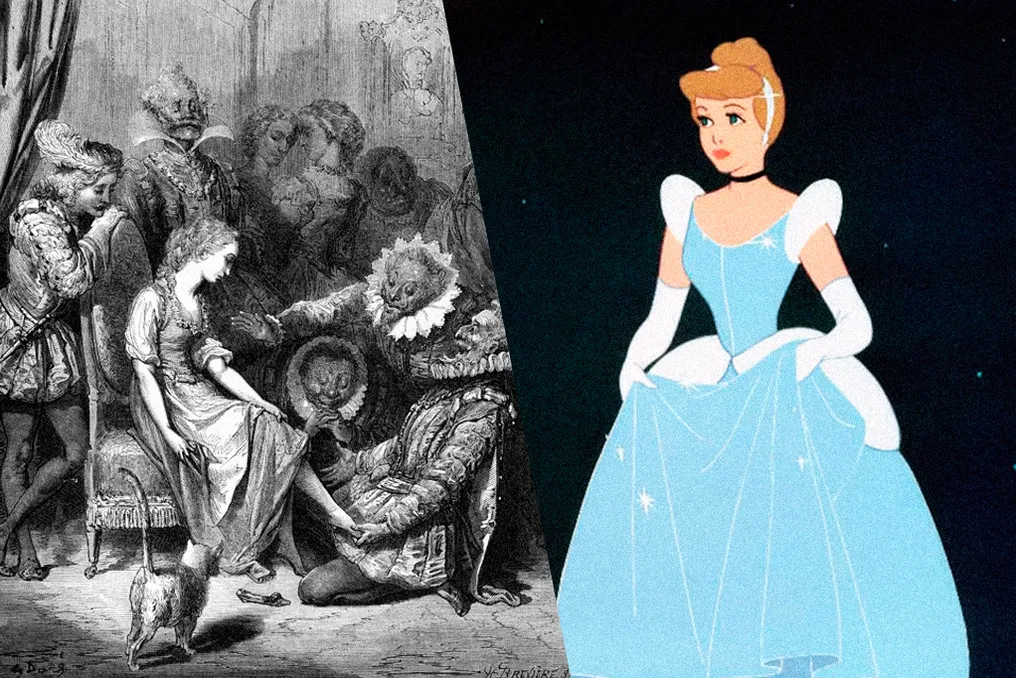
It is impossible to pinpoint the exact author of the Cinderella story. For those familiar with it through Disney adaptations, the idea that the original plot might be over two thousand years old may seem questionable, as Cinderella clearly originates from a post-medieval context.
The Disney version, released in 1950, is largely based on the story of Cinderella or the Glass Slipper, published by French author Charles Perrault in 1697. Many elements considered classic today—such as the fairy godmother, the ball, and the pumpkin-to-carriage transformation—originated specifically in Perrault's version.
However, the core narrative structure of this story—the loss of a shoe, the king's search, and the royal marriage—existed before the Common Era. More specifically, these elements can be found in the tale of Rodopis, an ancient Egyptian narrative recorded by the Greek historian Strabo between the 1st century BCE and the 1st century CE (the exact date is unknown).
In this story, a Greek courtesan named Rodopis (meaning 'rosy-cheeked') is bathing when an eagle steals her sandals and carries them to Memphis, an important city in Ancient Egypt. There, the bird drops the sandals at the feet of the king, who, impressed by the beauty of the sandals and the unusual incident, decides to find the owner. He sends emissaries throughout the country and finds a slave girl in Naukratis, another city. She is then brought to him, and they marry.
Thus, two millennia before Disney, there was a foundation upon which the Cinderella story would be built. And no one knows who wrote it: Strabo merely recorded the fable, but he was not its original author. It is possible that Rodopis was a folklore tradition passed down orally among Egyptians even earlier.
Some historians link Strabo's Rodopis to a character of the same name recorded by Herodotus in his 'Histories' approximately 500 years earlier. In this tale, Rodopis is a slave from Thrace who is sold and taken to Egypt. There, a man named Charax falls in love with her and pays to free her from slavery. Eventually, Rodopis becomes the wealthiest woman in Egypt, lending the story fairy-tale characteristics. It is possible that the names in the two stories are not coincidental, and both narratives originally related to the same character.
The story of the girl who lost her sandals was passed down orally for centuries. Rodopis reappeared in the collection 'Varia Historia' (or Various Stories) by the Roman orator Claudius Elianus (175–235 CE).
Around the 9th century in China, during the Tang Dynasty, the writer Duan Quanshi records the story of Ye Xian in his anthology 'Youyang zazu' (Collection of Youyang Facts). Ye Xian is very similar to the pre-Disney European version of Cinderella: she is a young girl subjected to cruel treatment by her stepmother, receives help from an animal, is dressed in magical attire, attends a celebration, loses a slipper, the ruler finds the slipper, searches for its owner, and marries her. Researcher Fei Bosham highlights the striking similarity between Ye Xian, Perrault's Cinderella, and the Disney version.
In Europe, one of the first significant literary versions is 'La Gatta Cenerentola' by Italian writer Giambattista Basile, published in the collection 'Lo cunto de li cunti' between 1634 and 1636. This version differs significantly from the Disney Cinderella. The main character, Zezolla, is much more aggressive: she kills her own stepmother with the help of a maid. Only after this does the maid marry Zezolla's father and begin tormenting her.
In 1697, Charles Perrault publishes 'Cendrillon ou la petite pantoufle de verre' ('Cinderella or the Glass Slipper') and solidifies many classic elements: the stepmother, stepsisters, the ball, the fairy godmother, the magical transformation, the carriage turning into a pumpkin, and the glass/crystal slipper.
In 1812, the Germans Jacob and Wilhelm Grimm publish 'Aschenputtel'. This is another version of the same large narrative family, but with noticeable differences. Instead of a fairy godmother, Perrault's version mainly features birds, especially doves. Instead of a glass slipper, there is a golden slipper. And the violence is much more explicit: the sisters go so far as to mutilate their own feet trying to fit them into the slipper.
When Disney releases his Cinderella in 1950, he primarily relies on Perrault's version (the only one that gained recognition), although the film also incorporates elements from other traditions of the story. Thus, he establishes the modern version of the character, softening the dark aspects and emphasizing incredible romance. And it all began more than two thousand years ago...