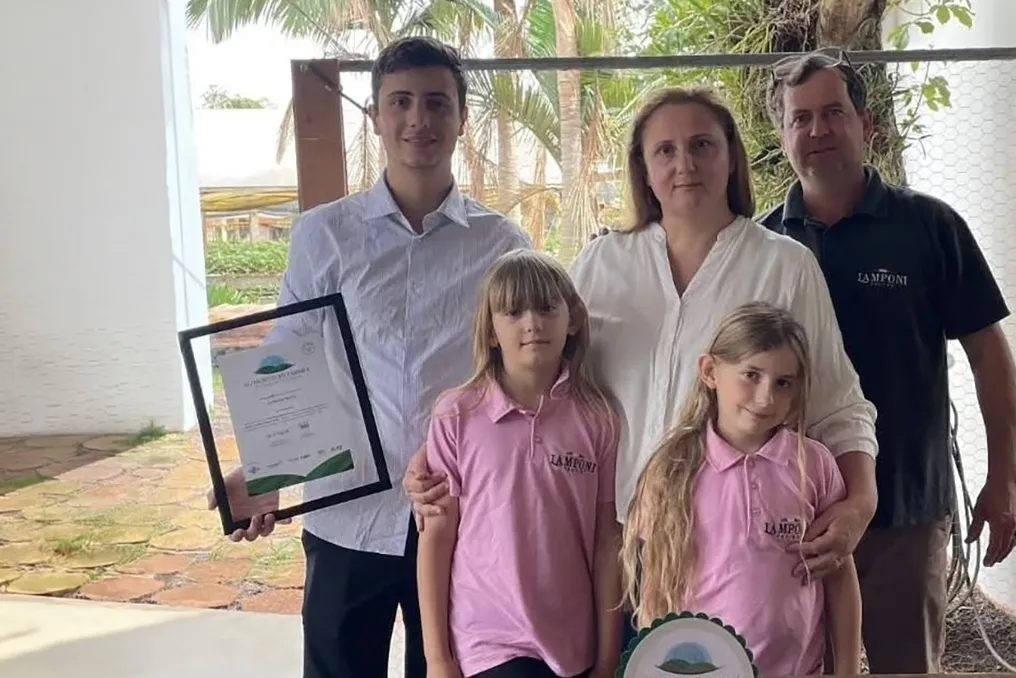
Lamponi, whose name derives from the Italian word for raspberry, originated from a family experience in western Paraná. This red fruit led to a rural venture that adapted European experiences to the Brazilian agricultural context.
The Favero family members lived in Barcelona, Spain, for several years, where they encountered raspberry cultivation. Upon returning to Brazil, they noticed that this fruit was not yet cultivated in the region and decided to start production eleven years ago.
Mattew Favero, who collaborates on the business with his mother, Edina Favero, and stepfather, Claudiomir Pereira, reported that the fruit also evokes memories of time spent in Europe. Initially, the family already had experience with soybean plantations and poultry farms, but they had to overcome significant obstacles to establish the new activity, including the bureaucratic complexities inherent to a family farming business.
The challenge of adaptation
Mattew highlighted that structuring the family business involves numerous regulations, fiscal, tax, and administrative issues, making the organization of these aspects the biggest challenge faced.
A second major obstacle was adjusting a fruit accustomed to the cold European climate to the specific climatic conditions of western Paraná. According to Embrapa research, raspberries are widely cultivated in parts of Eastern Europe and North America, requiring cold periods for development, which complicated local production.
Mattew explained that the decision to stop producing fresh raspberries was due to climatic reasons, as the ideal condition for the plant is 700 hours with temperatures below 7.5°C, conditions the state can no longer provide. Although there are varieties that require fewer cold hours, implementing appropriate infrastructure requires capital and specialized personnel; he mentioned that building a greenhouse for 5 to 9 thousand plants can cost between R$ 180 thousand and R$ 200 thousand.
Even after suspending fresh raspberry production, the family chose to continue diversifying the property. The experience with red fruits led the producers to cultivate strawberries. Currently, the property has about 15 thousand seedlings spread across five greenhouses, in addition to an agro-industry of approximately one hundred square meters.
However, climatic variations also posed difficulties in marketing the strawberries. Fruits that did not meet the desired visual standard for fresh sale began to be frozen and sold in packages at the local fair. It was from this situation that the family identified a new business opportunity, which has since become the main source of income.
Lamponi's frozen strawberries exemplify concepts of sustainability and economy. Currently, Lampone markets fresh strawberries in two ways: in winter, the period of highest harvest, the focus is on selling them raw; in summer, when the crop decreases, part of the production is destined for freezing.
The company produces about six tons of fresh strawberries and approximately fifteen tons of frozen strawberries annually. Their products reach about sixty supermarkets, in addition to being supplied to restaurants, confectioneries, small entrepreneurs who make artisanal popsicles, and state schools through meal programs.
For Mattew, the satisfaction of transforming farm production into food accessible to consumers is a central motivational factor for staying in agriculture. He emphasized that the greatest incentive is knowing that the product is the result of their own work, which provides an honest and healthy life.
The family's journey began with the attempt to grow raspberries in a climate distinct from Europe. The need for adaptation led to the cultivation of strawberries and subsequently, the freezing of fruits that did not meet fresh sale standards. Through diversification, the property managed to maintain the rural business, converting an international experience into an activity that today serves consumers from various areas of Paraná.