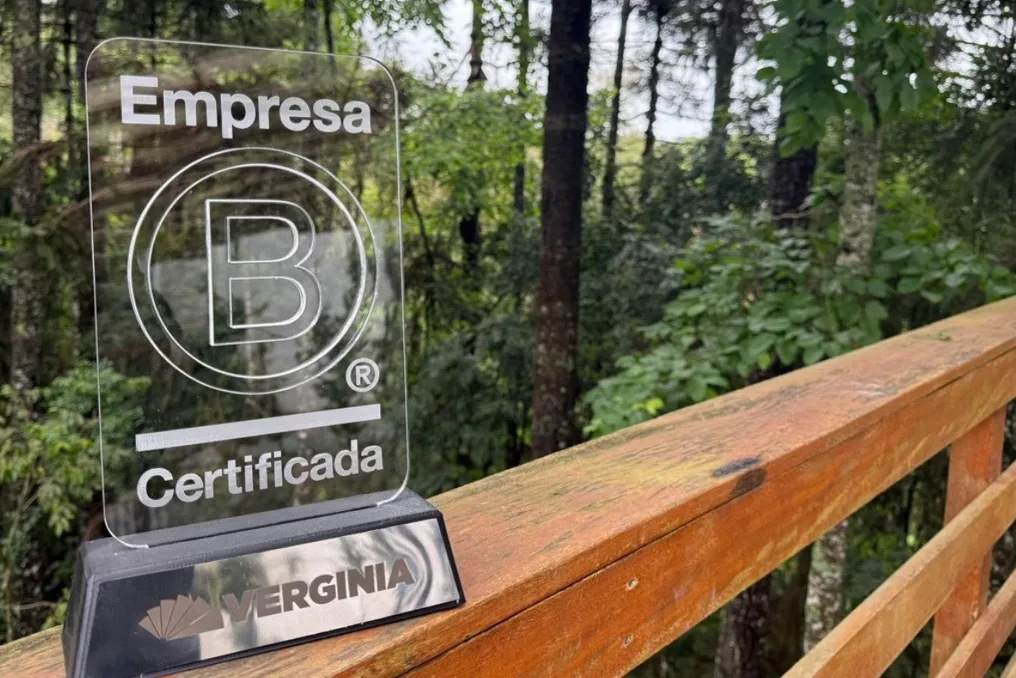
Tintas Verginia, a company from Paraná, has achieved B Certification, joining the select group of companies recognized by B Lab. The company, which began its activities 35 years ago as a multi-brand reseller and later developed its own manufacturing of paints, complements, and accessories, earned this seal in 2026.
Nicholas Rosa, Human Resources Manager at Tintas Verginia, explained that the certification served as a catalyst to go beyond important but unstructured practices, transforming intentions into measurable management and creating mechanisms to track the company's evolution.
The Rigor of the Assessment
The certification process is notably rigorous; merely filling out the questionnaire is only the first phase. Every claim must be validated by documentation, policies, and real indicators, which are analyzed by B Lab specialists before approval. For medium-sized companies like Tintas Verginia, structuring non-existent routines and records represents an additional challenge.
The statutory change required by the seal grants legal security to the social and environmental commitment, ensuring that administrative decisions formally consider the impacts on employees, suppliers, the community, and the environment, regardless of changes in management or company control.
In Brazil, Sistema B coordinates the certified companies, promoting the adoption of socio-environmental impact practices. The goal of the seal is to assess a company's effects on people and the planet with the same seriousness given to financial results. Furthermore, the certification is not permanent and requires periodic renewal, forcing the company to continuously maintain and improve its practices.
In 2026, B Lab's global standards became more demanding, replacing the previous model based solely on scoring with a structure of mandatory requirements distributed across seven impact areas: purpose and stakeholder governance, fair work, diversity and inclusion, human rights, climate action, environmental management and circularity, and engagement in issues of collective interest. This implies that each front has its own minimum requirements, making it difficult to compensate for failures in one area with successes in another.
Within this more demanding scenario, Tintas Verginia demonstrated how social, environmental, and governance criteria are integrated into its administration, presenting policies, processes, and indicators that prove commitment in daily business operations.
The Journey of Tintas Verginia
Eduardo Bathke, CEO of Tintas Verginia, reported that the process began by focusing on people. The first step was raising team awareness about the initiative's purpose. The company sought inspiration from large corporations, such as Natura, conducting in-person visits to the factory and distribution center to observe implemented actions, bringing members of HR, production, and logistics to experience the reality.
According to Bathke, employee sensitization and presenting success examples are crucial for strengthening belief in the process. Allowing professionals from various sectors to participate in these visits enabled each area to understand how initiatives functioned in other operations.
From Intention to Management
In terms of human capital, the main transformation occurred in the working methodology. Nicholas added that there is a difference between knowing what the company does and being able to demonstrate, through methods and evidence, how it is done, what the result is, and where there is still room for improvement; the certification provided this shift in perspective.
What Changed in Daily Life
Bathke highlighted the extremely positive impact of B Certification, which brought along other good practices and seals, since the recognition covers the entire company ecosystem, including workers, governance, and the environment. By analyzing these aspects, Tintas Verginia invested in internal satisfaction surveys and obtained other seals for having a good work environment. This trajectory resulted in process improvement, better quality of life for employees, and the construction of a healthier culture focused on mental health, environment, transparency, and governance.
People Indicators
Actions directed at employees began to be monitored by specific indicators. The company maintains training programs for new consultants, manager preparation, and development of future leaders, in addition to training focused on diversity. Between 2025 and the first eight months of 2026, over 13,000 hours of training were accumulated.
Internal mobility data is also tracked. In 2025, 36.11% of recorded movements corresponded to internal promotions, indicating that more than one in three movements represented career advancement within the organization itself. Diversity is also monitored by metrics: by the end of 2025, women occupied 19.79% of leadership positions, a percentage that rose to 20.79% by July 2026.
Impact Beyond the Factory
The company's responsibility extends beyond its industrial operation. In 2026, until August, Tintas Verginia donated 4,528 liters of paint to 35 institutions, directly assisting approximately 8,758 people, with an estimated investment of R$ 100 thousand in these donations.
Environmental Management
Environmentally, the company implements initiatives such as reverse logistics for disposing of paint surpluses, carbon offsetting, and the use of renewable energy. The Coleta Colorida program receives paint scraps, empty cans, and painting materials at Tintas Verginia stores.
Reverse logistics is stipulated in the National Solid Waste Policy (Law 12.305/2010), establishing that manufacturers and retailers are responsible for the destination of products after consumption. This issue is critical for paints, as improperly discarded waste can contaminate soil and water.
Bathke assesses that by choosing a certified company, the consumer has the guarantee of acquiring products from an honest company that respects the environment and employees, possessing genuine governance and transparency, which means investing in businesses aimed at improving the world.
Pioneering in the Sector
Tintas Verginia is the second company in the civil construction sector to obtain the certification and the first in the paint market. Bathke points out that in the broader context of civil construction, the first to receive the seal was Vedacit, a manufacturer of waterproofing and technical products.
This achievement is significant in an industrial segment where issues such as energy consumption, waste generation, and workplace safety are central to management. The company has published sustainability reports annually for five years, which, according to the CEO, serves to inspire competitors and other markets to follow the same path, reinforcing the belief that good practices build a more productive world.
A Long-Term Vision
Bathke expresses a personal and corporate desire to make Tintas Verginia a centennial company, citing brands like Cini and Alpargatas as inspiration. He mentioned visiting very old establishments in Japan, with over 1,300 years of existence, defining this longevity as a company goal.
The executive understands that with strategic planning, qualified people, and good partners, the path to this goal is viable. He emphasizes the need to view the planet with a long-term perspective, but act adaptably in the short term, as the ecosystem demands.
The brand's next step, related to B Corp and ESG, will be to deepen the understanding of its product life cycle and identify points in the production chain where it can still generate impact. Additionally, the company is building a new plant and headquarters that will seek the LEED (Leadership in Energy and Environmental Design) seal, an international certification from the U.S. Green Building Council that evaluates buildings based on energy efficiency, rational water use, material selection, and indoor environmental quality, requiring technical proof at all stages.
A Continuous Commitment
Due to the need for periodic recertification, maintaining recognition depends on the continuity and evolution of the evaluated practices and indicators. Therefore, Tintas Verginia views the achievement as a new level of internal requirement that renews with each evaluation cycle.
Eduardo Bathke concludes that when considering a can of paint, one should not focus only on the moment of sale, but on the entire process: the people involved, the resources consumed, the waste generated, the relationship with the community, and the final impact of the product.