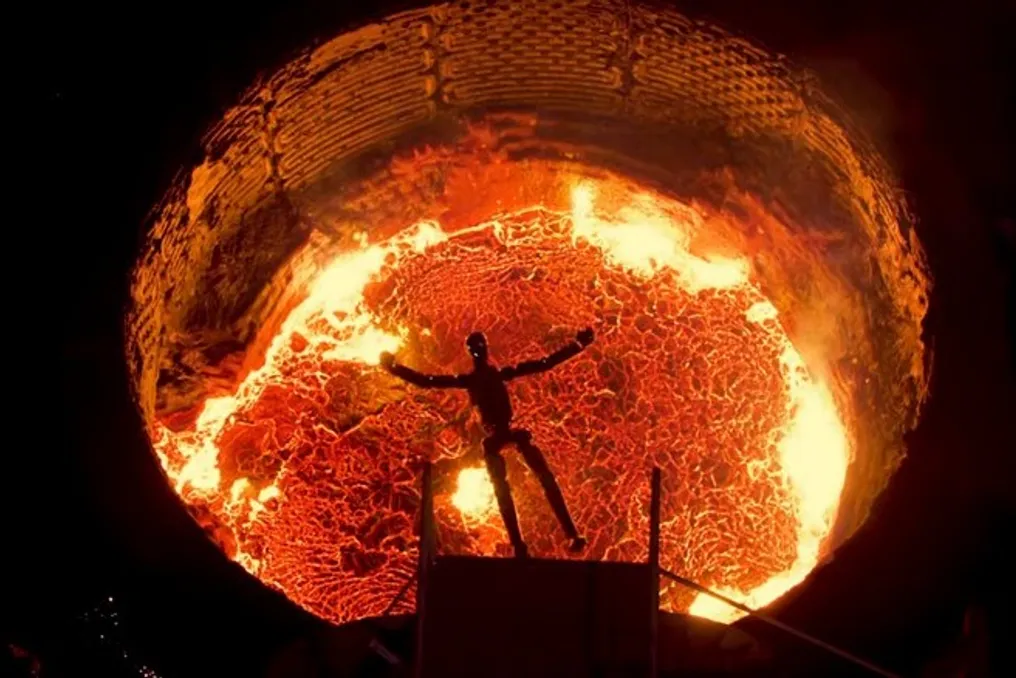
Figure Company sent scrapped Figure 02 androids for smelting in Finland
Read more
N+1
nplus1.ru

Figure Company sent scrapped Figure 02 androids for smelting in Finland

The American company Figure organized the process of smelting its outdated humanoid robots, model Figure 02. These robots were sent to a metallurgical plant located in the Finnish city of Imatra.

According to information posted on the startup's official website, the robots jumped into an electric arc furnace filled with molten metal. The company also released video footage demonstrating this smelting process, where the androids perform a somersault before falling into the liquid metal.

One of the robots was lowered using a crane, mimicking a famous scene from the ending of the film 'Terminator 2: Judgment Day,' where the T-800 robot asks to be smelted to destroy technologies that could lead to the emergence of 'Skynet.' The idea of this disposal method was proposed by Arnold Schwarzenegger, the actor who played the role of T-800, who left a comment on the social media platform X under a post by the head of Figure, asking his followers about the best way to dispose of old robots.

Similar stories

Weekly highlights include new weather forecast model, satellite explosion, and advances from Roman and Starship
Read more
olhardigital.com.br

Weekly highlights include new weather forecast model, satellite explosion, and advances from Roman and Starship

Several notable events marked the week, ranging from climate model development to high-tech aerospace tests.

The National Institute for Space Research (Inpe) implemented the Ocean, Earth, and Atmosphere Forecast Model (Monan), a weather forecasting computational model that operates on the Jaci supercomputer, located in the agency's data center in Cachoeira Paulista, SP. This new system will gradually replace Inpe's old forecasting model, known as the Brazilian Global Atmospheric Model (BAM).

According to information from the Ministry of Science, Technology, and Innovation (MCTI), Monan will raise the accuracy of Brazilian meteorological forecasts to the level of international agencies such as the UK Met Office, the National Oceanic and Atmospheric Administration (NOAA), and the U.S. National Weather Service (NWS).

On another front, the Hayabusa2 probe initiated a pioneering test by firing lasers at the asteroid Torifune during a pass at approximately 5 km/s. This experiment, conducted by the Japan Aerospace Exploration Agency (JAXA), demonstrated the feasibility of measuring an asteroid's distance while a probe passes quickly by it.

In space, an old American spy satellite orbiting at about 775 km altitude suffered an unexpected disintegration last Sunday (13). The event was confirmed through a notice published on Space-Track, the official U.S. government platform for tracking space objects, although the cause of the fragmentation has not yet been determined. The disintegration occurred around 9:13 PM UTC (6:13 PM Brasília time) and was announced in the catalog on Thursday (17).

The satellite involved, identified as USA 32 (number 19460), was launched on September 5, 1988, using a Titan II rocket. Its secret mission consisted of monitoring Soviet radars in orbit, employing electronic and signals intelligence (ELINT and SIGINT) equipment.

NASA also made a significant step in the Nancy Grace Roman Space Telescope mission by successfully activating its main scientific instrument, the Wide Field Instrument (WFI). This 300-megapixel infrared camera is capable of capturing in a single image a celestial area larger than the apparent diameter of a full moon, maintaining sharpness comparable to telescopes like Hubble. Furthermore, the team conducted the first tests of the coronagraph, designed to directly observe planets orbiting other stars.

The Roman mission has received an extended timeline; due to fuel savings in the initial phases, the probe can conduct scientific observations for up to 22 years.

Finally, SpaceX scheduled the first attempt to place Starship into Earth orbit for September 22. This will be the 14th test flight of the mega-rocket and constitutes a crucial phase in the vehicle's development. The launch is scheduled to take place at the Starbase facility, located in southern Texas, USA, within a 75-minute window, starting at 9:15 AM (Brasília time).

Popular