During Campinas Innovation Week, held on Friday, the 18th, technology executive Nina Silva gave a lecture at PUC-Campinas, in partnership with FEAC. The central theme addressed was 'Technology, Social Impact, and Future Business: The Power of Diversity in the Economy.' Nina Silva, who serves as CEO of the Black Money movement and angel investor, emphasized the need to increase the participation of diverse social segments in creating innovative solutions and ventures.
At the Green Stage, Nina Silva stressed that the presence of multiple perspectives is crucial for expanding debates, fostering new ideas, and enabling the exploration of market niches that are not yet fully served. She stated that diversity is essential for minds to open up and, above all, for new markets to be discovered.
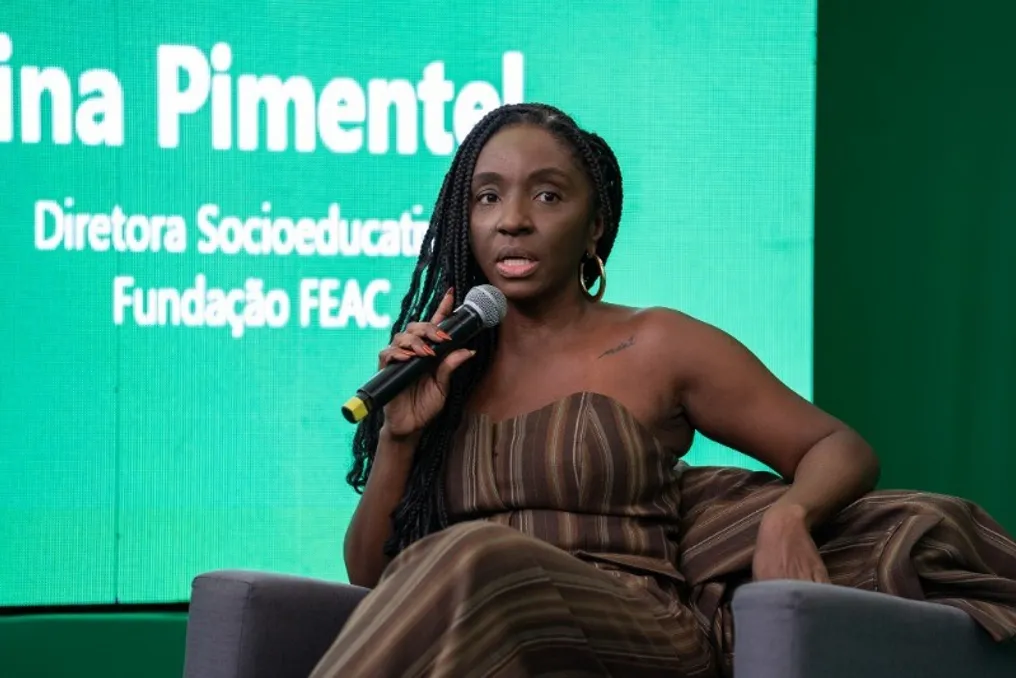
The discussion included Professor Dr. Camila Brasil Gonçalves Campos, coordinator of the Department of External Relations (DRE) at PUC-Campinas, and Lina Pimentel, socio-educational director of FEAC. Both contributed with academic perspective and the vision of FEAC's work in Campinas.
The Search for Inclusion as a Historical Movement
Nina Silva recalled that the pursuit of inclusion is the result of social movements developed over centuries and decades, involving groups that have been historically marginalized. According to her analysis, the contemporary challenge lies in converting the debate into effective policies and actions capable of altering existing social and economic structures.
She argued that when this theme remains only in the realm of discourse—whether in academia, the private sector, or the public sphere—the absence of organized and active powers prevents the formation of coherent social strata for the incorporation of these policies.
The executive also pointed to recent changes in the global corporate landscape, classifying it as a regression in the dialogue about diversity. Nina observed that multinationals that previously led initiatives in this field have, in some cases, reconsidered their positions due to political changes and priorities related to capital.
She further affirmed that inequalities have a structural character, being rooted in the structures themselves, but that solutions are not being conceived in a structural manner.
Data, Artificial Intelligence, and the Need for Diversity
When discussing technological advancements, Nina Silva connected the themes of data, human behavior, and artificial intelligence. She explained that the data used by technologies are largely records of human interactions, relationships, and experiences. For this reason, the diversity of people involved in the collection, analysis, and development of these technologies is vital to prevent specific social and cultural contexts from being left out.
Nina reinforced that data is essentially human behavior, as what is recorded are patterns of behavior and established relationships.
Innovation and Digital Sovereignty
Linking the discussion on diversity to the innovation environment, Nina Silva highlighted the urgency of debating Brazil's technological and financial sovereignty. Although tools like artificial intelligence represent significant progress in technology distribution, she pointed out that a considerable part of these structures needs evolution in the country and with local leadership.
She emphasized that 'there is no innovation without people.' Furthermore, she warned against the danger of a new technological dependence if the country only uses resources created by other nations without strengthening its own capacity to generate knowledge and technology.
For Brazil to develop its own models of innovation, it is essential that Brazilian society is involved in this creative process. And only those who are truly included—economically, financially, and socially—participate in this creation.
The executive concluded her reflection by arguing that inclusion must also create opportunities for new generations to expand their future possibilities, especially for groups that have been historically underrepresented. Nina expressed her desire to be the last generation of pioneers in her family, advocating for the construction of desirable futures instead of limiting options to what is merely considered possible.