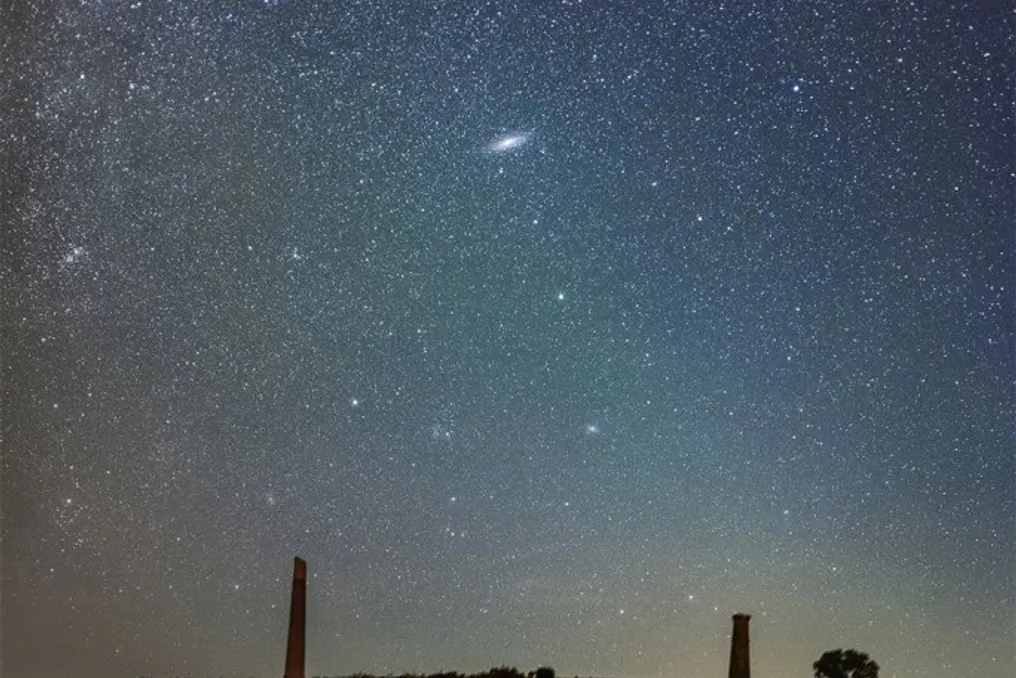
Stargazers have a special reason to look up at the sky in the coming nights, as the Andromeda Galaxy (M31)—the farthest object visible to the naked eye from Earth—will reach its best viewing moment.
According to the platform InTheSky.org, Andromeda will reach its highest point in the sky early on Friday (the 2nd), around 0:00 (Brasília time zone). In subsequent nights, the peak visibility will occur approximately four minutes earlier each day.
The higher an object is above the horizon, the fewer layers of air its light must pass through, which reduces atmospheric distortion and provides a clearer image of our cosmic neighbor.
Located approximately 2.5 million light-years from Earth, in the constellation Andromeda, the galaxy has a visual magnitude of 3.4. Thus, it can be seen even without equipment; it appears as a soft whitish spot—but only in absolutely dark skies, far from the light pollution of large cities.
Marcelo Zurita, president of the Paraíba Astronomy Association (APA), member of the Brazilian Astronomical Society (SAB), technical director of the Brazilian Meteor Observation Network (Bramon), and columnist for Olhar Digital, notes: 'It is important to say that observing Andromeda is like gazing into a window into the past. Due to the distance it is from us, the muse we observe through this window is today two million five hundred thousand years older.'
He adds: 'But it certainly remains beautiful!'
According to the expert, like the Milky Way, Andromeda is a barred spiral galaxy, meaning it consists of spiral arms connected by a central bar structure. However, Andromeda is a giant compared to our galaxy; it is more than twice as large and contains about a trillion stars, while the Milky Way has 'only' 400 billion, making it only slightly more massive.
Using simple binoculars or small telescopes, one can observe the oval and bright structure of Andromeda's central core, as well as details of its spiral arms.
Observation is largely favorable in the Northern Hemisphere, where the galaxy remains visible almost all night. Nevertheless, observers in the northern and northeastern regions of Brazil (and at latitudes above 28° south latitude) can also see this phenomenon closer to the horizon in the northern direction during the early hours of the morning.
To ensure the best experience, it is recommended to seek locations away from city lights, wait about 20 minutes for your eyes to adapt to the darkness, and use star map applications such as Star Walk, Stellarium, or SkySafari to easily locate the constellation.