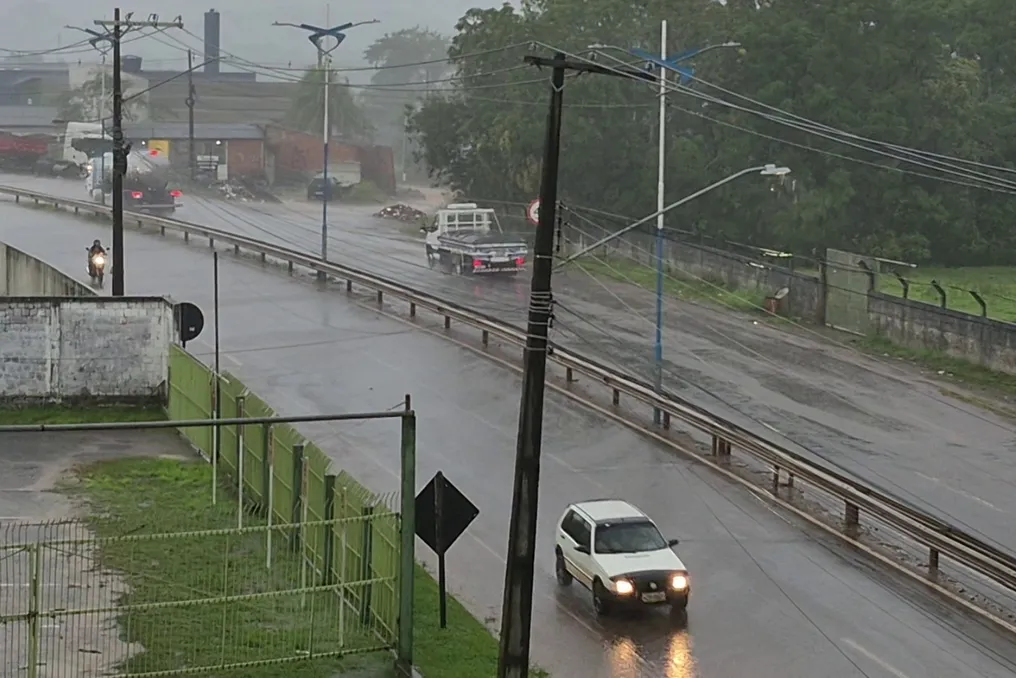
The capital Rio Branco ended the month of September with rainfall volume exceeding projections, totaling 168.6 millimeters. According to data provided to g1 by the Municipal Civil Defense, this value represents an increase of 81.9% compared to the initial forecast of 92.7 mm.
Cláudio Falcão, coordinator of the Civil Defense of Rio Branco, informed g1 that September this year, a month historically associated with drought, presented one of the highest rainfall volumes when compared to previous years. He highlighted the positive impact of this precipitation, mentioning that the Rio Acre currently has a level of 1.66 meters, whereas without this rain, it would be between 1.37 and 1.40 meters.
Positive impacts and drought alerts
Falcão emphasized that the benefits of the rains are notable, especially in the city's rural area. However, he warned that the September rain is not enough to solve the problems caused by the drought. He recalled the serious consequences observed in July and August and stressed that resolving the drought depends on the maintenance of rains in subsequent months, such as October and November.
The coordinator expressed caution regarding forecasts, citing the difficulty of accuracy this year in 2026, which would be outside usual norms. The days with the highest recorded rainfall in September were: September 13th with 19.6 millimeters; September 18th with 24.2 millimeters; September 23rd with 11.4 millimeters; and September 25th with 70.6 millimeters.
Rio Acre far from minimum levels
In addition to the unusual rainfall record, the Rio Acre also registered one of the lowest levels of the year in September. On September 6th, the water source reached 1.59 meters, approaching the lowest historical level for September, which is 1.25 meters in 2024. However, on the last day of the month, the 30th, the level rose to 1.75 meters. The following morning, the 1st, the level decreased by nine centimeters, reaching 1.66 meters.
September is considered a crucial month for measuring the water source. Although in 2022 the level reached 1.25 meters, this occurred in October. The four lowest previous levels, however, were reached during the month of September.
Storm caused damage
On the 25th, heavy rain hit the capital of Acre, resulting in several damages. In less than two hours, this precipitation reached almost 80 millimeters. According to the Municipal Civil Defense, this volume represented almost 90% of the total expected for September.
The storm generated 17 calls handled by the Fire Department and Civil Defense teams, affecting situations in 14 neighborhoods. Among the registered incidents were floods, trees falling on residences and public roads, risk of landslides, and the collapse of a tower.
The National Institute of Meteorology (Inmet) had placed Acre and five other states on yellow alert due to the possibility of intense rain. Acre, along with Rondônia, Amazonas, Mato Grosso, Roraima, and Pará, registered rains accompanied by strong winds, varying between 40 and 70 km/h. Despite the risk being classified as low, there were power outages and flooding in the capital of Acre.
One of the affected locations was the Solidarity Economy fair, located at Lago do Amor. The intensity of the wind knocked down stalls and caused losses to merchants. The rain started around 6:20 PM. Fair vendors filmed the damage, showing overturned stalls and areas with accumulated water. Carlos Taborga, coordinator of the Acrean Forum of Solidarity Economy, reported that the wind damaged the electrical parts of the stalls, wetting some products and objects. The sellers united to provide mutual aid after the damage caused by the storm.