PUC-Campinas demonstrated strong engagement in the Campinas Innovation Week (CIW) 2026. Through its innovation hub, Mescla, the university participated in several panels with its faculty and was active in the ecosystem organized by the Coalition for Impact. Furthermore, the institution promoted a lecture in collaboration with FEAC, featuring Nina Silva, CEO of the Black Money movement.
The event, which took place from September 14 to 18 at Pátio Ferroviário in Campinas, attracted approximately 23 thousand participants over the four days of programming. In its third edition, CIW fostered discussions, experience sharing, and meetings covering themes such as innovation, technology, entrepreneurship, investments, and business development. According to data from the Campinas Municipal Prefecture, the event featured over 250 speakers, in addition to more than 200 companies and startups, totaling investors, research institutions, and entrepreneurs.
Innovation on Multiple Fronts
During the four days, Mescla maintained a dedicated booth to display projects, solutions, and initiatives created by PUC-Campinas students and faculty. The activities were structured around four main axes: Technological Transfer, Entrepreneurship, Capacity Building, and Support for Companies and Governments. The presented projects covered various areas, including health, artificial intelligence, environment, education, cities, and industry.
Technical highlights included the Tubeless Cuff, aimed at non-invasive blood pressure monitoring; the M.O. Testing system, created to test pressure cuffs; HydroMonitor, intended for tracking and identifying anomalies in river basins; Project RESFRIA, which investigates the effects of urban heat; and the Low-Cost Microscope, based on open hardware concepts. There were also presentations of initiatives related to digital health, computer vision, and urban infrastructure, such as FaceMetrics, Irya: Digital Health in Palliative Care, and the Innovation Hub project at the Railway Complex.
This variety of projects illustrates a central characteristic of Mescla's work: connecting research and technological development to the practical needs of governments, companies, and society.
Faculty Lectures
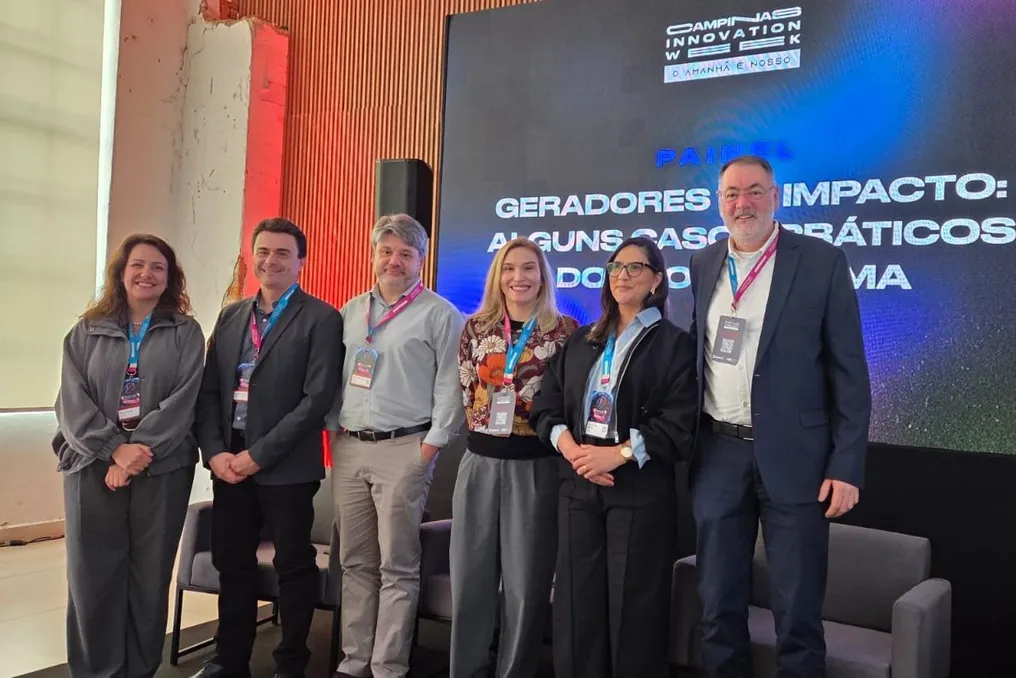
PUC-Campinas' presence was also notable on the stages of Campinas Innovation Week, with its professors participating in debates on artificial intelligence, health, innovation, and female entrepreneurship. On Tuesday (15th), Roberto Soboll, Executive Director of Mescla, participated in the panel titled 'Impact Generators: Some Practical Cases from the Ecosystem.' This panel brought together leaders and specialists from major entities in the innovation ecosystem to share real examples of impact, demonstrating how such organizations drive technological progress, strengthen the local community, and generate tangible value for the sector.
Roberto Soboll emphasized the need for preparation in the face of technological change, stating: 'At this moment when society is experiencing a technological inflection point, we need to be prepared. Thus, innovation becomes the main driver of development for us.'
Professor Dr. Silvia Cristina de Matos Soares contributed to the 'National Hub of Quantum Technologies' panel, alongside executives and managers from ICTs and IT companies in Campinas. She highlighted the importance of the contribution of Campinas' technology and innovation ecosystem to the hub, declaring: 'It is very important for PUC-Campinas to position itself as an active part of this technology and innovation ecosystem in Campinas, as it has been working with technologies that are 'hand-in-hand' with quantum computing, such as Artificial Intelligence (AI) and Cybersecurity.'
The professor detailed that the university offers undergraduate courses with updated curricula in these technologies and participates in partnerships for residencies and short technological training. She also mentioned collaboration with CNPEM, where more than 100 students participate in challenges. Silvia Cristina concluded that 'The Quantum Technologies Hub of Campinas will bring new opportunities for growth to the city and its people, as well as new challenges. And PUC-Campinas is already prepared for this future.'
Professor Dr. Leonardo O. Reis joined the panel 'Artificial Intelligence: Are We Prepared? The Questions That Will Define the Health of the Coming Years.' In this debate, experts discussed AI applications in medicine, covering diagnosis, prevention, disease prediction, and treatment definition. The professor highlighted the advancement of AI tools and the ability to integrate different sources of information to enhance medical analysis, commenting: 'We have increasingly efficient tools that are making processes more efficient and faster. And allowing us to deal with, interfere in more complex environments.'
The program also included a lecture by Professor Ma. Patrícia Culhari, titled 'Connections That Transform: The Role of Human Development in Female Entrepreneurship,' held on the Elas Conectam stage. The presentation focused on personal development, self-knowledge, and relationship building as crucial factors for empowering women entrepreneurs. Patrícia Culhari stressed the relevance of having a dedicated space for women, given the male predominance in the environment, and stated: 'First, we need to lead ourselves, only then can we understand that we can be anywhere.'
Additionally, Professor Dr. Daniela Scarpa Benelli addressed the issue of female underrepresentation in innovation sectors, presenting the lecture 'Reflections on Female Underrepresentation in Innovation Spaces: The Case of Campinas.' Based on RAIS data and studies on the gender division of labor, she pointed to low female representation in the most valued positions in innovation. Daniela Scarpa reported: 'The survey shows that in 2025, women represented 44.8% of people employed in R&D in the municipality, a proportion below parity. This underrepresentation is accompanied by a wage gap.'
CIW also hosted the panel 'Academia and Knowledge Society Towards Transformation: How Academia, Civil Society, and Impact Businesses Can Build Solutions for Territorial Challenges.' This panel featured Prof. Dr. Adolfo Calderón and Prof. Dr. Camila Brasil Gonçalves Campos, coordinator of the DRE at PUC-Campinas. The discussion focused on how universities, civil society organizations, and impact entrepreneurs can collaborate to accelerate solutions for complex socio-environmental problems, strengthening local ecosystems and increasing social value generation.
Camila Brasil Gonçalves Campos reinforced the importance of PUC-Campinas in the city of Campinas, saying: 'PUC-Campinas is a very present institution in the city of Campinas, very important for the Campinas society. So, being in an environment where innovation is discussed, where various organizations connect, wanting to exchange experiences and contribute to a better future for all of us, is always important.'
Diversity as a Force for Innovation
Another highlight of the university's participation was the lecture 'Technology, Social Impact, and Future Business: The Power of Diversity in the Economy,' organized by PUC-Campinas and FEAC on Friday (18th). Nina Silva, technology executive, angel investor, and CEO of Black Money, argued that the inclusion of different viewpoints is essential in creating new products and businesses. According to Nina, diversity expands creative capacity and enables companies to identify demands from audiences often neglected in development.
The discussion also touched upon the link between diversity, data, and artificial intelligence. Nina argued that since technological data reflects human behavior, the participation of multiple groups in developing these solutions is vital to enriching the contexts analyzed by technological systems.
The lecture was attended by Camila Brasil Gonçalves Campos, coordinator of the DRE at PUC-Campinas, and Lina Pimentel, socio-educational director of FEAC. Nina Silva was awarded, for the second consecutive year, at the BRICS Women’s Startup Contest, held during the BRICS Week in India, in the Education and Skills Development category, underscoring her work at the intersection of technology, entrepreneurship, diversity, and development.
PUC-Campinas also participated in the panel 'Strategies and Development Routes for a Positive Socio-Environmental Impact Economy: Municipal Committee for the Impact Economy Strategy of Campinas,' with the presence of members of the Coalition for Impact, including Camila Brasil Gonçalves Campos.
Summary
In summary, throughout the Campinas Innovation Week, PUC-Campinas was involved in multiple facets of the innovation agenda. Its participation ranged from exhibiting internal projects developed at the university to its professors contributing to debates on artificial intelligence, health, entrepreneurship, diversity, and female participation, reinforcing Mescla's proximity to the ecosystem.