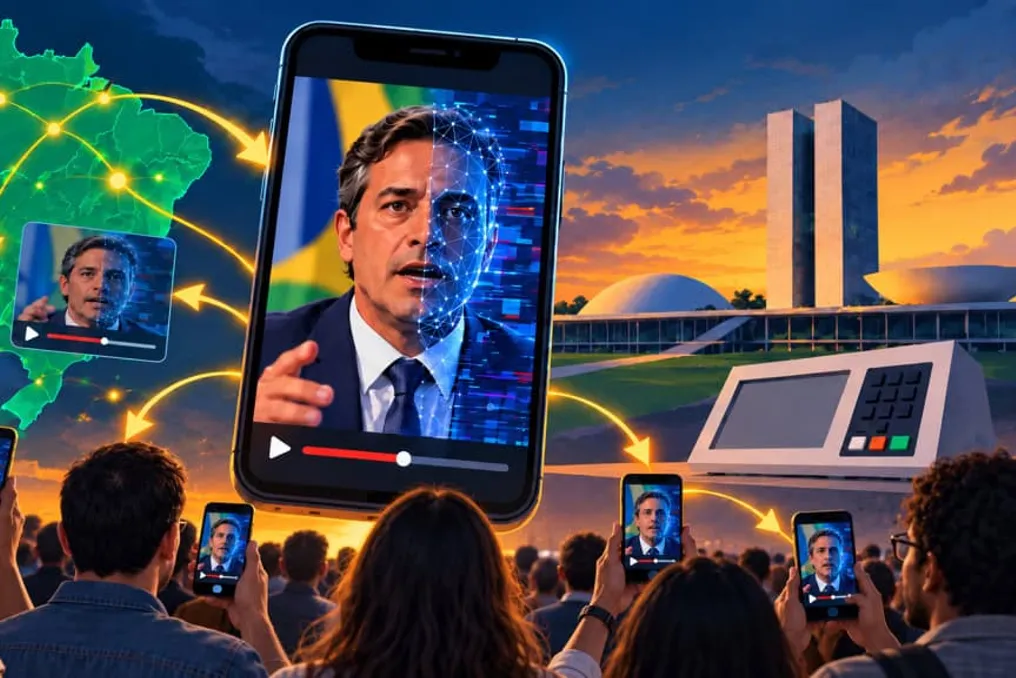
In recent weeks, especially with elections approaching, fake videos created using the voices and images of famous people have been actively spreading on social media. These cases demonstrate the power of artificial intelligence (AI), which is capable of generating political statements, altering audio recordings, and creating scenes so realistic that they easily deceive users.
This tactic leverages the influence of popular figures to lend credibility to fabricated content. Thus, public figures become part of manipulations that combine real and false elements to deceive the public.
One example involves Caetano Veloso and Neymar Jr. A recording circulating on TikTok was created to look as if the singer stated that 'Lula saved this country from hatred' and supported the continuation of his rule in 2026. However, this is a deceptive fake, as the singer never made such a statement.
The falsification used real elements to create an appearance of authenticity. Caetano did participate in Lula's campaign in 2026, where artists chanted the phrase 'Bora, Lula!'. Nevertheless, the singer's image was reused in the fake video, and the new AI-generated audio contained words he never uttered. Caetano's own team confirmed to DW that the content is false.
In Neymar's case, the strategy was similar but with the opposite political slant. The manipulated video depicted the player claiming that he was monitoring alleged persecution against Jair Bolsonaro and that Lula and Supreme Court Minister Alexandre de Moraes 'fear the president's power.' Such a statement was also never made by the player.
In this instance, a real element was also present to help give the fake authenticity. Neymar voted for Jair Bolsonaro in the 2022 elections, and in 2026, he appeared in a real photograph signing the Brazilian national team jersey for Flavio Bolsonaro, the son of the former president and presidential candidate. However, this real photograph does not prove that the player made the political statement claimed in the fake video.
The combination of true facts and fabricated content is one reason why these cases are particularly difficult to identify. Those who already know that Caetano participated in Lula's campaign or that Neymar had public ties to Jair Bolsonaro may consider the video 'plausible' even before checking its source. This mix complicates verification because the false content relies on facts that the public already considers true.
The use of images and voices of famous people is not limited to political propaganda. Toni Ramos was also a victim of a deepfake, as reported by Olhar Digital. During a recent appearance on the TV Cultura program Roda Viva, the actor revealed that his image was used in a fake video alongside Ana Maria Braga to sell medicine. According to him, his speech was voiced over and used to lend authenticity to an advertisement he never made.
In recent days, a fake image of Alexandre de Moraes and Edson Fachin, also an STF minister, has also circulated. The publication implied that they were discussing something, but according to fact-checking platforms, the image was generated by AI. This incident shows that manipulation does not necessarily have to be a video: a photograph can also create a non-existent situation and generate a misleading narrative.
Resolution 23.610/2019 of the Superior Electoral Council (TSE) requires that synthetic content created or modified using AI must be labeled when used in propaganda. The norm also prohibits deepfakes in election campaigning that create, replace, or alter the image or voice of people to support or damage candidates. In early September, the TSE established criteria for identifying such content.
According to the body, a deepfake is synthetic content generated or altered by artificial intelligence or equivalent technology that possesses a high level of realism, capable of creating, reproducing, or modifying the image, voice, or statement of any person—living, deceased, or fictional. Under the established understanding, a direct ban on the use of this technology applies to content classified as election propaganda.
AI has not eliminated old methods of manipulation. Real videos continue to be taken out of context, cropped, or combined with other audio tracks to create situations that never happened. A check by UOL Confere, published on Wednesday (30), uncovered manipulation in an old video where a man attacked a priest in Rio de Janeiro in 2022.
In the original recording, the attack occurred after a personal dispute; in the edited version circulating this week, the original audio was replaced with speech about national sovereignty. The edit simulated that the religious figure was attacked for political motives—a clip taken out of context that garnered over 100 thousand views on Facebook before the material was published.
Data from the First Review of Disinformation in Brazil, published by Agência Lupa in February, shows that false content generated or altered using AI identified in the organization's checks grew from 39 in 2024 to 159 in 2025—a 308% increase. A recently published study by Ekō, an international corporate responsibility organization, found at least 1.1 million Brazilian reais paid across 26 profiles to promote election advertisements that, according to the study, violated Meta rules and Brazilian law, including unidentified deepfakes.
The same combination of altered imagery, political content, and news appearance can be used not only for disinformation but also for financial fraud. Recently, AI-generated images and a simulated news portal suggested that entrepreneur Luciano Han, owner of Havan stores, was allegedly subjected to an 'attack' ordered by former Finance Minister Fernando Haddad, the current PT candidate for governor of São Paulo state.
This story appealed to political competition to direct the public to a fake website promising profits of up to 10 thousand Brazilian reais per day, where users were persuaded to make deposits or provide personal data.
Wilder Martins, a cybersecurity specialist from EXA, a developer of solutions against virtual threats, emphasizes that the technology currently mimics reality with perfection, creating and maintaining fake links and websites very similar to the originals. He notes: 'Therefore, the main barrier to protection has changed: the question should no longer be just 'does this look true?', but rather 'why am I being asked to click the link, provide confidential data, or make a transfer?'.'
According to Martins, the same structure can be adapted for various topics that become relevant during election periods. The widespread dissemination of political information creates new opportunities for criminals to use the names of candidates, officials, institutions, and media. Possible scenarios include messages about voter ID, biometrics, polling locations, electoral polls, false fines, campaign fundraising, and content altered by the voice or image of public figures.
The specialist warns: 'If the message creates urgency (whether to prevent blocking, ensure a right, or demand payment), stop immediately. This is a classic scam trigger. Your main defense is not to take the shortcut offered by the scammer. Close the message and use verification tools and software available both for free and paid, such as EVA [EXA's AI analyzing suspicious content on WhatsApp], to confirm the information before making any transaction.'
With the development of AI, it has become harder to detect fraud based solely on visual or auditory signs. Errors that previously betrayed some manipulations have become less obvious, and verification must go beyond the appearance of the content. Instead of only looking for visual defects, it is recommended to check the content's trail: confirm whether the person actually made such a statement through official channels, check if the media reported it, and remain skeptical of controversial videos distributed without a clear origin.