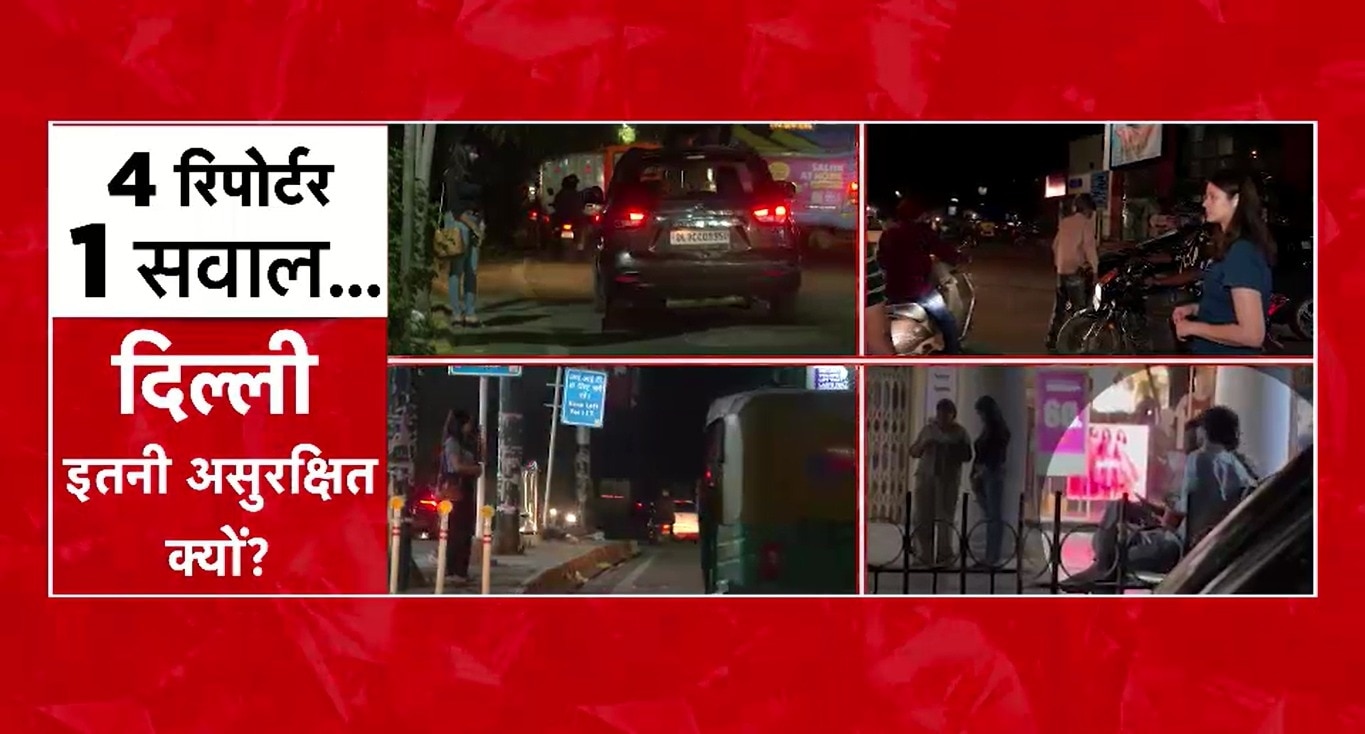
Accusations of crimes against women often arise after major incidents, but little attention is paid to actions that occur before them. Currently, it has become common in public places in Delhi for women to be subjected to constant staring, stalking, street stops, or attempts to start conversations.
In such cases, the police are not always present, and First Information Reports (FIRs) are not always filed. However, this does not mean that nothing happened. To understand this situation, four Aaj Tak journalists visited various parts of Delhi late in the evening. They deliberately chose locations where the daily life of Delhi was bustling, rather than deserted or uninhabited streets. These places included markets, hospitals, campuses, temples, and business districts.
Around 7:30 PM, journalist Aishwarya Pallival was in an area near Maulana Azad Hospital as people were returning from work. Amidst the traffic, cars, and pedestrians, a man from a car stopped her and asked, 'Do you want me to give you a ride?' The journalist refused. But the conversation did not end there. The man then asked, 'Do you need company?' After the second refusal, the girl refused again. The young man introduced himself as a 'nice guy,' but after a third clear refusal, he moved the car forward and then reversed it about 50 meters later. He then asked again, 'For sure?' Thus, the woman had to say 'no' three times to make her point. This situation demonstrates a complex picture of street events that are not always easy to classify as direct crime. For a woman, this can cause fear or discomfort, but to an outside observer, it might just seem like a conversation.
Journalist Jessica Goel visited areas in Patel Nagar, Kirti Nagar, Rajori Garden, Janakpuri, and Tilak Nagar in West Delhi. Although everything seemed normal, in this ordinary setting, men repeatedly stopped and stared at women on motorcycles or in cars. In Patel Nagar and Kirti Nagar, instances were recorded where drivers stopped and stared intently at women. At a bus stop in Rajori Garden, motorcycles were also spotted stopped without apparent reason. In Janakpuri, a car approached Jessica from a distance near Happy Model School. The driver did not try to talk to her; he got out of the car, smoked a cigarette, and kept looking at Jessica. From afar, it could be said that nothing happened, but for a woman, stalking is also an event. Constant observation is also an event. Unwarranted approach is also an event, and the constant feeling of discomfort due to someone's behavior matters.
Near Bharti College, there was a dark and dimly lit spot. In Tilak Nagar, one person walked very close to Jessica, creating the impression that he was trying to touch her. There was no major scandal, nor did the police arrive; just another day passed on the streets of Delhi when a woman felt uncomfortable.
After this, the team headed to South Delhi. In Lajpat Nagar and AIIMS areas, journalist Kartiki Arora spent about an hour observing the situation, during which 7-8 cars stopped. Most people offered rides, some cars drove away, but many returned even if they had already been refused. A voice was heard in the frame asking, 'Will you go?' That is, 7-8 cars stopped in one hour. 2-3 cars returned after being refused. 2-3 people asked, 'Will you go?' Kartiki was not there to ask for a ride, nor did she stop any car. Nevertheless, many cars approached her in an hour. If such minor incidents happen constantly, a woman starts watching every car, every person, and every turn. Discomforting behavior is not always expressed in words.
Sometimes simple constant observation is enough. This happened at the entrance to Hauz Khas village. One person was sitting and watching the women. He did not stand up or say anything; he just sat, waiting for the next woman to pass by. A motorcycle passed. Two women moved on. The motorcycle driver turned his head almost 180 degrees and looked at them. The question arises: when will the discomfort regarding such behavior disappear in society if staring at a woman becomes so commonplace that the person doing it doesn't have to worry about getting caught?
In front of a Hindu temple, four or five men were sitting. A middle-aged woman entered the temple, performed worship, and bent down upon exiting. At that moment, the gaze of one of the sitting men was fixed on her body. Here too, the question arises: women bend down for worship, but why should this become a reason for another person to stare at them?
In Hauz Khas, two foreign women were passing by a group of men. Not just one person was looking here; one looked, another signaled, and then the second one also turned around. So sometimes staring at a woman becomes not the action of one person, but a form of entertainment for the whole group. For the woman, the problem...