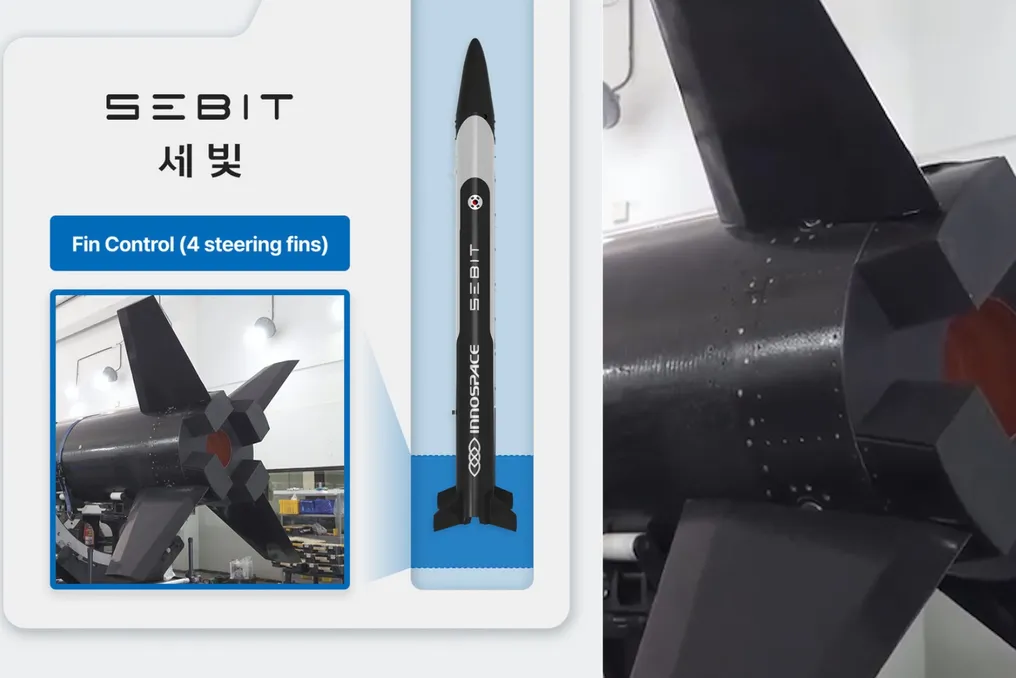
The South Korean company InnoSpace has concluded its internal investigation into the reasons for the trajectory deviation that occurred with the SEBIT rocket, which was launched in August from the Alcântara Launch Center (CLA), located in Maranhão. Data collected by the company indicated a problem with the vehicle's fin control mechanism, requiring adjustments to the algorithm responsible for this control.
Due to the continuation of tests on the SEBIT and the scheduling of an additional verification flight, InnoSpace revised its schedule, postponing the launch of HANBIT-Nano, its main model, to the first half of 2027. The mission was originally scheduled for November of this year.
This new planning is conditional on discussions with the Brazilian Aerospace Projects Company (ALADA) and the Brazilian Air Force (FAB). The company emphasized that the future launch calendar will depend on the progress of the investigation, the technical improvements implemented, the checks on the rocket, and the operational conditions of the Alcântara Launch Center.
What the analysis identified in the flight
This conclusion is part of an internal analysis conducted by the company and forwarded to the Aeronautical Accidents Investigation and Prevention Center (Cenipa). InnoSpace maintains the investigation in collaboration with this Brazilian body.
The company detected discrepancies between the projected behavior and the actual performance of the fins during the low-speed phase. This data will be used to refine both the control system and the design and testing procedures before the next verification attempt.
The fins, structures located on the lower part of the rocket, function to assist in controlling the direction and position of the vehicle during flight. According to InnoSpace, telemetry data revealed these differences specifically during the low-speed phase. However, the company did not specify whether the divergence in fin control was the sole factor causing the trajectory deviation.
Regarding the end of the flight, it occurred approximately 35 seconds after takeoff. The rocket landed in a pre-established maritime safety zone for the mission, with no reports of injuries or damage to facilities.
InnoSpace confirmed that the Flight Termination System (FTS) operated as expected. This system, developed by the company, does not use pyrotechnic devices; it interrupts the oxidant supply to the engine after receiving the stop command and executes the planned sequence to conclude the flight. The FAB also evaluated and certified that the termination procedure was carried out safely.
What is SEBIT
SEBIT is a multifunctional suborbital rocket created by InnoSpace, a South Korean company, intended for research missions, technology verification, and payload testing. This equipment has the capacity to reach altitudes of up to 100 kilometers.
The model features a hybrid engine that generates three tons of thrust and an integrated telemetry system, used to transmit and analyze crucial information in real time, such as the rocket's location and the payload status during the flight. InnoSpace developed this device to meet the demand for space technology demonstrations and scientific research in fields such as biotechnology, medicine, new materials, and navigation and orientation systems.