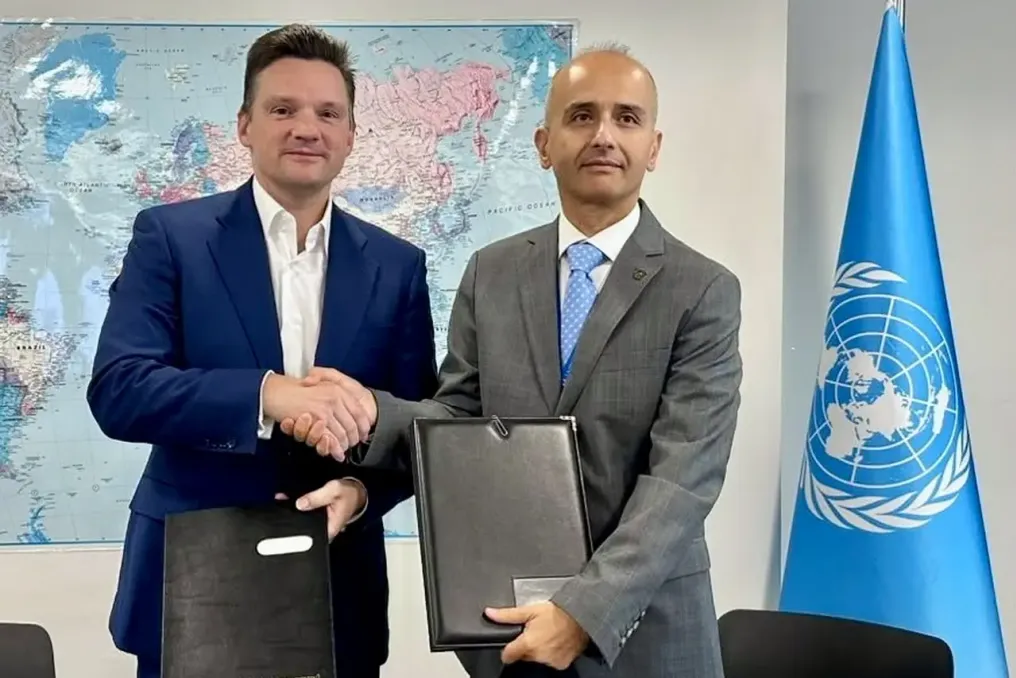
The Eurasian Development Bank (EDB) and the United Nations Human Settlements Programme (UN-Habitat) have signed a memorandum of understanding, agreeing to collaborate on urban development projects in Eastern Europe and Central Asia.
The agreement provides for cooperation at all stages of initiatives: from developing and preparing project ideas to their practical implementation. EDB intends to combine its financial and project experience with UN-Habitat's expertise in housing and sustainable urban development.
In the initial phase, both parties will focus on four key areas: providing technical assistance in preparing and strengthening urban projects; enhancing the capacity of national and local authorities and municipal organizations; digitizing urban infrastructure, including the use of artificial intelligence and data; and conducting analytics, joint research, and knowledge exchange.
The memorandum was signed during a meeting of representatives from EDB and UN-Habitat. The meeting was chaired by EDB Board Chairman Nikolay Podguzov, while UN-Habitat Executive Director Anakludia Rossbach joined the event online.
EDB is already implementing projects in the field of urban infrastructure. In Dushanbe, the bank, through its Digital Initiatives Fund, is financing the creation of a unified electronic digital map of the city—a unified system for managing urban infrastructure. This project is carried out in collaboration with 'Smart City', a state enterprise under the Dushanbe mayor's office.
Nikolay Podguzov noted that urban development is a priority, especially in Central Asia. He emphasized that the bank has experience working with digital solutions for urban infrastructure, such as creating an electronic city map in Dushanbe, which helps the mayor's office manage municipal services, property, and urban processes. Cooperation with UN-Habitat will allow for a more systemic approach to project development and the utilization of global UN experience.
Anakludia Rossbach pointed out that the global housing crisis affecting up to 3.4 billion people requires interaction between governments and international organizations. She expressed confidence that the partnership with EDB will help turn common commitments into real actions to ensure affordable housing and create safe, sustainable, and inclusive cities and settlements.
UN-Habitat will provide its expertise in urban planning, affordable housing, urban governance, climate resilience, and basic urban services. In turn, EDB will contribute its financial, institutional, and regional experience.
Both parties plan to jointly develop urban projects, study potential financing mechanisms, and ways to attract investment. UN-Habitat's regional and country presence is expected to facilitate interaction with governments, cities, UN country teams, and other partners across Eastern Europe and Central Asia.
EDB also cooperates with other UN agencies. Together with the United Nations Economic and Social Commission for Asia and the Pacific (ESCAP), the bank implemented a project on experience exchange between energy companies in Kazakhstan, Kyrgyzstan, Tajikistan, Turkmenistan, and Uzbekistan. In Kazakhstan, EDB and the United Nations Development Programme (UNDP) are implementing an irrigation development project worth $5.3 million. In Tajikistan, projects are underway to strengthen wheat flour production with the participation of the World Food Programme of the UN, and a school milk program is being implemented in Armenia.
As of the end of June 2026, EDB's portfolio included 348 projects with a total investment volume of $22.1 billion. Most of this portfolio consists of projects with integration effects in transport infrastructure, digital systems, green energy, agriculture, industry, and mechanical engineering.
Under its Strategy for the period 2022–2026, EDB is implementing three mega-projects: the Central Asia Water Supply and Energy Complex, the Eurasian Transport Framework, and the Eurasia Commodity Distribution Network.
UN-Habitat is a UN agency specializing in sustainable urbanization. Its programs operate in over 90 countries and aim to develop socially and environmentally sustainable cities and human settlements.