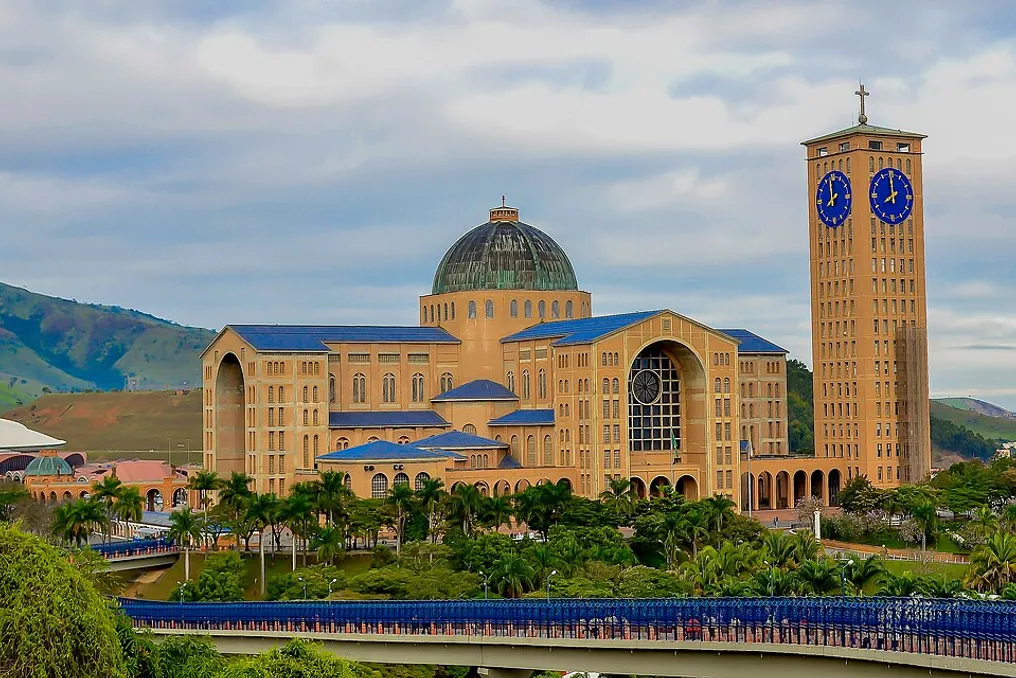
The interior of the state of São Paulo has a vast number of Catholic temples, attracting people interested in history and architecture as well as religious tourism enthusiasts. The Paulista map is rich in basilicas, which are churches of great historical or architectural relevance to the faithful. These options offer alternative outings, whether for residents of the capital or distant visitors, going beyond the well-known trip to Aparecida.
Less than 2 hours and 30 minutes by car from São Paulo, it is possible to reach the municipality of Aparecida, where the Historic Basilica of Aparecida is located, also known as the Church of Monte Carmelo or Old Basilica. This was the first official sanctuary dedicated to the patron saint, built to receive its devotees, many of whom were local fishermen.
Inaugurated in 1888, the church marked the faith tourism of the city. In 1908, it received the title of Minor Basilica, granted by Pope Pius X. The original image of Our Lady of Aparecida remained in the church until 1982, when it was transferred to the New Basilica, the National Sanctuary. In the same year, the Old Basilica was listed as heritage by the Council for the Defense of Historical, Archaeological, Artistic, and Tourist Heritage (CONDEPHAAT).
This place is worth visiting even for those who are not religious, as art and architecture lovers can admire the arabesques and stylistic details characteristic of 19th-century constructions. For the religious, there is the tradition of visiting the historic temple and continuing the pilgrimage to the New Basilica, which is the second largest Catholic temple in the world, only behind St. Peter's Basilica in the Vatican. Masses are held from Monday to Friday at two times (8 am and 6 pm), while on Saturdays and Sundays they take place at 9 am, 3 pm, and 7 pm.
Located in front of Embaré beach, in the municipality of Santos, is the Minor Basilica of Santo Antônio do Embaré. This city is approximately one hour from São Paulo, making it an ideal destination for day trips. The building was initially erected in 1922 as a parish, being handed over to Capuchin friars in 1929.
The church impresses those passing by the waterfront due to its robust stone construction and Neo-Gothic style. Upon entering, visitors find stained glass windows, medieval-style rose windows, and ornaments on the doors and pulpits. The Basilica celebrates masses daily at various times, available on the church's website. Blessings and confessions are held from Wednesday to Friday in two periods: from 9 am to 10:30 am and from 3 pm to 4 pm.
It is important not to confuse this Basilica with the one in Santos, despite the similar name inherited from the common patron saint. The Basilica of Santo Antônio de Pádua is located in Americana, a little further from São Paulo, requiring about a two-hour drive.
The Basilica of Americana is recognized as the largest Neoclassical church in Brazil. It was built in a cross shape, measuring 22 meters high, 80 meters long, and 30 meters wide. The interior of the temple features walls and ceilings decorated with murals executed by the Italian brothers Pedro and Uldorico Gentilli.
This church is the largest in the Diocese of Limeira and achieved the status of Diocesan Sanctuary in 2013. Subsequently, in 2014, Pope Francis granted it the title of Minor Basilica. Mass and visitation schedules vary according to the day of the week, all detailed on the church's website.
The Basilica of Our Lady of Carmel, the central point of the city, originally served as the Mother Church of Campinas, around which the settlement developed. During the colonial and imperial periods, it functioned as the seat of the Parish of Our Lady of Conception. In 1870, the urban core of Campinas divided into two parishes: the New Mother Church, which was the cathedral under construction, and the Old Mother Church, which gave rise to the Basilica of Carmel.
In the 1920s, the Old Mother Church was almost entirely demolished to make way for the current Basilica. The initial concept of the project was grandiose, aiming for a large and tall structure inspired by European Gothic churches. However, due to the coffee crisis, the work was adapted to a smaller scale than planned, while maintaining inspiration from the Neo-Gothic style. In 1975, Pope Paul VI elevated the church to the status of Basilica because it was the first in the city. Service and mass schedules can be consulted on the Campinas City Hall website.
For those with more time, it is possible to visit São José do Rio Preto to see the Minor Basilica of Our Lady of Conception Aparecida. This city is the farthest from the capital on this list, requiring almost six hours by car. However, the temple is considered one of the most beautiful in the state.
Its construction follows the Art Deco style, with Neo-Romanesque influences. The floor is composed of Portuguese hydraulic tiles arranged in a mosaic that simulates a carpet extending to the altar. The ceiling is adorned with a series of paintings narrating the journey of Jesus Christ and Saint Francis of Assisi. Inside the basilica, there is also a pipe organ dating from the 1940s, built in Indaiatuba and used for religious music, which is a piece of great historical value.
For the faithful, the Basilica serves as a place to fulfill promises; devotees who made vows to Our Lady of Aparecida but cannot travel to Aparecida can fulfill their obligations there. Confessions take place on Wednesdays from 9 am to 11 am, and on Thursdays in two shifts: from 9 am to 11 am and from 2 pm to 4 pm. Mass schedules can be checked on the archdiocese's website.