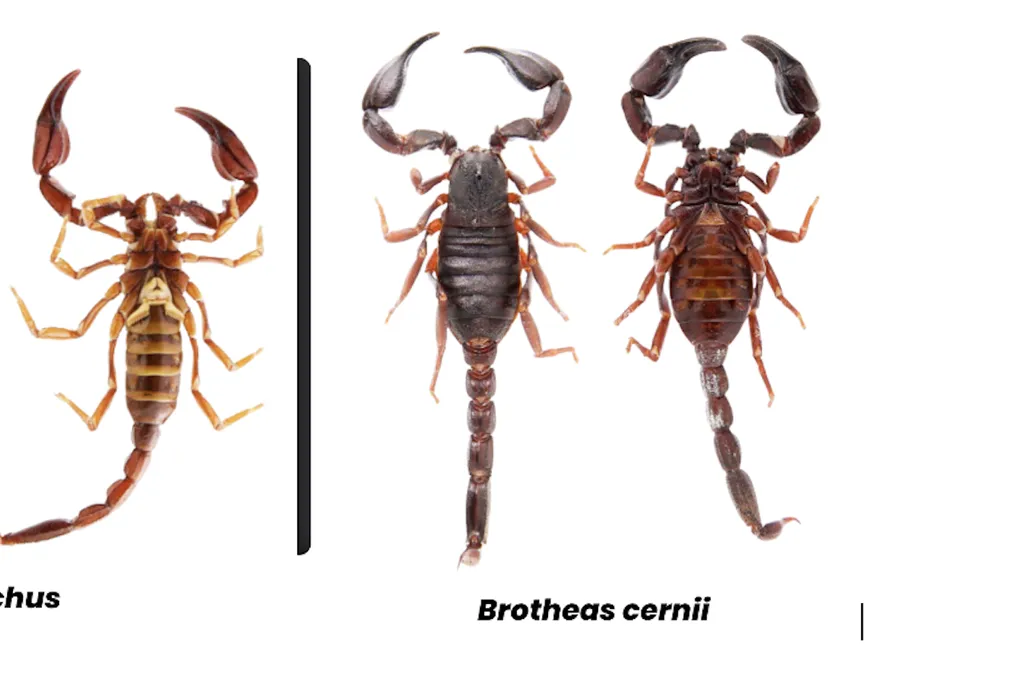
Researchers have discovered two previously unknown species of scorpions in the Amazon by using ultraviolet light to search for animals in the dense forest at night.
These findings were made by a group of researchers from the Laboratory of Immunology and Toxicology of the Faculty of Pharmaceutical Sciences at the State University of Paulista (Unesp). They found these species near an inselberg—an isolated rocky outcrop.
The discovery site was the Cachoeira do Evandro area in Mucajaí, Roraima state. The new species have been named Cayooca puchus and Brotheas cernii. The scientific description was published on June 6, 2026, in the journal Diversity and was recently highlighted by the G1/Roraima portal.
The work was based on years of expeditions and sample collection in the region. In October 2022, researchers used ultraviolet flashlights because scorpion bodies fluoresce under this light. Samples were compared with known species by analyzing morphological characteristics such as size, coloration, body granulation, and structures used for taxonomic identification.
Experts from various institutions, including the Federal University of Agricultural Sciences of Pernambuco, the Butantan Institute, and the National Autonomous University of Mexico, evaluated these features and verified the species identification. Morphological analysis allowed them to distinguish the samples from closely related known species, confirming the status of the two species as new to science.
Both species belong to the family Chactidae, which is predominantly found in the Americas. This family includes scorpions with great morphological diversity and a predominantly neotropical distribution. In Brazil, Chactidae mainly inhabits the Amazon, including the genera Brotheas and Cayooca.
The species Cayooca puchus measures between 3.2 and 5.1 centimeters. It is distinguished by denser body granulation and pronounced ventral carinae. The name puchus was chosen to reflect the surprise of the discovery; it comes from the Spanish expression pucheros, related to astonishment.
Brotheas cernii reaches a size of 4.5 to 5.7 centimeters. This species is characterized by a smaller body size and more intense granulation compared to related species. The name cernii is a tribute to the biologist Felipe Augusto Cernei and his family, and it also notes his contribution to the study of scorpion venoms.
Currently, both species have only been found at the base of this inselberg, although this does not mean they are restricted to this area. Future expeditions may discover other unexplored populations. The team suggests that the habitat itself might explain this pattern: the inselberg creates an isolated rocky landscape in the forest, which can limit dispersal and promote differences between populations over time.
In isolated conditions, populations may have less gene flow, and genetic differences can accumulate over time, leading to the emergence of new species. While isolation and the special conditions of inselbergs can promote diversification, specific studies are needed to verify whether this has occurred with Cayooca puchus and Brotheas cernii.
This discovery also helps assess a broader issue: the Amazon is the world's largest continuous tropical forest and still contains significant gaps in knowledge about its biodiversity. In science, the absence of known species is called the 'Linnaean gap,' and the lack of knowledge about their habitats is the 'Wallacean gap.' Roraima still has important sampling gaps, as some areas of the state remain understudied. The discovery of two new species in one area underscores that others are likely present as well.
There is an urgent need for these searches: describing a species is the first step toward recognizing its existence. Under growing environmental pressure, some species may disappear before they are cataloged. Scorpions are also important for public health in Brazil. In 2025, 225,695 cases of scorpion-related injuries were registered in Brazil, according to data from the Ministry of Health's Epidemiological Panel. This accounted for over 65% of all venomous animal cases that year, demonstrating the importance of this group for epidemiological surveillance.
The Ministry of Health notes a higher incidence rate in the Northeast and Southeast regions. In the North region, Tityus obscurus is the main cause of injuries and deaths. Since the new species belong to the family Chactidae and are not among the primary medically significant species, this discovery expands knowledge about Amazonian scorpions.
The taxonomic discovery is just the first chapter. Researchers have already begun studying the molecules contained in the venoms of these two species. Scorpions are specialized insect predators and have evolved very specific molecules in their venoms throughout evolution. These substances are of interest to science due to their potential use in developing biological insecticides, as well as in pharmaceutical and biomedical applications.
However, studying these animals requires respect for their living conditions. As they are sensitive to changes in temperature and humidity, live specimens were kept at the Federal University of Roraima instead of being sent to São Paulo. However, their venoms were collected and are already being analyzed at Unesp. The next stage is already being prepared: future expeditions to Roraima will also study spiders and barbiders, expanding knowledge of the region's fauna. The authors thank the State of São Paulo Research Support Foundation (FAPESP) for financial support through the BIOTA-FAPESP Program, which made this research possible.