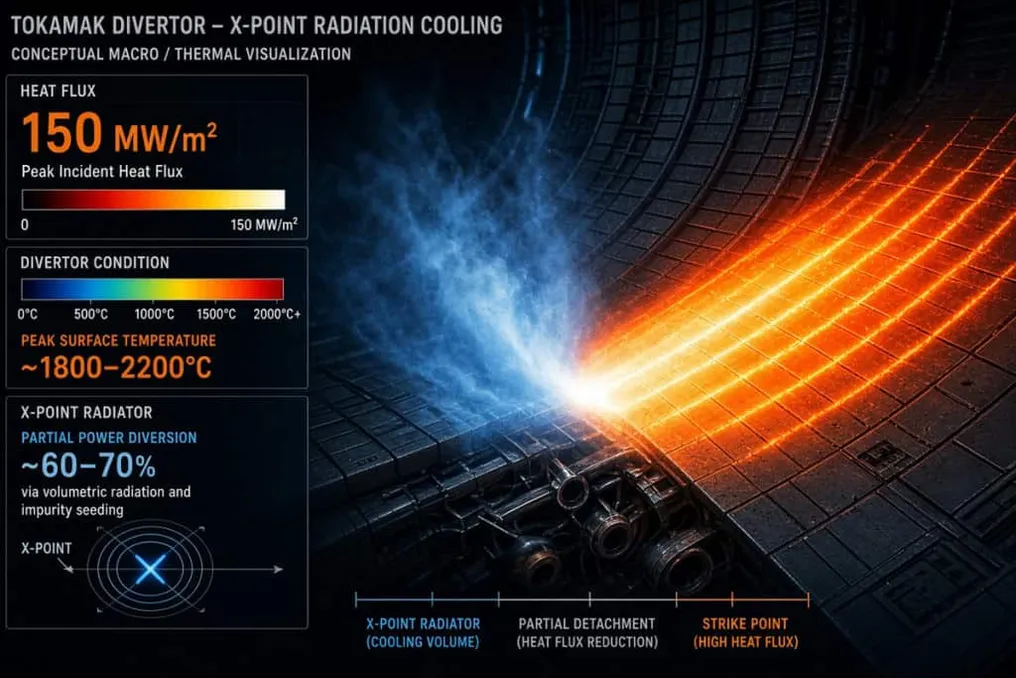
A high-speed camera captured the color behavior of the plasma inside the ST40 tokamak from Tokamak Energy, operating at a speed of 16 thousand frames per second. These images demonstrate how lithium particles pass through the outer region of the plasma, helping researchers study methods for controlling the vast amount of heat generated by the fusion process.
The experiment aims to solve one of the key problems for future reactors: ensuring that heat-receiving components can withstand extreme loads over long periods. Furthermore, the obtained shots allow tracking the movement of lithium at speeds exceeding previous recordings.
To achieve fusion, ST40 must contain the plasma—an extremely hot gas—using magnetic fields. The temperature reaches millions of degrees, and some energy is dissipated. This load is directed to so-called divertors—special elements installed to absorb heat before it reaches other parts of the equipment.
During tests on ST40, researchers have already measured fluxes up to 150 megawatts per square meter. The complexity increases when considering a future power plant, where these components must withstand similar conditions for much longer periods.
This is where the color images help. The pink hue comes from deuterium, a form of hydrogen used in the plasma. Lithium, introduced as fine granules, changes its color when passing through different areas.
The camera speed is critical for this type of observation. In the T-11M tokamak, the color camera operated at a speed of 1000 frames per second. Researchers noted that speeds above 10 thousand frames per second are necessary to track the evolution of lithium filaments.
The experiment also tests the concept of reducing the volume of energy directed to the divertors. Instead of allowing all the heat to go to these parts, scientists are trying to release some of it into the outer region of the plasma. This strategy is known as X-point radiator (XPR). In fact, specialists aim to concentrate this cooling near the magnetic field area called the X-point, which is located near the divertors. Meanwhile, the plasma core, where fusion conditions must be maintained, remains hot.
Initial tests on ST40 showed the possibility of creating an energy-releasing region near the X-point, which led to a reduction in the periphery plasma temperature. Measurements also recorded a decrease in the amount of heat reaching the divertors.
However, a question remains open. According to researchers, a significant part of the energy released during these tests likely originated from carbon that detached from the tokamak walls, rather than from the intentionally introduced lithium. Experiments with lithium and neon are currently underway to further reduce the thermal load.
Additional Information
Tokamak Energy plans to upgrade ST40. The company intends to replace the carbon coating with molybdenum, install systems for applying lithium onto the surfaces facing the plasma, and add new instruments for better observation of this zone.
Thanks to such fast images and detailed analysis of the light emitted by elements in the plasma, researchers gain a way to track exactly where the heat is being released. The goal is to figure out how to control this process without disrupting the conditions necessary for fusion to occur.