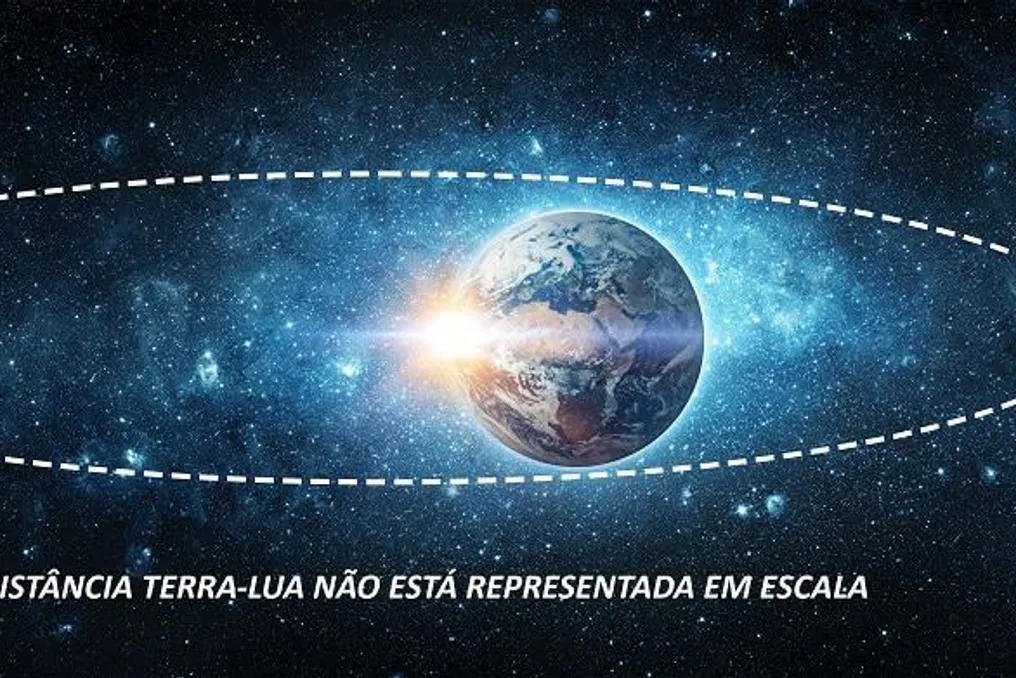
At the end of Thursday (the 1st), specifically at 17:51 Brazilian time, the Moon will reach perigee—the closest point in its orbit to Earth. A few hours later, early Friday morning (the 2nd), it will obscure a bright star located in the constellation Taurus in a kind of eclipse.
According to the platform In-The-Sky.org, the distance of the Moon relative to Earth changes because its orbit is not perfectly circular but has a slightly oval shape, following an ellipse. As it travels this elliptical path around our planet each month, its distance fluctuates between 356,500 km at perigee and 406,700 km at apogee (the farthest point).
Marcelo Zurita, president of the Paraíba Astronomy Association (APA), member of the Brazilian Astronomical Society (SAB), technical director of the Brazilian Meteor Observation Network (Bramon), and columnist for Olhar Digital, notes: 'These values are averages because in practice they vary greatly due to the gravitational influence of the Sun and other planets in the Solar System.'
The angular size of the celestial body also changes for the same reason. At perigee, our natural satellite can become up to 14% brighter in the sky when visible. However, this is difficult to notice in practice as the phases of the Moon change simultaneously.
A few hours after approaching Earth, the Moon will pass in front of Beta Tauri (also known as Elnath), the second brightest star in Taurus.
About Beta Tauri
According to the observational platform Sky & Telescope, the name Elnath originates from Arabic and means 'head' or 'one who pushes with horns.' This is a direct reference to the star's position at the tip of the Taurus horn. This name emphasizes the tradition of linking bright stars with visual elements of constellations in the sky.
According to InTheSky.org's guide, the lunar eclipse of Beta Tauri will occur from 3:10 to 6:46 AM and will be visible across almost all of Brazil.
The lunar eclipse is only visible over a small part of the Earth's surface. Since the Moon is much closer to our planet than other celestial objects, its position in the sky depends on the observer's exact location on Earth due to its large parallax (the difference in the apparent position of an object relative to the background, as seen by observers in different places or in motion).
The Moon's position, visible from two points on opposite sides of the Earth, can differ by up to two degrees, or four times the diameter of the full Moon. This means that if the Moon is aligned to pass in front of a specific object for an observer on one side of the Earth, it may appear up to two degrees away from that object on the other side of the globe.
The map shows various contours indicating where the disappearance of Beta Tauri can be seen (in red) and where its reappearance might be observed (in blue).
Solid contours show locations where the eclipse is likely to be visible with binoculars at a reasonable altitude in the sky. Dotted contours, in turn, indicate where the event occurs above the horizon but may be invisible due to overly clear skies or the Moon's proximity to the horizon.
Outside these contours, the Moon does not pass in front of Beta Tauri at any time or is below the horizon during the eclipse.
This implies that the South, Southeast, Central-West, Northeast, and most of Northern Brazil are within the visibility zone. Only the northernmost part of the country, along the line of low eclipse over Amazonas and Roraima, is at the limit of the phenomenon.