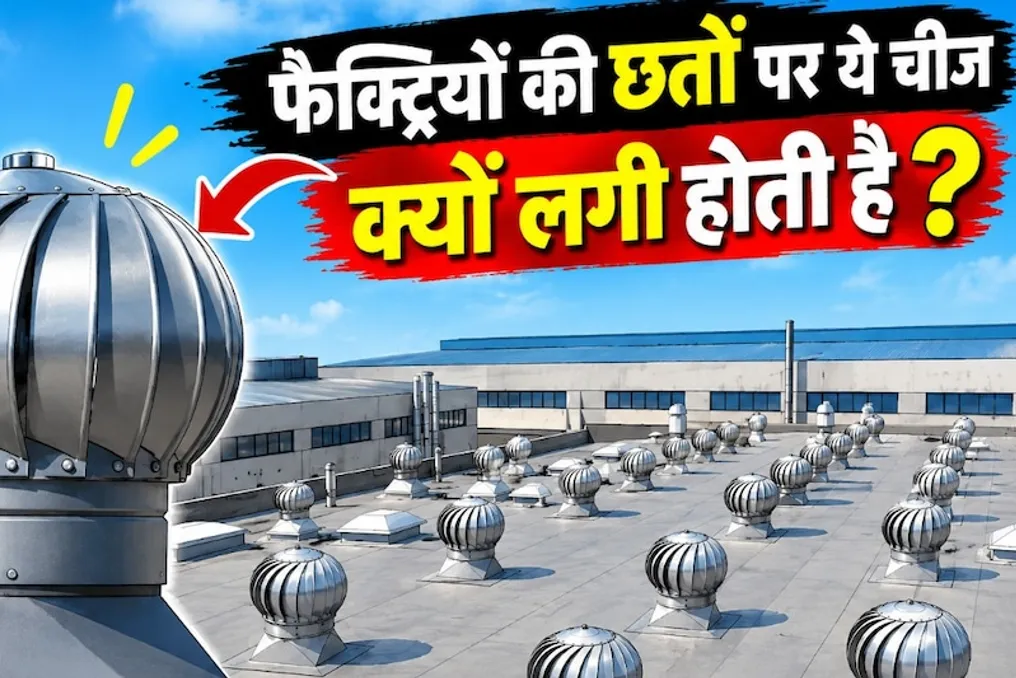
When looking at the roof of any large warehouse or factory, one can often notice a rotating metal object. Questions arise about its purpose: is it a fan, is an engine installed in it, and how can it rotate without being connected to the electrical grid?
In fact, this rotating element is called a turbo-fan or wind turbine fan. Its task is not to cool the premises like a regular fan, but to help expel hot and stagnant air from the workshop or warehouse.
The question of rotation mechanism without an electric motor is resolved by the fact that it is driven by the wind. The turbo-fan has curved blades. When external air moves, these blades capture the flow, and the entire fan begins to rotate. Thus, no electric switch is required for its operation; wind energy serves as its fuel. The stronger the wind, the faster the fan generally rotates.
The main work begins after rotation starts. Since machines and people operate inside factories and warehouses, heat is generated, which causes the air to heat up. Hot air, being lighter, rises upwards and accumulates near the roof. This is where the turbo-fan comes into play, helping to expel this heated air outside. When hot and stagnant air leaves the building, it creates an opportunity for fresh air to enter from the outside, which improves air circulation inside the building.
It is important to understand that a turbo-fan is not an air conditioner. Its function is not to cool the air, but to improve ventilation by removing hot and stagnant air. For this reason, such devices are installed on the roofs of large production facilities, warehouses, workshops, and other industrial buildings.
Another question concerns why water during rain does not fill the open fan. The design of such a fan is engineered to ensure air exit while minimizing the probability of direct rainwater ingress. The curved blades and upper frame help prevent direct water fall.
Next time you see such a rotating circle on the roof of a factory or warehouse, do not consider it just a strange mechanism. It is an integral part of the building's ventilation system that helps expel hot and stagnant air without using an electric motor, utilizing the power of the wind. Thus, this small rotating element has a very interesting and complex internal mechanism.