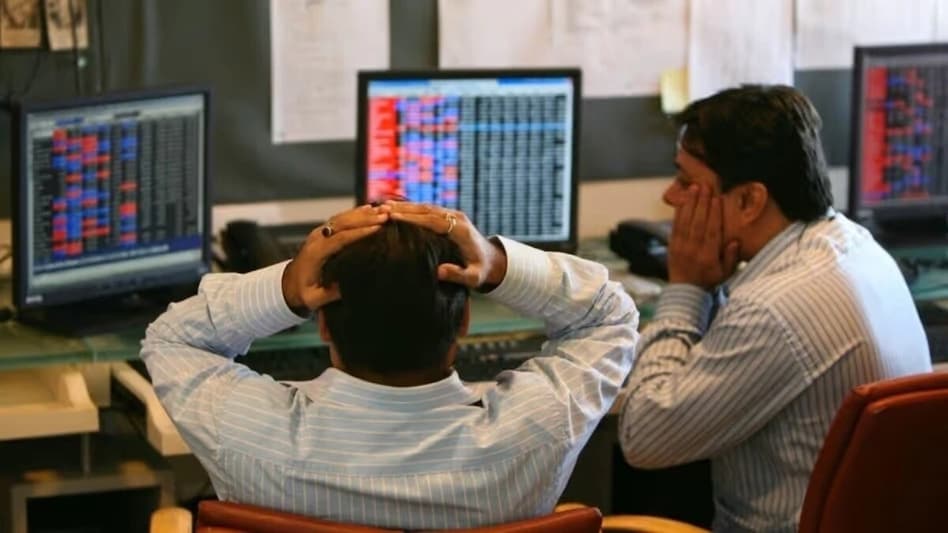
Indian stock market experiences crash: Sensex index falls by over 950 points
Read more
Aaj Tak
www.aajtak.in

Indian stock market experiences crash: Sensex index falls by over 950 points

The Indian stock market has once again faced a sharp decline. Although the Sensex and Nifty indices started with sluggish movement on the first trading day of October, the mood of both indices sharply deteriorated by noon, leading to their fall.

The Sensex index, which comprises 30 stocks from the Bombay Stock Exchange (BSE), lost more than 950 points. The Nifty index of the National Stock Exchange (NSE) also fell by 319 points. Among major companies such as Tata and Mahindra, there was a sharp drop in share prices, like cards in a deck.

Analyzing the decline shows that the BSE Sensex opened at 72,192, which was lower than the previous close of 72,480, and showed minor fluctuations for some time. However, around noon, the rate of decline of the BSE Sensex accelerated, and it plummeted to 71,527, representing a loss of over 950 points compared to the previous close.

The situation with the NSE Nifty was similar. This index of 50 stocks opened at 22,543, lower than the previous close of 22,620, and, following the example of the Sensex, dropped to 22,301.

During this market collapse, particular attention was drawn to the stocks that showed the largest decrease. In the Largecap category of the BSE, Maruti Share (down 4.45%), M&M Share (down 4.35%), Tata Steel Share (down 3.70%), ITC Share (down 2.90%), Adani Ports Share (down 2.74%), BEL Share (down 2.70%), Eternal Share (down 2.50%), and HUL Share (down 2.45%) saw significant drops.

In the Midcap segment of the BSE, Policy Bazar Share (down 6.50%), UPL Share (down 4.07%), Bharat Forge Share (down 3%), and AU Bank Share (down 2.80%) experienced declines. Additionally, in the Smallcap category, Sansera Share (down 6.80%) and One Source Share (down 5.50%) recorded significant decreases.

Similar stories

Indian stock market crash: Index falls by 1.58% due to foreign investor selling and rising oil prices
Read more
www.aajtak.in

Indian stock market crash: Index falls by 1.58% due to foreign investor selling and rising oil prices

The week proved extremely difficult for the Indian market. Following Monday, the Indian market experienced another sharp decline. During intraday trading, the BSE Sensex fell by 1,147.15 points, representing 1.58%, reaching 71,333.14, while the NSE Nifty50 decreased by 390.40 points or 1.73%, dropping to 22,230.05. Although some recovery was observed in subsequent trading hours, by the market close, the Sensex lost 570.59 points, settling at 71,909.70, and the Nifty declined by approximately 200 points to 22,421.

The strongest sell-off was recorded in small and mid-cap indices, which fell by more than 1%. Market volatility, measured by the India VIX index, increased by 13.82%, reaching the level of 15.36.

The total market capitalization of companies listed on the BSE decreased by approximately 10.08 lakh crore rupees, falling from 471.86 lakh crore rupees in the previous session to 461.77 lakh crore rupees due to a significant drop in stock prices. However, after the market closed, there was a slight recovery, and the total losses amounted to 6 lakh crore rupees, bringing the BSE capitalization to 466 lakh crore.

One of the factors contributing to the decline is active selling by foreign investors, who are withdrawing funds from the Indian market. These investors sold stocks worth over 10,148 crore rupees on September 30th. Over the last two trading days of September, foreign investors sold stocks worth over 20,000 crore rupees. In contrast, domestic institutional investors (DIIs) purchased stocks worth 11,271 crore rupees on Wednesday.

Another influencing factor was the rise in the yield of US 10-year bonds to 5.3%, making them more attractive for investment and prompting many investors to consider allocating funds to this segment.

Furthermore, the increase in crude oil prices put pressure on the market. Brent Crude futures prices for December delivery rose from $96.55 per barrel at 11:03 AM to a peak of $100.20 per barrel by 1:07 PM.

The Indian currency is also under constant pressure, falling below the 96 level against the dollar. In the latest check, the rupee reached its lowest level at 96.19 against the US dollar. The rupee's fall was caused by the continued withdrawal of funds by foreign funds and high crude oil prices, which were the main reasons for the market sell-off on Thursday.

Stock Market Crash: Over 700 Billion Rupees Lost Due to Crude Oil Price Hike and Trump's Decisions
Read more
www.aajtak.in

Stock Market Crash: Over 700 Billion Rupees Lost Due to Crude Oil Price Hike and Trump's Decisions

A massive crash is observed in the market, which began on the first day of the trading week. The sharp decline led to significant losses among investors; over 700 million crore rupees were lost in just a few minutes. Shares of major companies such as HDFC Bank, Bajaj Finance, Reliance, and ICICI Bank turned out to be extremely volatile.

The drop was quite substantial: the BSE Sensex index fell by more than 1040 points after opening, trading at 72,854. Meanwhile, the NSE Nifty decreased by more than 330 points or 1.38%, reaching the mark of 22,807. Analysis shows that the market capitalization of companies listed on the Bombay Stock Exchange (BSE MCap) decreased to 475,64,385 crore rupees, compared to 483,25,067 crore rupees recorded last Friday. Thus, after the market opened, investors incurred losses amounting to 7,60,682 crore rupees.

One of the key factors that triggered this crisis was the sharp rise in crude oil prices. On the international market, the price of Brent Crude Oil exceeded $107 per barrel, showing an increase of about 3%, while WTI Crude traded around $95. The rise in crude oil prices once again put investors under stress, as India depends on oil imports. The increase in oil costs threatens to raise the import bill and may lead to increased inflation on daily goods.

This jump in oil prices is directly linked to the actions of US President Donald Trump. Since relations between the US and Iran have not improved, Donald Trump has again rejected Iran's peace proposal. This undermined hopes for the opening of the Strait of Hormuz and the cessation of hostilities in the Middle East, causing a sudden surge in oil prices.

In addition to the rise in oil prices, other factors also influenced the market. The India Volatility Index (India VIX), which serves as a measure of market fear, suddenly jumped by 14.50% to the level of 14.14, signaling potentially strong fluctuations in the near future.

A third reason was the sharp weakening of the Indian currency. At the start of trading in the foreign exchange market, the Indian rupee fell by 20 points against the dollar, reaching the mark of 95.95.

Negative sentiment in the market was also contributed to by Foreign Institutional Investors (FIIs), who continued to withdraw funds from the Indian market. Last Friday, FIIs withdrew about 3700 crore rupees, putting pressure on the market.

The fifth factor contributing to the crash was negative signals from global markets. The world market is in a state of anxiety due to the sharp increase in crude oil prices. Chaos was also observed in Asian markets: South Korea's KOSPI fell by approximately 2%, and Japan's Nikkei traded in negative territory. Furthermore, the key indicator for Sensex-Nifty, Gift Nifty, showed a significant drop of 350 points.

Stock Market Crash: BSE and NSE Indices Plummet, Raising Questions About NSE IPO Debut
Read more
www.aajtak.in

Stock Market Crash: BSE and NSE Indices Plummet, Raising Questions About NSE IPO Debut

On Thursday, as the trading session began on the stock market, a crash occurred. Both market indices plummeted. The BSE Sensex index, comprising 30 stocks, fell by more than 700 points from the opening, while the NSE Nifty index, moving in sync with the Sensex, also sharply declined. NSE Nifty lost over 200 points immediately after opening.

Amid this crash, many stocks, including shares of Reliance, HDFC Bank, Axis Bank, and Indigo, were in the red zone. Particular attention was drawn to the NSE IPO, which is set to debut at 10 am amidst this market turmoil.

At the start of trading on Thursday, the BSE Sensex opened at 74,272, lower than the previous close of 74,828. During the entire five-minute trading period, the Sensex began a rapid decline, reaching 74,120 with a drop of over 700 points.

As for the Nifty index, which consists of 50 stocks, it followed the example of the Sensex. Nifty opened at 23,221, below the previous close of 23,446, and then continued to fall, trading at 23,205, losing more than 200 points.

In the context of the stock market crash, shares of companies such as Reliance and HDFC Bank opened in the negative. Among the most heavily falling stocks in the BSE large-cap segment were Bajaj Finance Share (down 5%), Axis Bank Share (down 3.70%), Bajaj Finserve Share (down 3.50%), and Kotak Bank Share (down 2%).

A decline was also observed in the mid-cap category: Policy Bazar Share (down 10%), MFSL Share (down 9.10%), AU Bank Share (down 5%), IDFC First Bank Share (down 3.30%), and Yes Bank Share (down 2.60%).

Despite the devastating events in the stock market, the NSE shares debut will take place. This situation has caused concern among investors. It should be noted that the NSE IPO, valued at ₹22,561.57 crore, was open from September 17 to 21 and received a positive response from investors. Nevertheless, in the 'grey money' market, this IPO signals a sluggish listing, as the NSE IPO GMP is only about 2% just before listing.

The reasons for the stock market decline are linked to deteriorating sentiment in American and Asian markets. In the previous trading day, the Dow Jones fell by 250 points. This was due to US Treasury yields on twenty-year bonds reaching a two-decade high. Furthermore, crude oil prices continue to rise in the international market, trading above $100.

Popular