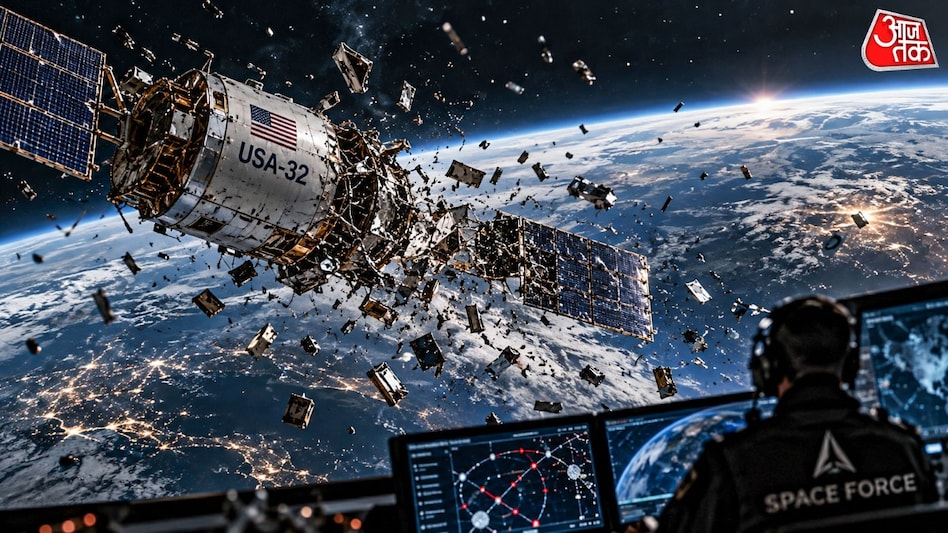
In September 2026, an old American reconnaissance satellite named USA-32 suddenly fragmented in space. The spacecraft, which was about 38 years old, was in low Earth orbit where many active satellites already circulate. US space forces confirmed the incident and began tracking the resulting debris. Although no direct threat to other spacecraft has been announced yet, this event once again highlights the risks associated with aging equipment.
USA-32 was launched on September 5, 1988, using a Titan-2 rocket. Its codename was Farah-3, and it served as a radio reconnaissance satellite for the National Intelligence Agency. During the Cold War, its task was to intercept Soviet radar and radio signals. Despite its service having long ended, it continued to orbit at an altitude of approximately 775 km.
On September 13, 2026, at approximately 21:13 UTC, the satellite suddenly fragmented. This was officially reported by Space Track and Space Force, and independent tracking groups also confirmed the debris breakup. Over several days, the fragments dispersed across a significant portion of the orbit.
The exact cause of the disintegration has not yet been determined. Experts suggest that the cause could have been a crack in the battery cell or in the pressurized tank after decades of heating and cooling cycles, or possibly a collision with small debris. Unlike modern satellites, where fuel and batteries are neutralized at the end of the mission, this requirement was not as strict in 1980s satellites.
Since the atmospheric drag is low at an altitude of 775 kilometers, the debris can remain in orbit for a long time. More than 200 active satellites, including communication systems, are located at this altitude. Space Force reported that the tracked debris is included in regular safety checks. Although there is no immediate danger, the risk of collisions increases in the long term. This case raises concerns similar to the Kessler syndrome, where one fragment can collide with another and create more debris.
This incident does not only concern one old satellite; thousands of inactive objects orbit the entire low Earth orbit. New large constellations, such as Starlink, have further congested the orbit, making the need to monitor and decommission old military satellites even more apparent. The main way to reduce this risk is continuous monitoring by Space Force and international cooperation. Scientists are constantly developing new technologies to detect small debris, but the problem remains unsolved.
Parallel to this, another piece of news emerged in online discussions: reports surfaced about contacts with NASA engineers who worked on old SR-71 Blackbirds. NASA administrator Gerard Isaacman recently stated his intention to strengthen the X-Plane program, mentioning high-altitude and high-speed flights. There were also reports of one Blackbird being moved into a hangar taken out of operational base. The Blackbird was an aircraft capable of flying faster than 3704 km/h and was used by NASA for research in the 1990s; its last flight took place in 1999. An attempt to relaunch it is considered part of efforts to restore X-Plane expertise amid supply chain issues and specialist aging.
Some observers link the satellite incident and the discussion about the Blackbird, but both situations belong to different timeframes and contexts. The satellite disintegration demonstrates the risks of outdated technology, while the Blackbird discussion reflects the drive to develop new high-speed capabilities. Both events highlight two different problems in the aerospace industry: managing old debris and maintaining future technological capabilities. Incidents like USA-32 remind us of the need to tighten rules for maintaining orbital cleanliness, while attempts to reactivate a classic platform like the Blackbird show how difficult it is to recover lost capabilities. Experts believe that risks in future satellites can be reduced by using new materials, improved batteries, and decommissioning processes.