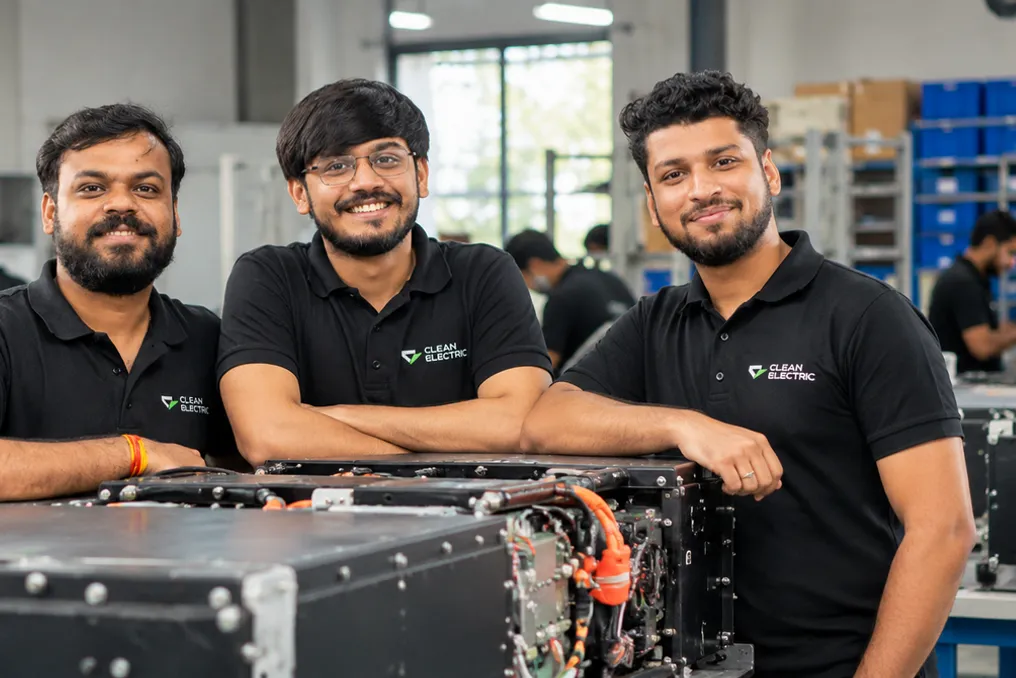
In 2020, in a dusty workshop in Bhopal, three friends—Akash Gupta, Abhinav Roy, and Ankit Joshi—were trying to create an electric truck for last-mile delivery. However, as they worked on the truck, a problem emerged that overshadowed all other aspects. Commercial transport generates income while moving; a diesel truck can refuel in minutes, whereas an electric one might require an hour or more to charge. Furthermore, there were concerns about range, battery lifespan, and safety. All these questions boiled down to one component.
Akash recalls asking himself, 'If refueling takes 10–15 minutes, why does the truck charging take one or two hours?' Initially, they handled most of the work themselves: Ankit managed all the wiring, Abhinav wrote the code, and Akash performed the welding of the first prototypes.
When seven more people joined them, they moved into a basement and painted the floor to make the workspace cleaner. By then, it was clear that for a practical truck, they needed a battery capable of fast charging, lasting for years, and remaining safe without making the vehicle too expensive. Therefore, they stopped trying to build the entire truck and focused on what they considered the most difficult problem within it.
It started with racing cars built in college
The decision to collaborate in 2020 was the result of years of reflection. Akash and Abhinav met at IIT-BHU in 2013, where Akash headed the automotive club and Abhinav led aerospace modeling. Their extracurricular time was dedicated to racing cars, drones, and remote-controlled airplanes.
Akash notes, 'We built many racing cars in college, and that's where we started working hands-on. That's how we became interested in creating products and kind of addicted to it.' Later, Ankit joined them, another automotive enthusiast with experience in electric powertrain technologies. Although they had already conceived of starting a company in college, they understood that hardware business required more than just enthusiasm. After graduation, they spent several years studying elsewhere.
Akash worked at JSW Group on an electric vehicle project, gaining experience in the EV business. Abhinav worked in robotics and automotive technology. Ankit continued his studies before deciding that product creation interested him more than pursuing a PhD. By 2020, their paths crossed again. Akash's EV project at JSW was paused, and the pandemic interrupted some of the research Abhinav was involved in. The three decided to return to the idea they carried from college, but this time full-time.
These years of experience also clarified one gap. Akash explains, 'You can buy a good engine, you can buy a good dashboard, but you cannot buy a battery pack. That realization came in 2020. We thought that instead of building a complete truck, let's focus only on the battery.'
The problem was not finding the cells themselves, but assembling them into a battery pack that could provide the driver with sufficient range, fast charging, safety, and function for years. The first goal was charging speed. They started with a target of around 30 minutes, hoping eventually to reach 15 minutes. After several months of experimentation, they achieved this figure in the lab.
Akash says, 'It was a 15-minute charge, but those were lab results. Then you need to turn it into a product. If a 15-minute battery is heavier, people won't buy it. Range, fast charging, safety, and cost must work together.'
The attempt to achieve all four parameters simultaneously led them to another problem: the faster the battery charges, the more carefully its heat needs to be managed.
How do you keep a fast-charging battery cool?
A battery pack consists of many smaller cells. If one cell overheats significantly, that heat can spread to neighboring cells and, in the worst case, trigger a chain reaction. The team chose an immersion cooling method to manage this process. Battery cells are placed in a special liquid that does not conduct electricity but is capable of absorbing and dissipating heat.
Abhinav explains, 'If you have a good cooling system, you can charge the battery faster while maintaining sufficient coolness. This also contributes to safety. If something goes wrong in one cell, you want to cool it down quickly so the problem remains localized and doesn't spread to the next cell.'
Choosing immersion cooling was just the beginning. Akash notes, 'What we were doing was unconventional. We submerged the batteries in coolant for better thermal management. But this also has its complexities: increased weight, rising cost, and increased leaks.'
This liquid had to remain inside the battery for years, even though wires and electrical connections still had to pass through the casing. Abhinav recounts that the team had to develop custom connectors to exit these connections while maintaining the battery's hermetic seal.
Creating five or ten prototypes was one thing. It was much harder to make every unit coming off the production line equally reliable. Abhinav says, 'Ensuring sealing stability was a problem. In the lab, engineers perform the sealing themselves. Then, this process needs to be transferred to the production line, where someone else can manufacture the sealed unit.'
Cooling was not enough. Individual cells within the battery can behave slightly differently. One might heat up faster, store slightly less energy, or age differently than another. If these differences accumulate over time, one weaker cell can start affecting the performance of the entire pack. Clean Electric therefore began to select and match cells more meticulously and developed its own Battery Management System (BMS) to track what was happening inside.
Clean Electric's 0Kelvin technology combines immersion cooling with software that analyzes data such as temperature, voltage, and current during battery use or charging. The system can regulate the charging speed as conditions change, rather than waiting for the battery to become too hot. Clean Electric calls this intelligent temperature modulation.
The company also created the Hive platform, which collects data from batteries already operating in the field. This information is used to monitor battery health, diagnose issues, and understand how the packs perform over time. Its SONIC charging system follows the same approach: the battery and charger are designed to work together, rather than treating charging as a separate stage.
Thus, the task ceased to be merely achieving 15 minutes in the lab. The battery had to repeat this performance safely across different vehicles, climatic conditions, and over many years of operation. The road quickly showed the team how complex this could be.
For example, in colder regions, water sometimes separated from the coolant and interfered with the electronics inside the pack. Abhinav notes, 'It was an intermittent issue. It happened sometimes and not at other times. So, first you need to recreate the problem, find the root cause, and then figure out how to solve it.'
Can the battery survive an autorickshaw's working day?
This question became even more critical when batteries started being installed in commercial three-wheeled vehicles. The electric auto-rickshaw in India is often a source of daily income. Its battery may undergo a much more demanding regime than a battery in a private car.
Abhinav says, 'In India, especially in the three-wheeler segment, these vehicles can cover about 200 kilometers every day. The range is also usually around 200 kilometers, so they can use one full charge daily. We also install smaller batteries to keep the product affordable.'
This means the same battery can be charged, used throughout the workday, and recharged again, day after day. For the driver, battery life and charging time are more than just brochure specifications. Early replacement is a major expense. An hour spent charging is an hour the vehicle cannot carry passengers or earn money.
Years of daily use provide the team with data that short laboratory tests could never give. Abhinav reports that some early vehicles have covered about 70,000–80,000 km, and their batteries showed approximately four percent degradation. He adds, 'The degradation rates were slightly better than we expected.'
Safety was tested under far less controlled conditions. Abhinav recalls an instance where an auto-rickshaw was charged using what he describes as improvised wiring. According to him, the failure did not start in the battery itself: the charger caught fire, and the flames eventually spread to the vehicle. 'The whole car burned down. The battery remained intact. The connectors melted, but the battery itself remained undamaged. Some plastic parts could be replaced, and the battery reused.'
The incident damaged components around the pack, but the failure did not spread to the battery cells themselves. For Abhinav, this was important because it demonstrated how the battery behaves in such an uncontrolled state, which is difficult to fully replicate in a lab. He concludes, 'It was good confirmation that what we built truly withstands real-world loads.'
From 3 batteries to thousands of kilometers
Clean Electric's first order outside the lab was quite modest. In 2021, Bounce Infinity ordered three battery packs. Around the same time, reports of e-scooter fires caused growing concern among Indian EV buyers regarding battery safety.
Akash says, 'Safety allowed us to get a foothold. Cycle life requires years of data to confirm, but safety is something that can be tested much earlier.'
Over time, vehicle manufacturers added another dimension. Omega Seiki Mobility reported testing Clean Electric batteries for the first time at its plant in Pune, and then in vehicles, gradually increasing volumes as their performance remained satisfactory. OSM states, 'The battery enables offering with a larger range, approximately 230–250 km of actual road range. This supports customers who prefer long continuous operation and do not want frequent charging during the day.'
The company continues to strive for improvements, including further work on the electrical architecture and BMS. Baxy, another manufacturer using these packs, states that their vehicles equipped with Clean Electric batteries have traveled approximately 30,000–48,000 km without customer complaints about degradation. The company adds, 'We have not observed functional or operational hazards with the packs,' and received 'field service, training, and support' from Clean Electric.
This feedback feeds back into the same process that started in Bhopal: build something, see how it performs when people start using it, and return to engineering. Abhinav says, 'Some key decisions must be right because you will live with them for a long time. But many small decisions are reversible. You can choose an answer, test it, and if it's wrong, go back and change it. You learn from practice and continue iterating.'
The dusty workshop in Bhopal has since been replaced by a larger facility in Pune. Clean Electric reports that over 6,000 of its batteries have been deployed in more than 100 locations, collectively covering over 20 million kilometers. Nevertheless, the bigger problem remains the same. For an electric vehicle to be a practical alternative at scale, its battery must charge quickly without creating new safety risks, withstand years of reuse, provide sufficient range, and remain affordable.