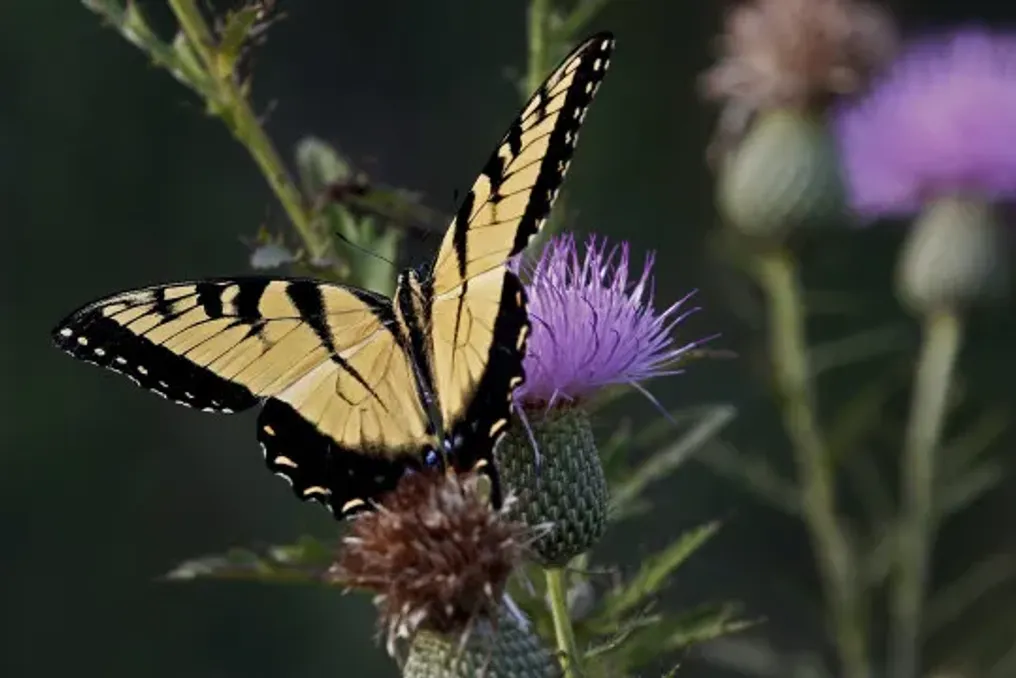
Research conducted by the British universities of Exeter and Essex, whose findings were published in the journal Nature, demonstrated that butterflies utilize powerful optical illusions to avoid being captured by predators.
Scientists discovered that despite possessing striking patterns that make them visible, few species of predators can capture them while they are flying. In contrast, moths are hunted by a wide range of predators that rely heavily on vision.
George Hancock, from the Centre for Ecology and Conservation at the University of Exeter, explained that the stripes and spots present on the wings of many butterflies interfere with how visual systems attempt to determine the direction and speed of moving objects. This generates false displacement signals while simultaneously masking the insect's actual trajectory.
These illusions affect the predator's fundamental visual focus system and destabilize the final moment of the 'ballistic attack,' which lasts only a few tens of milliseconds, when the predator commits to attacking and loses the ability to change course.
Consequently, the researcher observed that birds and other predators frequently miss their strike.
The mechanism behind this phenomenon is comparable to the 'barber pole illusion,' that structure with colored stripes (red, blue, and white) in front of beauty salons, where the lines appear to move vertically, even though the pole is only rotating on its own axis.
Jolyon Troscianko, also from the University of Exeter, detailed that butterfly wings undergo deformations during flight: they collide during ascent and separate during descent. This change in the angle of the stripes causes them to point in different directions as the wings beat.
He added that, combined with unpredictable flight paths, this configuration creates deceptive motion illusions, analogous to those of the barber pole. This leads the predator to completely miss the target or hit a less vital area of the wing, such as the tail or hindwing.
To reach their conclusions, the researchers employed various methodologies, including computational simulations and the use of high-speed cameras capable of recording real butterflies flying at over 1,000 frames per second, simulating bird vision.
The simulations showed that certain characteristics, such as high-contrast vertical stripes, singular bands, and tails on the hindwings, were correlated with an increase in visual confusion.
Troscianko concluded that the study presents an unprecedented approach to analyzing motion vision and believes that this type of visual confusion is much more common in nature than previously imagined, spanning from bird wingbeats to the rapid movements of reptile and fish tails, opening up a new and interesting area of research.