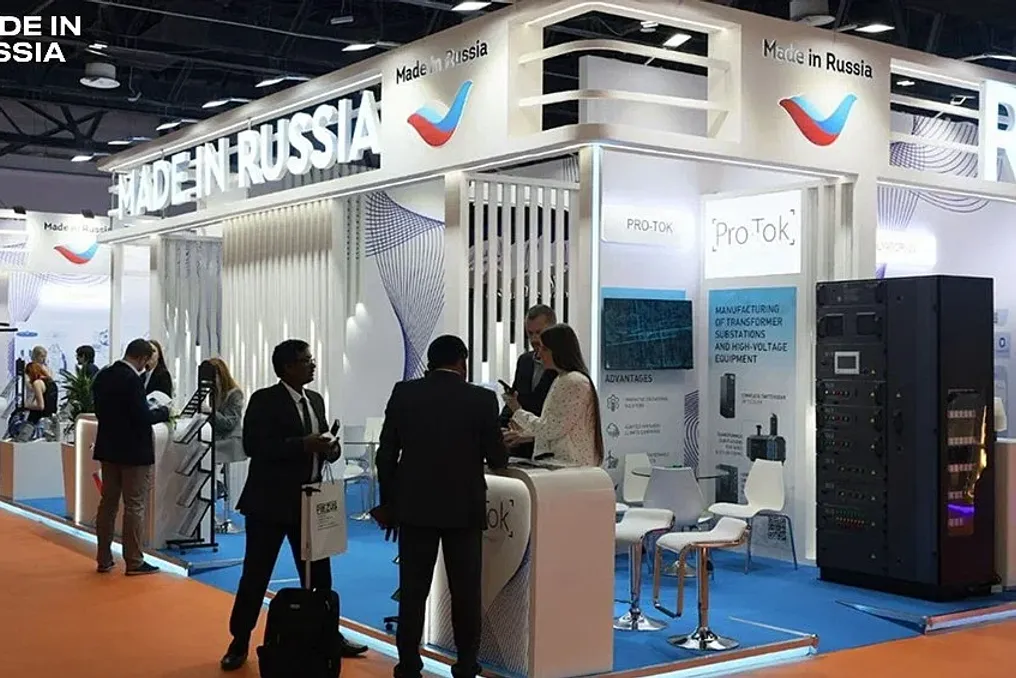
The Wetex 2026 exhibition will once again take place in Dubai and will be one of the largest global platforms dedicated to ecology, energy, and water supply issues. The event is scheduled for October 20 to 22 at the Dubai World Trade Centre. The national brand pavilion Made in Russia will participate again, presenting more than twenty Russian companies.
Most goods from these companies have official Made in Russia certification, which serves as a guarantee for buyers in the UAE and the Middle East that the product has undergone strict quality inspection. The Made in Russia program helps Russian producers enter foreign markets by requiring participants to assess production, control quality, and comply with environmental standards. Obtaining this certificate is a significant first step toward international trade for many small and medium-sized Russian exporters, as it gives foreign partners a basis to trust a company they have not previously collaborated with.
Wetex has established itself as one of the key platforms for this program in the Persian Gulf region. At last year's Wetex 2025, the Made in Russia pavilion brought together 30 companies operating in the fields of clean energy, water purification, waste recycling, and sustainable agriculture. The exhibition was divided into four sectors: energy, water treatment, waste management and recycling, and agriculture and infrastructure. The Made in Russia organizers emphasize that at Wetex, Russian companies are not just demonstrating products but also forming long-term partnerships.
This year, the pavilion returns with a similar range of technologies, and among the exhibition participants is the Russian company Ecopak, presenting an organic soil product called Peatgel. Ecopak's product solves problems familiar to every city in a hot climate. Urban trees and green areas face constant pressure: compacted, poor soil from construction and paving; heavy metals and chemicals from road traffic; exhaust fumes that weaken immunity and photosynthesis; extreme summer heat and sharp winter temperature fluctuations; asphalt that hinders natural watering; chemical runoff that disrupts soil pH balance, as well as the high cost of replacing trees that do not survive.
Furthermore, cities with many palms and tropical plants common in the UAE, Saudi Arabia, Egypt, India, and Southeast Asia face the problem of tons of fallen palm leaves, which are usually sent to landfills instead of being utilized. Peatgel is designed to solve several such problems simultaneously. It is a liquid concentrate made from peat, a lowland peat—a natural raw material rich in humic compounds. The product is produced using patented technology that preserves the natural structure of peat in an aqueous suspension.
It contains humic and fulvic acids, which promote root growth and soil restoration, as well as nitrogen, phosphorus, potassium, iron, magnesium, copper, and zinc in a form easily absorbed by plants, plus amino acids that act as natural plant protection against stress. Since it acts simultaneously on the soil, the root system, and the visible part of the plant, it works in two directions: restoring the growing environment and strengthening the plant itself.
There is also the aspect of the circular economy, which aligns well with a region like the UAE. Because Peatgel accelerates humification, it can transform waste from palm and tropical leaves, which are currently viewed primarily as a disposal problem, into a resource for soil restoration. For a country managing large volumes of palm waste annually, this is a practical way to close the loop between green waste and soil health.
Ecopak already exports its products abroad, supplying them to Uzbekistan, Kyrgyzstan, Armenia, and Vietnam. The UAE is the next target market for the company, and over the next year, it plans further expansion into the Middle East and Southeast Asia, including Vietnam, Malaysia, and Dubai. It is important to note that Peatgel already has the Made in Russia certificate, as well as an internal conformity certificate, environmental safety documentation, and a product safety data sheet. This means that the company is presenting at Wetex a product whose production, quality, and environmental impact have already been tested and confirmed by independent certification bodies, a process that typically covers all stages—from sourcing raw materials to the final formulation and its impact on soil, people, animals, and insects.
For landscape design contractors in the UAE, municipal green space managers, and agricultural enterprises seeking solutions to similar problems, the Made in Russia stand at Wetex 2026 will be a place to start such a dialogue. Exhibition visitors will be able to meet the Ecopak team in person and see how Russian peat-based technology, backed by the trust of the national brand Made in Russia, is adapted for one of the world's most challenging growing environments.