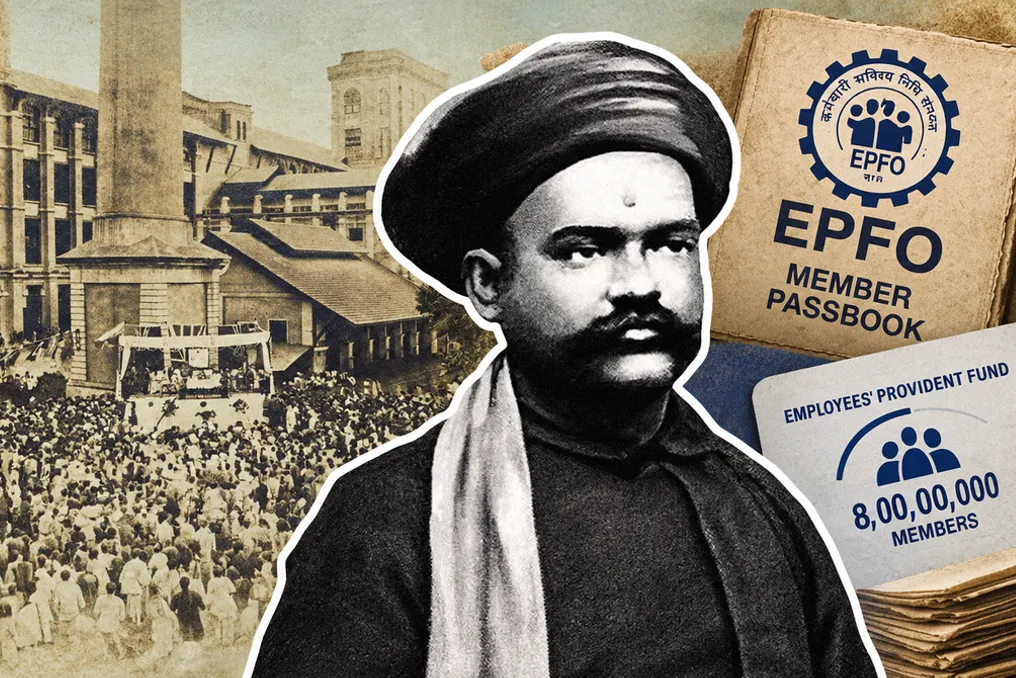
In April 1890, over ten thousand workers from textile factories gathered at the Race Course stadium in Mahalaxmi, Bombay, to demand a weekly day off—something many Indians consider commonplace today. The organizer of this gathering, Narayan Meghaji Lokhande, who previously worked in a factory store, spoke after the factory owners decided to close the establishments two days a week. Many female workers were also among those present.
The factory owners agreed to provide a Sunday off on June 10, 1890, and in the same year, the Government of India included Lokhande in its Factory Labour Commission as a member.
Lokhande, born in 1848 in Thane, initially worked in the railway and postal services before starting as a storekeeper at Mandavi Textile Mills in 1870. His factory experience exposed him to long working hours and terrible living conditions, which prompted him to organize workers into an association to advocate for their rights.
How a day off turned into a pension issue
Lokhande's campaign was initially about rest, not retirement, but it sparked a long discussion about the responsibilities employers and the state bear towards people working in Indian factories, and this debate developed slowly.
The first Pension Fund Act appeared in 1925, but it regulated funds only for some private enterprises, so its impact remained limited. In 1929, the Royal Commission on Labour emphasized the need to create pension funds for industrial workers, and the Indian Labour Conference in 1948 agreed that a legislative scheme could be introduced for industrial workers.
To test this idea on a limited scale, the government launched the Coal Mines Pension Fund Scheme in 1948. The success of this scheme led to demands for its expansion to other sectors, and the Provincial Labour Ministers' Conference in January 1951 largely supported the proposed legislation for this purpose, paving the way for a national law.
A decree reaching the factories
The Government of India issued the Workers' Funds Ordinance on November 15, 1951, and the Workers' Funds Act replaced it on March 4, 1952. The scheme then began to operate in phases, and by November 1, 1952, it covered six industries: cement, cigarettes, engineering products, iron and steel, paper, and textiles. Thus, the textile workers organized by Lokhande in Bombay became among the first to receive coverage, concluding the factory story.
The administration of the Act and its schemes is carried out by a tripartite Central Trust Board, involving representatives from the central and state governments, employers, and workers. The Board manages the provident fund, pension scheme, and insurance scheme for workers in the organized sector, while the Ministry of Labour and Employment exercises administrative control over the organization.
How the safety net expanded
In subsequent decades, the safety net expanded: the Employees' Deposit Insurance Scheme of 1976 began paying benefits in case of a member's death, and the Employees' Pension Scheme of 1995 replaced the Employees' Family Pension Scheme of 1971 and started paying monthly pensions upon reaching retirement age, disability, or death of the member.
On the official EPFO website, this structure is described as one of the largest organizations in the world by number of clients and volume of financial transactions. Currently, the scheme meets the daily needs of the worker as well as their needs in old age. Members receive their savings plus interest upon retirement, resignation, or death, and can also make partial withdrawals for housing construction, higher education, weddings, or medical treatment.
The Act applies to 187 classes of establishments, and any such establishment employing more than 19 people automatically falls under its purview. Latest data shows how far this idea has progressed: according to a Business Standard report from September 22, 2026, EPFO has about 7.98 crore contributing members, its pension scheme serves about 82 lakh pensioners, and it manages pension accumulations worth over 25 lakh crore rupees.
More than 130 years separate Race Course stadium from today's EPFO offices, yet both are based on a demand made by Lokhande's crowd to the Bombay factory owners: that labor deserves protection beyond wages. The day off gave workers time to recover, and the pension and insurance fund schemes now provide millions of Indians with a degree of security after the end of their careers. No law traces directly back to Mahalaxmi, but the demands voiced there reinforced the expectation that employers and the state share responsibility for the future of workers.