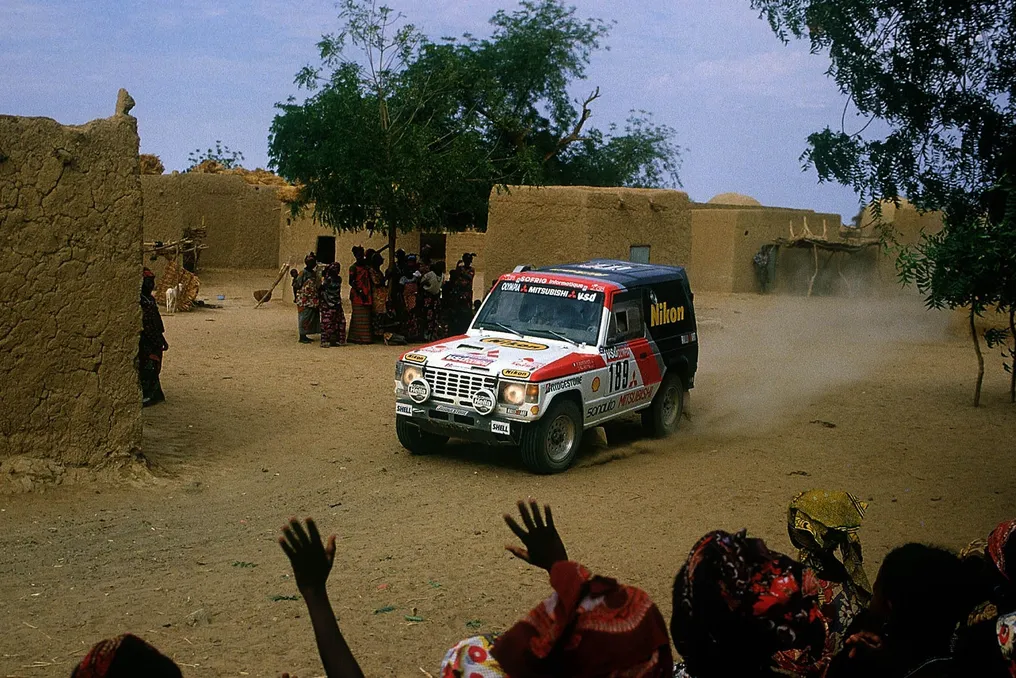
The Mitsubishi Pajero holds a unique and perhaps privileged place in the public consciousness. For those unfamiliar with cars or who do not pay much attention to them, the Pajero is simply a spacious, comfortable, possibly even 'luxurious' SUV in the broad sense of the word. However, for car enthusiasts, the Pajero is a true legend and one of the few sports wagons to receive the Enthusiast Vehicle™ badge.
It represents a classic, an icon of off-road driving, a favorite of overlanding enthusiasts, and one of the most successful four-wheeled projects in the world of motorsports. This refers to a very specific form of motorsport—rally raids, or long-distance rallies, specifically the Dakar Rally.
It might seem strange to an outsider that this imposing and equipped SUV has such a huge tradition in one of the world's most difficult competitions. Nevertheless, for those who appreciate the true essence of the Pajero, it is completely natural. Although Mitsubishi retained very few original elements when transforming the Pajero into a Dakar winner. Moreover, when the Pajero won its first victory in 1985—exactly 41 years ago—it was an even more 'authentic' jeep.
It is interesting how the perception of the Pajero changes depending on the observer. In an urban environment, the name Pajero (or Pajero Full for purists) is associated with a brutal yet sophisticated wagon with a leather interior, a complex all-wheel-drive system, and an imposing appearance. But its reputation among enthusiasts was formed not in shopping malls or outside schools, but under the scorching sun of the Sahara Desert, cutting through dunes at speeds exceeding 180 km/h. It embodies the golden age of Japanese engineering in the 1980s and 1990s—a time when it was not enough for Japanese manufacturers to compete in the West; they aimed for the pinnacle of global motorsport in the most extreme categories.
The Beginning
Mitsubishi's connection with all-wheel-drive wagons did not happen by chance, but due to the need for post-war recovery. In 1953, the Japanese factory entered into a licensing agreement with Willys-Overland to produce the legendary Jeep CJ-3B in Japan. This brave and ascetic 4x4, known as the Mitsubishi Jeep (J3 and its variants), performed brilliantly in its task, serving the armed forces, forestry industry, and civil recovery for decades.
However, as the 1970s approached, the global automotive landscape began to change. The 4x4 wagon ceased to be exclusively a work tool for agriculture and the military, transforming into a leisure item. Pioneers like the Ford Bronco, Toyota Land Cruiser FJ40, and Range Rover demonstrated that there was an audience eager to explore nature, but one that was simultaneously beginning to demand a civilized level of comfort. Mitsubishi realized that relying on the archaic Jeep architecture with solid axles and leaf springs would not secure its future—they needed their own project, developed from scratch.
It was in 1973, at the Tokyo Motor Show, that Mitsubishi presented the first concept named Pajero. It was a design project still searching for itself, fully inspired by the original Jeep. The name 'Pajero' was found in zoology: it comes from Leopardus pajeros, the pampean cat, a predator inhabiting South America, known for its agility, strength, resilience, and ability to live in harsh conditions. (Interestingly, in Spanish-speaking countries, the word was named Montero due to its semantic meaning, and in the UK, Shogun).
Six years later, at the 1979 Tokyo show, the brand presented the Pajero II Concept. This was no longer a vague idea of an open wagon, but effectively corresponded to a production vehicle. With a closed body, a removable targa roof, and clear proportions, the Pajero II showed that Mitsubishi was ready to challenge competitors with a truly modern wagon.
1982: Pajero Appears to the World
When the production Mitsubishi Pajero arrived at Japanese dealerships in May 1982—initially only in a short chassis configuration (three-door) with a steel or canvas roof—it caused a sensation in the SUV segment. Before this, there was an unofficial rule in the 4x4 world: if you wanted a vehicle capable of driving through mud, clay, and rocks without breaking down, you had to accept that it would bounce like a kid on asphalt.
The Pajero proved that this was not necessarily the case. The great revolution of Japanese engineering lay in the introduction of independent front suspension with overlaid triangular wishbones and torsion bars to the new wagon. At that time, solid front axles were an undeniable religion for Toyota, Nissan, and Land Rover, so Mitsubishi's independent solution was initially met with skepticism from conservative jeep enthusiasts who feared fragility. However, it soon became clear that the Pajero's design was not only robust enough for rough trails but also capable of providing precise and pleasant dynamic behavior on the road and highway—while competitors forced you to fight the steering wheel at 100 km/h, the Pajero felt like... a normal car.
The interior also accompanied this civilized revolution. Mitsubishi installed shock-absorbing seats to reduce shaking, improved sound insulation (improving the famous noise, vibration, and harshness rating), and included unheard-of luxuries for the old guard, such as progressive power steering and a genuinely air-conditioned climate control.
Furthermore, there were important innovations under the hood, notably the Astron family gasoline engine, a 2.6-liter four-cylinder 4G54. However, the most significant innovation was the introduction of the 2.3L (4D55) turbocharged diesel engine, making the Pajero the first Japanese passenger 4x4 supplied with such an engine type from the factory. Commercial success was immediate. Nevertheless, more than selling cars, Mitsubishi wanted to create an aura of invincibility around the Pajero. And for this, there was the perfect place: the African desert.
Baptism in the Sand
The decision to participate in the Paris-Dakar Rally was immediate, almost spontaneous. In January 1983, just a few months after the start of worldwide sales, Mitsubishi displayed the new Pajero in Paris. The goal was clear: to prove that independent suspension and the new powertrain were not just 'asphalt novelties,' but an indestructible mechanical complex.
Instead of immediately entering the modified prototype category, they were clever and registered the vehicles in the Marathon class, intended for practically unmodified series cars, using the 'win on Sunday, sell on Monday' strategy. Trusting experienced Andrew Cowan and Colin Malkin, the vehicles were mechanically identical to what customers could buy—which significantly increased the prestige of the successful performance. Cowan's Pajero conquered the dunes, winning the Marathon class for series cars and finishing in a respectable 11th place overall, leaving many much more specialized prototypes literally in the dust. The reliability of the basic design was proven.
With great enthusiasm and awareness of the car's potential, Mitsubishi felt it could compete for the overall title. For the 1984 season, the brand raised the stakes and moved to the Modified class—as the name suggests, for modified cars. Thanks to greater freedom in the regulations, engines received larger turbos, and the body began to be lightened.
The result of 1984 was almost incredible. Andrew Cowan brought the modified Pajero to 3rd place in the absolute overall standings. To illustrate the scale of this achievement, the Pajero was only surpassed by the Range Rover with a V8 engine driven by Frenchman Patrick Zaniroli (2nd place), and the legendary Porsche 953 (1st place)—a factory Porsche 911 AWD that served as a laboratory for the powerful 959, driven by René Metge and Jackie Ickx.
Seeing the Mitsubishi jeep approaching Stuttgart's engineering perfection, the Japanese factory realized that the Dakar crown was within reach. The car was exceptional; it just lacked a ruthless mechanical approach that allowed no compromises. The plan for the following year began to take shape.
Preparation
Mitsubishi prepared for the 1985 season with full determination. The square silhouette of the Pajero was maintained, but beneath the outwardly untouched body lay preparation worthy of Le Mans prototypes, with a single goal—to destroy the competition. This began with hiring none other than Patrick Zaniroli, who had nearly beaten them last year, to drive the Pajero alongside Cowan.
The first order concerned a strict diet. Almost all original steel panels were removed, and the body was rebuilt using composite materials reinforced with carbon fiber and Kevlar. Combined with aerospace plastic windows and an interior reduced to an absolute minimum for human survival, the weight of the structure dropped sharply by 200 kg compared to the 1984 model.
Under the composite hood, the 4G54 (2.6L, SOHC) engine also received a powerful 'anabolic' boost. Engineers installed a high-volume intercooler and a massive Mitsubishi TD06-17C turbocharger (a turbine so effective that it gained cult status in the 90s, powering American GMC Syclone and Typhoon). The output rose from the civilized 145 hp version for roads to a powerful 222 hp. But more important than peak power was handling: the team added a pressure relief valve to the system—during constant downshifting in the five-speed manual gearbox in the dunes, this valve released excess pressure back into the intake, preventing so-called compressor surge and keeping the turbo constantly saturated, guaranteeing almost instantaneous torque for pulling the car out of deep sand.
The chassis geometry was also radically changed: an extended front driveshaft shifted the front axle forward. Increasing the wheelbase slightly sacrificed the attack angle but provided the necessary directional stability: thanks to the new, longer rear differential, the jeep could now achieve terrifying 185 km/h on desert plains with much greater stability.
To maintain traction and not break under such loads, the original rear suspension with leaf springs was eliminated, and Mitsubishi installed a rigid three-link axle, coil springs with long travel, and Bilstein racing dampers, with side-to-side roll control provided by a Panhard rod. High-strength restraint straps were added to prevent the springs from literally flying out during dune jumps.
Completing the survival kit, the trunk was replaced with a massive 320-liter fireproof fuel cell, surrounded by two spare wheels and tools to allow the driver and navigator to repair the car during a sandstorm, if necessary.
1985: Consecration in the Desert
The seventh edition of the Paris-Dakar Rally started on January 1, 1985. Unlike previous years when the start was at Place de la Concorde, the caravan departed from Versailles under the gaze of tens of thousands of spectators, and the preliminary program in the vicinity of Paris attracted over 70,000 people.
The scale of the event was unprecedented: there were 552 participants, 362 of which were in the car category. The route covered 10,284 kilometers over 22 days, crossing seven countries and including 7,487 km of sand.