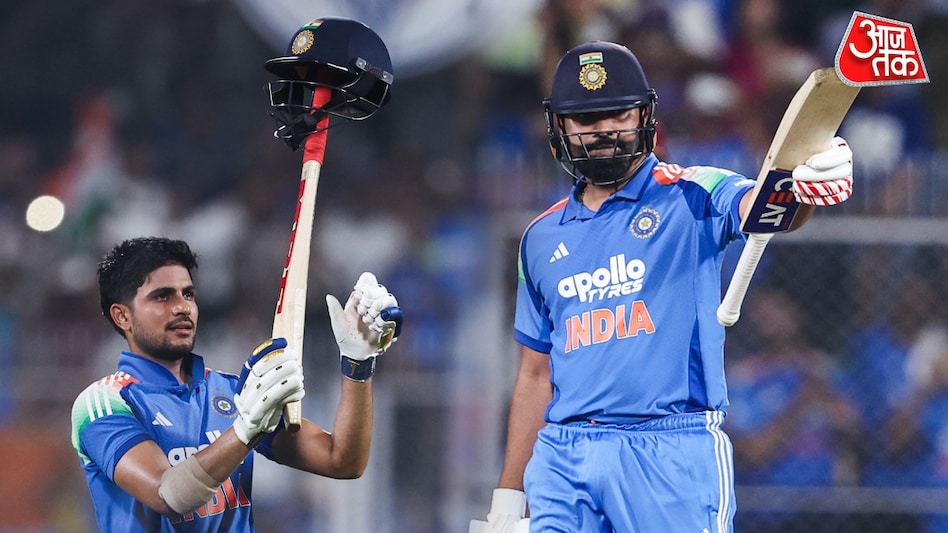
Records were broken in Guwahati: the target of 406 runs was surpassed, and India secured an unassailable 2-0 lead in the series. Although West Indies managed to score an impressive 405/7 on Wednesday (September 30), Shubman Gill's and Rohit Sharma's batting made this target insignificant. India won the match by scoring 406/2 in just 43.3 overs, ensuring a confident lead in the three-match series.
Captain Shubman Gill demonstrated incredible play that entered the ODI record books. He reached a double century off 117 balls, marking the fastest double century in 50-over cricket. In his innings, Gill scored 133 runs, hitting 26 fours and 8 sixes.
This achievement allowed Gill to surpass Ishan Kishan's record, who had previously scored a double century off 126 balls in ODIs. Furthermore, it was Gill's 11th century in ODIs, which he achieved in just 62 balls, making it the fastest century in ODI format.
At the other end of the pitch, Rohit Sharma played in his usual style. He scored 101 runs off 75 balls, utilizing powerful drives down the ground and pick-up shots. During this innings, Rohit also crossed the 12,000-run mark in ODIs, becoming the seventh player globally to reach this milestone and the third Indian after Sachin Tendulkar and Virat Kohli.
The start of the match was very strong: Gill and Rohit attacked the West Indies bowlers, and India scored 100 runs in just 12 overs. Gill completed his half-century in 38 balls, and Rohit in 32 balls.
By the 22nd over, India's score without loss stood at 200 runs. In the chase of over 350 runs, this was the first instance in ODIs where the opening pair scored 200 runs. Both players contributed 255 runs to the team for the first wicket. This partnership was broken after 26.2 overs when Rohit was dismissed after scoring 101 runs. At that point, India needed 151 more runs with 24 overs remaining. Gill continued to play aggressively and led the team to victory.
Prior to this, West Indies created a real storm, scoring 405/7, exposing the weakness of the Indian attacking pace. John Campbell scored 101 runs off 68 balls, Shay Hope scored 104 off 94 balls, and Amir Jangu scored 114 off 77 balls. Campbell reached a century in just 65 balls, displaying an aggressive style similar to Chris Gayle, including 9 fours and 5 sixes.
Hope, who was caught early by Virat Kohli, managed to stabilize the innings and then started scoring runs, hitting 8 fours and 3 sixes. Jangu achieved his second ODI century in just 69 balls, hitting 13 fours and 3 sixes. Thus, West Indies recorded three centuries in ODIs for the first time and surpassed their previous best score of 389 runs.
However, the Indian bowlers faced questions. In the absence of Jasprit Bumrah and Mohammed Siraj, young players were given a chance, but the results raised doubts. Akib Nabi conceded 84 runs in 8.5 overs, becoming the best Indian bowler in terms of runs conceded in his debut ODI. Guruveer Bar took 2 wickets, conceding 96 runs in 10 overs, while Prasidh Krishna took one wicket, conceding 45 runs in 5 overs. Naman Dir sustained an ankle injury during the game and left the field after 6.1 overs.
A positive aspect for India was that Kuldeep Yadav completed his 200 wickets in ODIs, taking 2/65. Ravindra Jadeja also performed well, taking 2/75.
Historical context: India became the second team after South Africa to chase a score of over 400 in ODI history. Previously, the Indian team had reached a score above 400 eight times, but all these instances occurred in the first half of the match.
