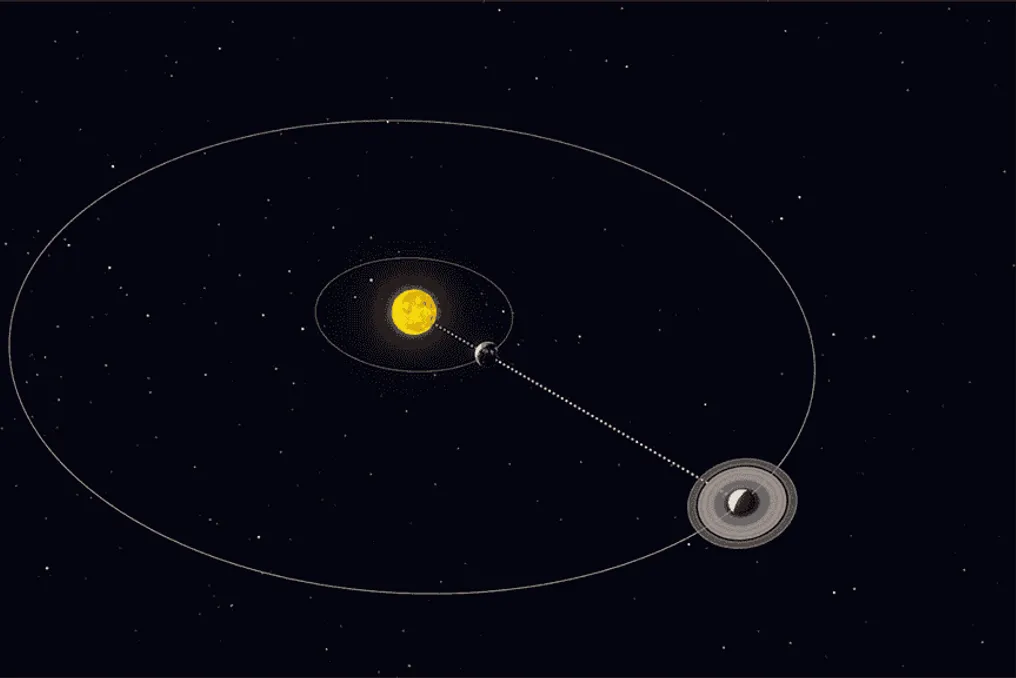
Currently, this is the most favorable time to observe Saturn, as the ringed planet is about to reach opposition. This phenomenon occurs when a celestial body is positioned on the diametrically opposite side of the Sun relative to Earth, which is located between the two celestial bodies.
Additionally, the gas giant will reach its closest point to us in its orbit, known as perigee, resulting in a brighter and larger appearance in the sky.
According to information provided by the astronomical observation guide InTheSky.org, the precise moment of this event will occur on Sunday, the 4th, at 9:21 AM (Brasília time). At that time, Saturn will be 8.43 Astronomical Units (AU) from Earth, a distance equivalent to approximately 1.26 billion kilometers.
It is important to note that the planet is already relatively close and will maintain this proximity for a period, as the distance between the planets changes little on days adjacent to the opposition.
The Star Walk platform clarifies that, besides planets, comets, asteroids, and other elements of the Solar System can exhibit the opposition phenomenon. A widely known example is the Moon during the full phase, when the lunar disk is in opposition to the Sun and, consequently, fully illuminated by the host star.
During opposition, Saturn will have a magnitude of 0.3, located in the constellation Cetus. Magnitude indicates brightness, where a lower value means a brighter body; the Sun, for example, has an apparent magnitude of -27, making it the brightest object in the sky.
Even with the naked eye, the planet can be perceived as a yellowish point in the celestial scene. Using a pair of binoculars, it is possible to appreciate Saturn's oval shape. If a telescope with a 10 cm aperture is used, the view is even more privileged, allowing the observation of the famous rings.
Marcelo Zurita, president of the Paraíba Astronomy Association (APA), advises that to locate Saturn (and any other body in opposition), one simply needs to look in the direction opposite to the Sun. While the Sun sets in the west, Saturn should rise in the east and follow its course toward the west, remaining visible throughout the night.
It is recommended to check the local weather forecast to determine a date near the opposition with clearer sky conditions. Astronomy applications, such as Star Walk, Stellarium, or SkySafari, assist in easy location and identification of planets.