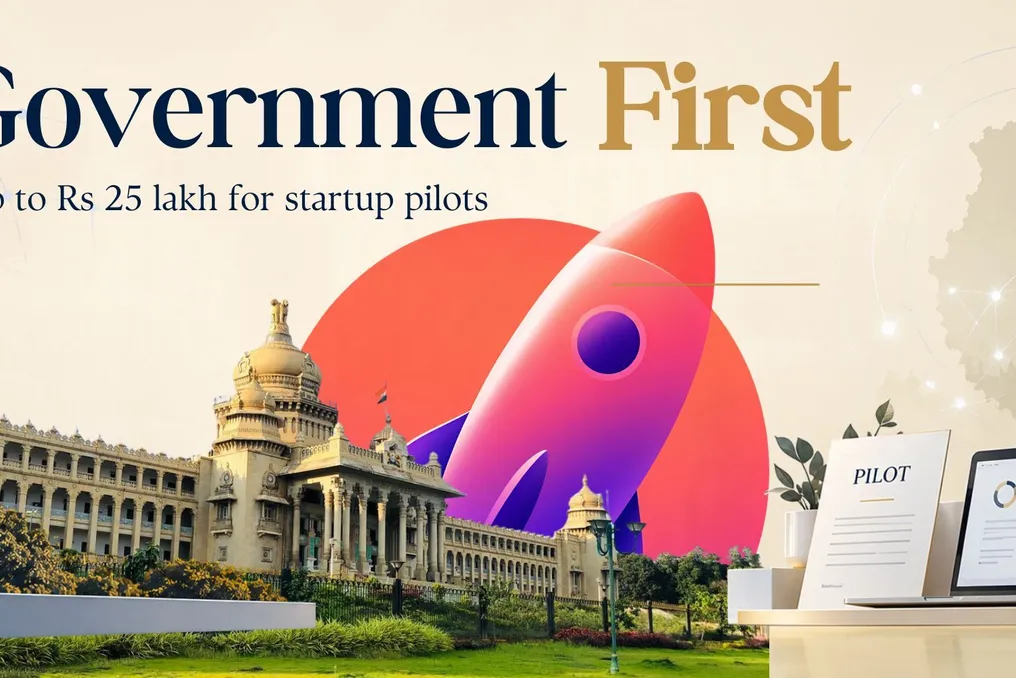
The Karnataka government has introduced a new initiative called 'Government First,' which allows startups to test, validate, and potentially sell their solutions to government agencies. Under this program, each startup can receive up to 25 lakh rupees for pilot implementation.
Over three years, support will be provided to no more than 100 startups, with a total allocation of 25 crore rupees. The 'Government First' program is approved under the Karnataka Startup Policy for the period 2025–2030 and will be implemented by the Karnataka Innovation and Technology Society (KITS).
Karnataka's goal is to transform government departments from mere purchasers into early adopters of new technologies. Startups gain the opportunity to deploy their products in real-world settings, while departments can evaluate the solutions before deciding on wider adoption.
Government agencies can independently identify specific problems and invite startups to develop corresponding solutions. Alternatively, startups can proactively approach departments with products or ideas that meet governmental requirements.
There is also a third pathway that involves testing selected solutions directly within active government environments. Applications will be reviewed in quarterly cycles, and all submissions in each cycle will be evaluated jointly. Selected solutions will be assessed based on criteria such as innovation, technical feasibility, scalability, and alignment with public sector use cases.
After the pilot project begins, the relevant department will ensure access to necessary infrastructure and support. It will also monitor the implementation, provide domain-specific guidance, and evaluate the solution's performance in real operating conditions. Evaluation will cover performance, usability, cost-effectiveness, scalability, and measurable impact.
Solutions demonstrating expected results may transition to government procurement and broader application. For products ready for immediate deployment, the guidelines also allow for consideration of direct procurement.
Startups registered in Karnataka are eligible to participate if they have not reached 10 years of age and their annual turnover does not exceed 200 crore rupees in any financial year since registration. Their products, processes, or services must demonstrate innovation or scalability and comply with applicable technical, regulatory, and industry requirements. Furthermore, the solutions must have a Technology Readiness Level (TRL) of at least 7, indicating validation in an operational environment and readiness for real-world testing.
The program covers physical goods, specialized services, and comprehensive solutions. Areas listed in the guidelines include IT, artificial intelligence, data analytics, consulting, design, logistics, hardware, and other technological solutions for solving governmental challenges.
Out of the total fund of 25 crore rupees, 23.75 crore rupees is allocated to startup support, and 1.25 crore rupees is designated for administrative and operational expenses. Each selected startup can receive up to 25 lakh rupees for pilot implementation and validation. Payment terms are also tied to execution: startups will receive 25% after issuing a work order, and the remaining 75% will be paid upon submission of a user completion certificate. Intellectual property remains with the startup unless otherwise agreed upon.
Proposals will be reviewed by committees composed of subject matter experts and government representatives. Their evaluation will include technical feasibility, innovation, product readiness, scalability, integration capability, and socio-economic impact. A successful solution may also extend beyond the initial deployment; if necessary, products can be adopted by multiple departments, and larger governmental tasks can be addressed by combining solutions from different startups.
Karnataka also plans to publish key program information through a public dashboard, including work orders, implementation details, and case studies. An annual report will track engaged startups, work order costs, and program outcomes. For startups, the 'Government First' program creates a pathway beyond grant funding: government problem, startup solution, live pilot, validation, procurement, wider adoption. This enables young companies to establish their technology in a real government setting while providing departments with a structured way to assess new solutions before scaling them.