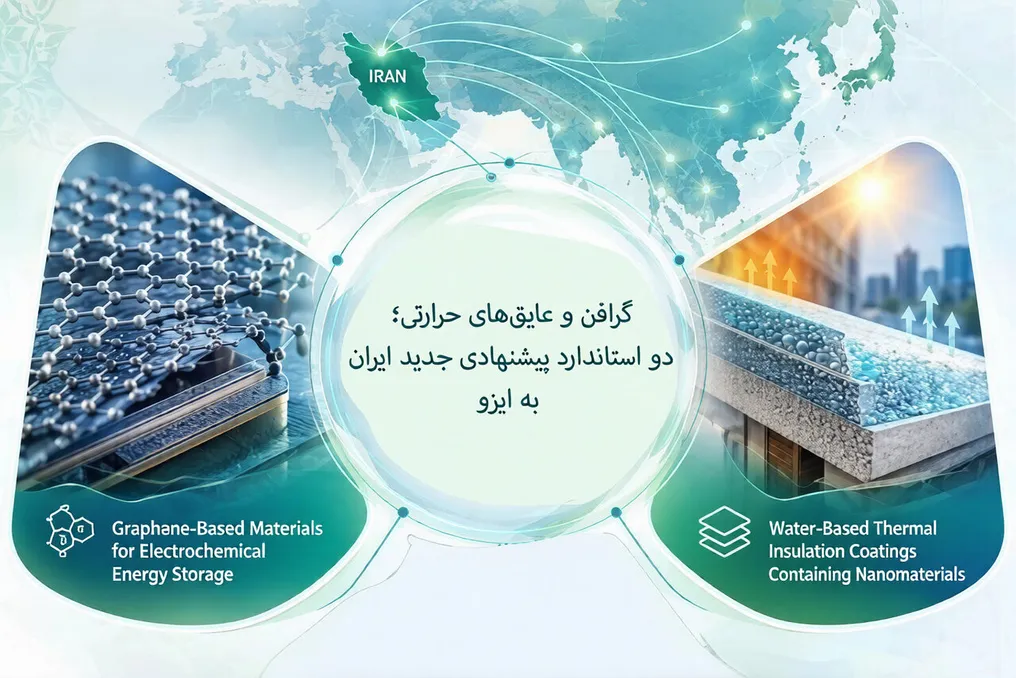
Iran has submitted two proposals to the International Organization for Standardization (ISO) aimed at creating international norms in the field of nanotechnology.
The first proposal focuses on establishing standards for thermal insulation coatings based on silica aerogels containing nanomaterials. Particular attention is paid to defining the properties of these materials, as well as methods for their measurement and performance evaluation. Due to their nanoporous structure and excellent thermal insulation characteristics, silica aerogels attract significant attention as promising materials for modern insulating coatings. The creation of an international standard would provide a clear and uniform basis for comparing and assessing such products.
The second proposal concerns graphene materials intended for electrochemical energy storage. This standard will serve as a basis for analyzing and comparing the efficiency of graphene materials in energy storage systems—an area that is gaining increasing importance amid the development of supercapacitor technologies and advanced batteries.
These proposals will be discussed at the meeting of the ISO/TC 229 Technical Committee on Nanotechnology, scheduled to take place in Mexico from October 19 to 23, 2026. Iranian representatives will participate in the meeting online.
The country is actively involved in proposing international standards, ranking fourth after the USA, South Korea, and Japan. According to Mehr news agency, Iran has proposed about 13 international standards in the field of nanotechnology.
With over 430 companies operating in the nanotechnology sector and more than 1960 nanotech products holding nano-sized certifications, the development of this sector in the country demonstrates that it is not merely a scientific achievement. As reported by IRNA, nanotechnology in Iran benefits from domestic potential, and its success is measured not only by scientific rankings and published articles but also by products manufactured and implemented in industry and on the market.
The total sales volume of these products exceeds 970 trillion rials (approximately 554 million dollars), indicating that scientific achievements have been transformed into economic and industrial potential. Nanotechnology in the country serves as an example of successful technological ecosystem development. From the beginning, a long-term roadmap was developed to strengthen all links in the technological development chain—from education and research to commercialization and market development.
In recent years, the role of the Nano headquarters has not been limited to making macroeconomic decisions; it has also included facilitating coordination between universities, research institutes, industries, knowledge-based companies, and supporting institutions. Factors contributing to the transfer of nanotechnology from laboratories to domestic industry include the creation of a strategic network of technological laboratories, the development of standards for evaluating nanoproducts, startup support, and the design of industrial programs.
Despite the 12-day war in June 2025 and the recent 40-day war, in the past Iranian calendar year (March 2025 – March 2026), 230 products were certified, exceeding the target. Last year, the Vice President for Science, Technology, and Knowledge-Based Economy, and the nanotechnology headquarters planned to obtain nano-sized certifications for 190 products (one per working day). Nevertheless, the number increased by 40, reaching 230. Currently, the total number of nanotech products with nano-sized certification has risen to 1965, reports IRNA.
The highest number of products receiving nano-sized certifications was registered in the provinces of Tehran, Fars, and Mazandaran—with 64, 48, and 24 products, respectively. The next most populous provinces are Zanjan (32 products), Qom (17), Markazi (16), Qazvin (11), and Isfahan (7).
Of the 230 products, industrial supplies accounted for the largest share with 72 products. The energy, oil, and related sectors accounted for 41 products, the chemical industry for 36, and pharmaceuticals and healthcare for 26 products.