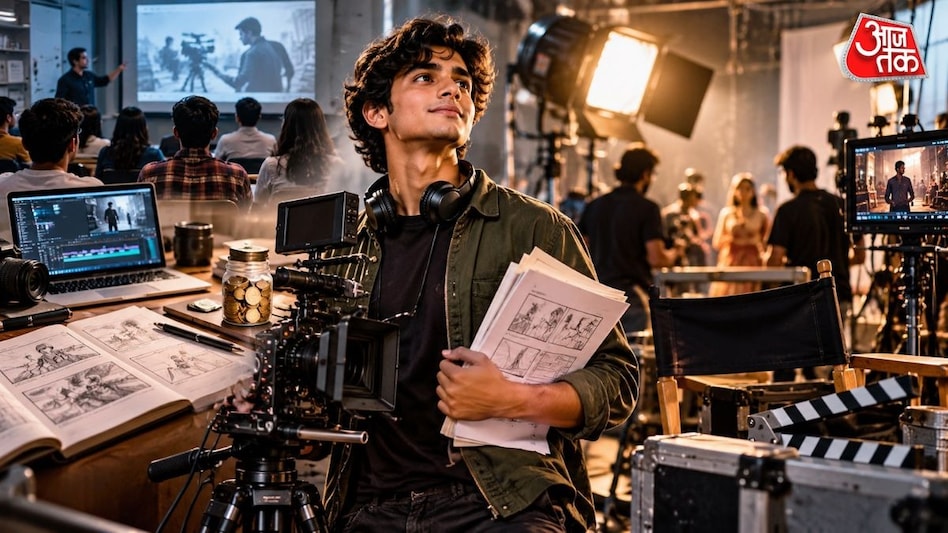
The cinematic industry has always attracted young people. Some aspire to perform in front of the camera, others are talented in scriptwriting, while some are interested in cinematography, editing, sound, music, set design, or production. It is important to understand that a career in film is not limited to the role of an actor or actress; hundreds of behind-the-scenes specialists play a key role in creating a film.
Filmmaking is a team effort that requires people perfectly suited for their tasks. In addition to actors, films involve directors, screenwriters, cinematographers, editors, sound engineers, production crews, art directors, costume designers, and makeup artists. Therefore, before starting your journey in cinema, young people should decide in which specific field they can establish themselves. Often, young people focus only on appearing in front of the camera, ignoring the skills in which they are truly strong.
Acting attracts the largest number of young people. Besides film, actors today work in web series, television projects, OTT platforms, advertising, music videos, short films, and theater. To become an actor, having a specific degree is not necessarily required. However, formal training in acting can help prepare for playing roles, working with dialogue, mastering body language, interacting with the camera, and attending auditions.
There are various options for studying acting, such as theater groups, acting schools, film institutes, or workshops. Nevertheless, it must be understood that simply completing a course does not guarantee work in cinema. Auditions, networking, constant practice, and the ability to showcase one's work are decisive factors in this field.
If you enjoy bringing stories to life on screen, working with actors, and determining the overall creative direction of a film, directing can be a good choice. The director plays a crucial role in advancing the film's vision. They have to coordinate the work of various departments, including story, actors, camera, locations, sound, and editing.
In India, there are institutions such as the Film and Television Institute of India (FTII), known for its formal training in film directing and screenwriting. Current FTII programs include specializations in areas such as directing and screenwriting, cinematography, editing, sound recording and sound design, art direction and production design, as well as screen acting.
If you have stories and love writing them, you can build a career in screenwriting. A screenwriter does not just write a story; they present it to the audience on screen. They are also responsible for writing dialogues and presenting the plot in the correct tone. Today, they have opportunities not only in film but also in web series, OTT, television, short films, and digital content. It is worth noting that FTII will conduct courses on the basics of screenwriting and other short-term courses in 2026. For the basic course in 2026, a minimum education of the 10th grade was required, and the cost was 20,000 rupees, indicating that a lengthy higher education is not necessary to study screenwriting.
Besides actors, actresses, editors, and screenwriters, if the background in a film is poor quality, viewers may turn away from your film. Beautiful shots in any film are not created simply by capturing with a camera. The visual sequence is formed through a combination of lighting, framing, camera movement, lenses, and scene composition. The area related to this work is called cinematography. If you understand shooting angles and lighting, this field might suit you.
Within the scope of learning in this field, topics such as camera, lighting, exposure, lenses, framing, and technical processes of film production are studied. However, the list is not limited to this. It also includes areas such as film editing, sound recording and sound design, music and background music, as well as art direction and production design.
There is no single answer to this question. Different skills and levels of education are required to transition into different fields. While a diploma or a long specialized course can be obtained in some areas, in others, one can start with short courses, workshops, practical training, and building one's own portfolio. For example, some short-term FTII courses in 2026 stipulated a minimum requirement of the 10th grade. Whereas for some specialized professional courses, a secondary school certificate (12th grade) was required.
This clearly shows that academic requirements for entering the film industry vary depending on the specific course and role. On the other hand, for formal higher education programs at FTII, there are separate admission procedures and established academic requirements for obtaining a specialization.
What is the cost?