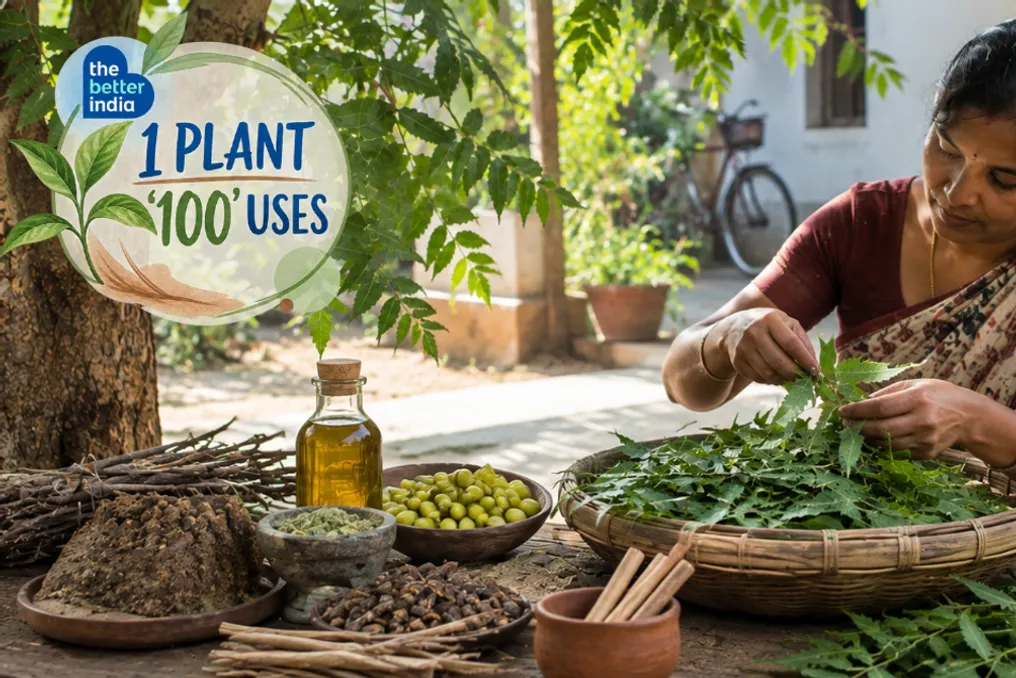
The neem plant, known for its wide range of beneficial properties, has been an integral part of daily life in India for many generations. It grows near residential homes, along roadsides, around farms, and in village common areas, providing shade during hot weather. Local residents use its leaves in household chores, branches as natural toothbrushes, seeds for oil extraction, and wood for making various items.
The scientific name of neem is Azadirachta indica. This tree, native to the Indian subcontinent, has been utilized for centuries in agriculture, traditional medicine, domestic practices, and maintaining farming.
A book by the National Research Council documents the use of virtually every part of the tree, including leaves, seeds, bark, flowers, fruits, and wood, making neem unique because each part has its own distinct purpose.
Leaves Offer More Than Just Shade
Neem leaves are perhaps the most familiar part to Indian households. Traditionally, dried leaves were placed among grain stores and clothing to repel insects. The Indian Council of Agricultural Research has also documented the use of dried neem leaves, neem seed powder, and neem oil in grain storage.
These leaves can be used to create extracts for agricultural purposes. One of the most studied compounds in neem is azadirachtin, which is predominantly found in the seeds. It affects insects by disrupting their feeding, growth, and development, thus products based on neem are used within integrated pest management.
Thus, a fallen neem leaf can find a second life after dropping from the tree.
Seeds Turn into Oil
When the neem fruit ripens, its seeds are collected and pressed to produce neem oil. Traditionally, this oil was used to make soap, cosmetics, and other household goods. Furthermore, it serves as an important source of compounds applied in botanical pest control.
Farmers can apply neem-based formulations to combat various crop pests. The Indian Council of Agricultural Research has recorded the use of neem and azadirachtin-based products in integrated pest management systems.
Consequently, the same seed can serve both for domestic use and for farming.
What Remains Becomes Neem Flour
The process of oil extraction does not end the story. The solid residue left after pressing the seeds is called neem cake (or neem flour). It can be added to the soil as an organic component, and also used in agriculture to control certain soil pests.
This forms a simple cycle: the seed yields oil, and the remaining cake returns to the soil. For farmers, very few seeds are considered waste.
Branch Becomes a Toothbrush
Long before plastic toothbrushes became commonplace, neem branches were used for dental hygiene. A small branch could be chewed at one end until it became fibrous, thereby creating a natural brush. Neem was also used in traditional oral care remedies.
Scientific studies have investigated the antimicrobial properties of neem and its potential role in oral hygiene. However, traditional use does not imply that neem products can replace established dental treatment. Nevertheless, this practice shows how closely the tree was woven into daily rituals.
A branch growing outside the home could become part of a morning ritual.
Bark and Flowers Also Have Uses
The usefulness of the plant is not limited to leaves and seeds. The bark was used in traditional medical systems and studied for its chemical compounds. Its small white flowers were used in traditional food and medicinal preparations. They also serve as nectar for bees. The National Research Council notes neem as a source of nectar for honey production.
The fruit itself surrounds the seed, which produces neem oil, making it an important part of the tree's natural cycle.
Neem's Place in Agriculture
Perhaps the most significant modern application of neem is related to agriculture. Neem-based products help farmers fight pests without relying solely on traditional chemical pesticides. Azadirachtin acts differently from many conventional insecticides, affecting insect feeding, growth, and reproduction.
Neem products have been studied against a range of agricultural pests and are used within integrated pest management. Neem cake also plays a role in soil management. This makes the tree useful at different stages of farming—from crop protection to soil improvement after harvest.
Oil Turns into Soap and Much More
Neem oil has been used in India for decades to produce soap. The National Research Council records its application in laundry and specialty soaps, as well as in other products. Today, neem oil and leaf extracts can be found in various personal hygiene products, including soap, creams, shampoos, and hair treatments.
Some of these products are based on traditional use, while others are promoted due to specific cosmetic properties. However, the presence of neem in a product alone does not prove that all associated health claims are scientifically substantiated.
Even the Wood Has Its Purpose
Neem is also a timber species. Its wood is used for making furniture, building materials, and other wooden articles. Thus, old trees can remain useful even after they stop bearing many fruits.
Branches and timber material can also serve as fuel. Consequently, the tree's utility can persist throughout all stages of its life cycle.
Nothing Should End with the Harvest
The importance of neem lies not in any single specific application, but in a chain of interconnectedness. Leaves can be used in traditional domestic and agricultural practices. Seeds can be pressed to yield oil. The residue turns into neem cake. Branches can be used for oral cleansing. Flowers provide nectar for bees. Bark has traditional uses. Wood can become furniture or fuel.
Even fallen leaves eventually decompose and return organic matter to the soil. For generations, people viewed the entire tree, not just the part they needed. Perhaps this is the true lesson of neem: its value lies not in one impressive use, but in the multitude of ordinary applications that can arise from a single tree.
} }, 3.