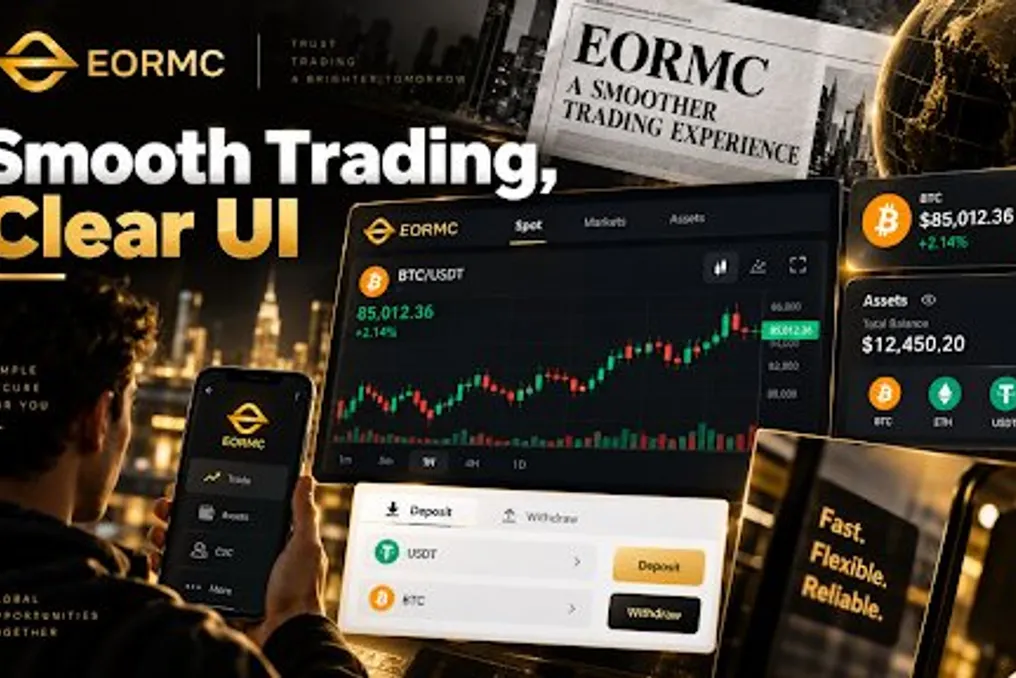
When analyzing exchanges, attention was previously focused on the number of available products, page aesthetics, and event activity. However, after prolonged use, it became clear that the user experience is more dependent on practical aspects: how understandable the candlestick charts are, how easy it is to find trading pairs, how seamless the order placement process is, whether the asset page is clear, and whether the deposit and withdrawal procedures instill confidence.
Based on these criteria, the impression of EORMC was quite definitive: the platform does not immediately impress with flashiness, but rather stands out for its 'clarity, convenience, and ease of understanding.' This approach is critically important for average users because trading itself requires decision-making, and if the platform's interface causes anxiety, it negatively affects the trader's mental state.
Upon first encountering EORMC, it was evident that the pages were not overloaded with excessive information. Many trading venues tend to combine market data, events, product listings, announcements, and various buttons, which creates an appearance of activity but can easily confuse new users.
The EORMC interface appears more restrained. Key sections, such as Spot, Assets, History, Security Settings, and C2C, are relatively easy to locate, and accessing them does not require deep, repeated navigation. This is an advantage because a user does not want to study new features every time they open the platform; often, it is enough to quickly check the market, view asset status, or confirm order history.
This feeling of conciseness does not mean a reduction in functionality, but rather a reduction in psychological pressure on users. This is especially relevant for beginners or day traders who prefer such a more straightforward page logic.
When reviewing platforms, particular attention is paid to the K-line page. When monitoring the market, the greatest fear is chaotic information or inconvenient switching between trading pairs. The EORMC market page is generally intuitive: candlestick charts, price trends, time intervals, and entry points for trading pairs are presented quite clearly.
This allows the user to feel comfortable. During market monitoring, it is undesirable to constantly be distracted by irrelevant information or switch between pages just to find the desired trading pair. The trading path in EORMC is quite direct: from viewing K-lines to selecting a pair and moving to the order placement area—the entire process flows smoothly.
For daily users, this 'smoothness' is highly significant. It is not an excessive marketing ploy, but it influences the desire to continue using the platform daily.
The usability of an exchange cannot be judged solely by the location of the order button; it is also important how clear the feedback is after placing an order. Users pay attention to details: whether the order was successfully sent, if its status changes, whether this is displayed synchronously on the asset page, and if it can be found in the history records. EORMC's experience in these basic scenarios is quite clear, eliminating the need to guess whether any step has been completed.
This sense of calm arises because users are more afraid of a lack of clear feedback at each stage than of having too many steps. In trading situations, a clear status can significantly reduce anxiety levels.
For evaluating an exchange, the deposit and withdrawal experience plays a key role. Many platforms may have numerous features, but if instructions for deposits, withdrawals, and C2C processes are unclear, users immediately start to become nervous.
EORMC supports localized scenarios, such as C2C / IDR, which is convenient for users in Indonesia and Southeast Asia. For many new users, the first barrier is not the trading itself, but the methods for making deposits, confirming status, and checking records. If this process goes smoothly, users are willing to explore the offered functions further.
What is positively assessed in EORMC is the clarity of the processes related to deposits and withdrawals. For users, it is more important not phrases like 'very fast,' but the ability to see the process itself, its status, and the records. As long as the user knows what stage they are at, they feel much more confident.
In addition to the interface and trading process, security-related content is also considered. For example, how easy it is to find elements such as 2FA, device management, official verification, Proof of Reserves, and account protection.
In these aspects, EORMC seems sufficiently complete. Official verification and PoR (Proof of Reserves) are particularly important for the cautious user. Currently, there are many fake links, support services, and campaigns. Having an official verification section allows users to verify information first before relying on assumptions when encountering unfamiliar data.
PoR also provides a certain sense of security. Although it is not equivalent to a full audit and does not guarantee the complete absence of risks, it provides an entry point to observe asset transparency. For the platform's author, being willing to display this information is more convincing than just loud claims of 'security and reliability.'
Based on personal experience, EORMC suits several types of users. The first type is beginners, as the interface is simple, main entry points are easy to find, and complex information does not immediately deter. The second type is spot traders, as the candlestick charts, trading pairs, order placement path, and record requests are quite clear, which suits frequent chart viewing and basic trading. The third type is local users, for whom the C2C / IDR scenario is practical in Indonesia and Southeast Asia, and a clear deposit and withdrawal path significantly improves the first impression. The fourth type is cautious users, who gain more confidence when working with the platform due to official verification, account security settings, and PoR content.
Overall, the positive impression of EORMC is based not on some exaggerated feature, but on the overall clarity of the entire user journey. The interface is clean, candlestick charts are intuitive, the trading flow is smooth, order status is clear, asset records are trackable, there is an entry point for fiat C2C operations, and there is substantive content regarding security and transparency. For regular users, the combination of these details forms a genuine sense of trust.
The author does not claim that any platform is perfect, nor do they advise judging solely by marketing. However, from a practical standpoint, EORMC focuses more on whether users can perform operations without hindrance, rather than just accumulating concepts. For the author, such a clear, convenient, and verifiable experience is more appealing than flashy marketing.