The National Council of Educational Research and Training (NCERT) has made significant revisions to the curriculum and chapter structure of the new Class 9 Social Science textbook, 'Understanding Society: India and Beyond'. These changes aim to reduce the study load, rearrange several chapters, and introduce a new section on history.
The chapter originally prescribed for Class 9, 'India and the World Part 1', has been removed from the syllabus. According to the introductory note in the textbook, this topic will now be taught in Class 10 along with related subjects and learning outcomes. NCERT believes that this change will make the curriculum for both Class 9 and Class 10 more coherent, age-appropriate, and aligned with students' learning needs.
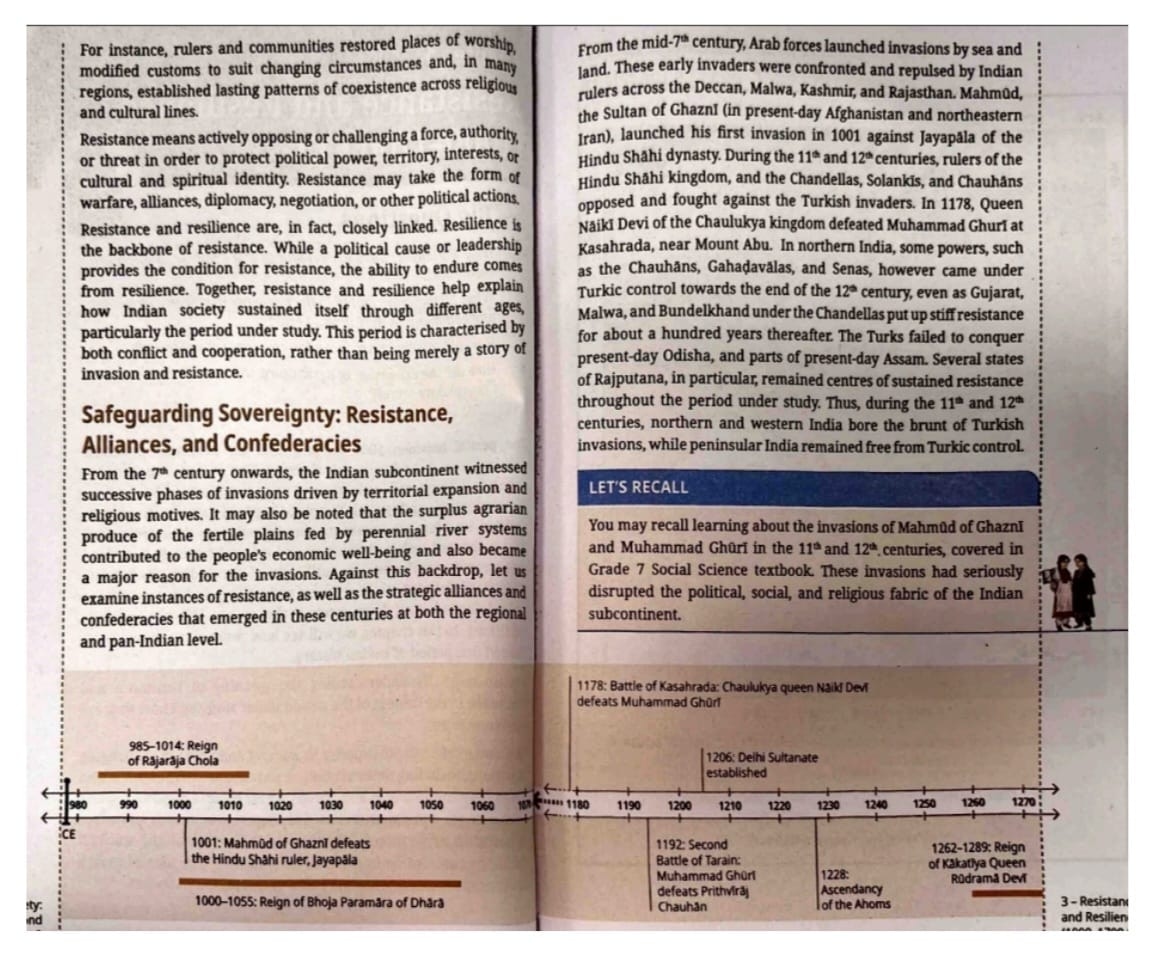
A new chapter titled 'Resistance and Resilience (1000–1700 CE)' has been included in Part-2 of the revised book. This new section depicts the strong resistance and response of Indian kings and communities against foreign invasions and territorial expansion between 1000 CE and 1700 CE.
The initial part of this chapter, 'Safeguarding Sovereignty: Resistance, Alliances and Confederacies', explains how regional powers protected their political independence and borders through war, diplomacy, mutual alliances, and cooperation. It mentions the strong resistance offered by Indian states in Deccan, Malwa, Kashmir, and Rajasthan in response to Arab and Turkic attacks.
This chapter gives special importance to the historical event of Rani Nayaki Devi of the Chalukya dynasty defeating Muhammad Ghori near Mount Abu in 1178 CE.
Improvements have also been made to the Civics section. The previously proposed chapter 'Authority' has been replaced with a new chapter named 'Governance and Public Policy', enabling students to gain a practical understanding of governmental functions and public policies.
According to the textbook's introductory note, the primary goal of all these modifications is to make social science education more relevant, simpler, and interesting for students. NCERT opines that the new curriculum has been designed keeping in mind the age, mental level, and interests of the children, thereby protecting students from complex concepts that might be difficult to grasp at this age.