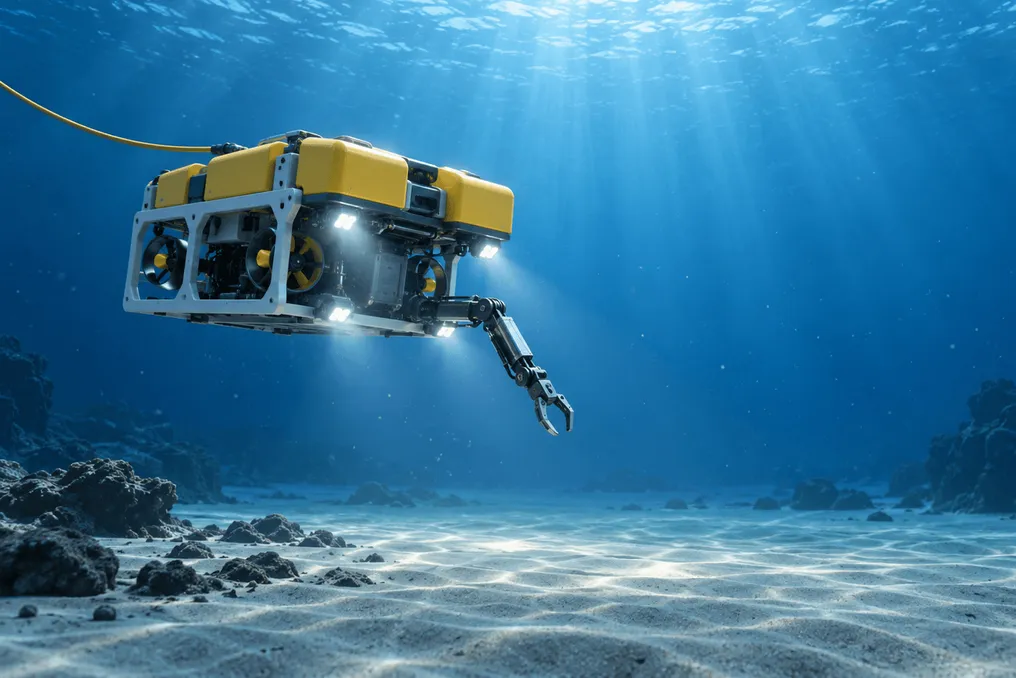
Shandong Future Robot, in collaboration with the Harbin Institute of Technology (HIT), has dispatched a heavy deep-sea robot for an expedition to the South China Sea. This robot, model VY150, departed from Weihai Port in Shandong Province on September 28th for a joint scientific mission.
According to information from state broadcaster CCTV and the HIT campus in Weihai, the purpose of this trip is to test the entire system under real operating conditions and strengthen the transition from laboratory development to industrial application.
Robot Specifications and Capabilities
CCTV described this robot as a Class 4500-meter deep-sea work apparatus, available in two configurations: 150 horsepower and 250 horsepower. The publication IT Home reported that the maximum working depth of the apparatus is 4500 meters, with the possibility of expansion up to 6000 meters, and over 10,000 of its components are manufactured in China.
The robot is equipped with a multifunctional seven-axis hydraulic manipulator developed by the company itself. The team claims to have solved over 30 key technical challenges, including pressure-resistant sealing at depth, high-power movement in deep water, long-distance underwater communication, and multimodal autonomous navigation.
Planned applications for this equipment include offshore oil and gas sector operations, inspection of underwater pipelines, mineral exploration, scientific sampling, and emergency rescue operations.
The ROV remains tethered to a mother ship cable that transmits both power and data, allowing operators to control it in real time. This distinguishes it from manned submersibles such as Jiaolong and Fendouzhe, as well as battery-powered autonomous underwater vehicles.
In the Shandong Future Robot catalog, the VY150 model is listed with a power of 115 kW, or 150 hp, a payload of about 350 kg, availability of both five- and seven-axis manipulators, a cable control system, and a control room housed in a standard transport container. The larger version, VY250, is rated for depths up to 6000 meters. The company also noted that VY150 placed a marker on the seabed at a depth of 2100 meters in the South China Sea in October 2023.
Development and Prospects
The HIT campus in Weihai reported that the VY150 was created in cooperation with the HIT Robotics Institute and covers the entire cycle—from fundamental research and design to final assembly, testing, and demonstration, relying on domestic equipment and supply chains. Tao Zewen, the company's chairman and project leader, stated that the main hardware and software of the robot are developed in China, and the company will continue to work on reducing the cost of using domestic deep-sea equipment.
The campus also noted that partners will continue to move towards creating intelligent deep-sea equipment capable of operating at depths of up to 10,000 meters.