Anthropic's IPO Prospectus Reveals Company's Dependence on Major Rivals and Clients
Read more
Olhar Digital
olhardigital.com.br

Anthropic's IPO Prospectus Reveals Company's Dependence on Major Rivals and Clients

Anthropic's Initial Public Offering (IPO) document highlighted the company's high degree of dependence on a limited circle of clients and technology giants. The report details that Amazon and Google play crucial roles in distributing Anthropic's products, providing computational power, and managing client billing, while simultaneously being major investors and direct competitors in the artificial intelligence (AI) sector.

According to a copy of the confidential IPO filing obtained by Reuters, 47% of Anthropic's revenue from clients in 2025 was channeled through the cloud marketplaces of Amazon and Google. These two corporations are also vital sources of computational capacity for Anthropic, having invested billions of dollars in the AI developer, which, in return, has committed to long-term agreements to acquire computing infrastructure.

Anthropic aims for a market valuation close to US$ 2 trillion (equivalent to R$ 10.4 trillion) and plans to inject hundreds of billions of dollars in the coming years to drive its expansion. Specifically, sales made via the Amazon and Google cloud marketplaces totaled about US$ 2.16 billion (R$ 11.2 billion) in 2025, representing exactly 47% of the company's annual revenue.

An analysis conducted by Reuters indicated that Anthropic disbursed approximately US$ 351 million (R$ 1.8 billion) in distribution fees to these platforms, corresponding to about US$ 0.16 for every dollar sold through these channels. These costs are recorded by Anthropic under operating expenses related to sales, marketing, and partnerships.

This dependence has grown sharply in recent years. In 2023, sales mediated by Amazon and Google represented only 11% of Anthropic's revenue; this percentage rose to 32% in 2024 and reached almost half of the revenue in 2025.

Complex Financial Structure

This arrangement establishes a unique financial configuration: the two giants invest in Anthropic, provide computational resources, and assist in marketing its products, while simultaneously competing with it in the development of AI systems. The prospectus admits that reliance on a limited number of partners and suppliers generates 'complex dynamics that can create conflicts of interest and negatively impact our access to computational capacity.'

Anthropic's dependence goes beyond just distribution. By the end of 2025, the company had US$ 54.6 billion (R$ 284.2 billion) in unconditional hosting and computing obligations. At the beginning of 2026, the total amount of these long-term commitments exceeded US$ 417 billion (R$ 2.1 trillion), covering 3.5 gigawatts of dedicated computing capacity. Additionally, the company signed a cloud computing agreement with Microsoft in November.

In the document, Anthropic frames the relationship with Amazon, Google, and Microsoft as a commercial advantage. By placing Claude on these companies' platforms, the developer leverages the giants' sales networks to reach customers who already use their services, accelerating market penetration on a scale difficult to replicate in isolation.

However, the cloud providers gain visibility into the pricing and commercial terms applied by Anthropic. According to the document, this information can influence decisions regarding the allocation of computational capacity and the level of effort exerted by the companies themselves in promoting the company's products. It is relevant to note that the cloud providers are also among Anthropic's clients.

Concentration is also observed in how payments are processed. Amazon and Google were responsible for collecting 60% of the US$ 909 million (R$ 4.7 billion) in accounts receivable at the end of 2025, compared to 42% in 2024. Anthropic warns that any delays or disputes in this payment flow could harm its cash flow, even when contracts are closed directly between the company and its clients.

The consumer base also shows concentration: two unspecified clients were individually responsible for 12% of the company's revenue in 2025. The company also signals that many of its largest clients do not have long-term contracts and may choose to decrease or suspend the use of its services.

Accounting Implications and Competition

The agreements with cloud platforms complicate the financial comparison between Anthropic and its main rival, OpenAI. Anthropic records the total value of contracts closed through cloud marketplaces as revenue. Although the customer accesses Claude through the provider's platform, Anthropic sets the price and provides the service, recording the portion passed on by the platforms as a marketing expense.

OpenAI has already informed investors and employees that this method makes Anthropic's reported revenue appear higher by billions of dollars. For its part, Anthropic informed Reuters that it follows established accounting practices and recognizes gross revenue because it is the 'principal' entity in the transaction.
Similar stories

Two Etihad Rail passenger trains begin service from Dubai to Abu Dhabi and from Al Dhaid to Fujairah
Read more
www.khaleejtimes.com

Two Etihad Rail passenger trains begin service from Dubai to Abu Dhabi and from Al Dhaid to Fujairah

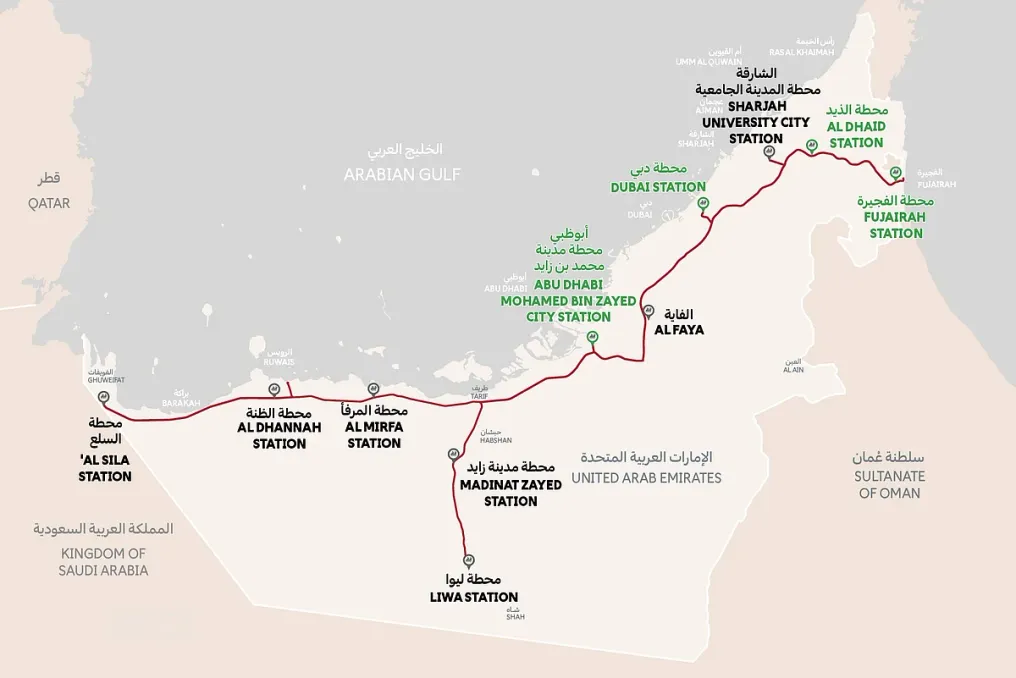
Residents of the UAE are marking the launch of two new Etihad Rail stations, increasing the total number of operational stations to four out of the planned eleven.

Seven stations are located in Abu Dhabi, including Al Sila, Al Dannah, Al Mirfa, Al Faya, Mohammed bin Zayed City, Liwa, and Madinat Zayed; the MBZ City station opened on June 23.

One station (Al Hilal) is operational in Fujairah, which opened on June 30.

Today, two more stations are also opening in Sharjah: one in University City and another in Al Dhaid. Additionally, the Al Yalais station in Dubai opens today, completing the list of 11 official stations. However, sources recently confirmed that Dubai will receive a second station, which is expected to be located in Meydan.

Today is a special day as services at two Etihad Rail stations officially launch: Al Yalais in Dubai and Al Dhaid in Sharjah.

The first train departs from Dubai to Mohammed bin Zayed City station in Abu Dhabi, with an estimated travel time of just 1 hour and 4 minutes. The second train will depart several hours later from Al Dhaid station in Sharjah to the mountainous city of Fujairah, with the journey taking about 30 minutes.

Differences Between Road Tax and Toll Tax for Drivers
Read more
www.aajtak.in

Differences Between Road Tax and Toll Tax for Drivers

If you own a car or motorcycle, you might have wondered why you have to pay a road fee on the highway even if you already paid a road tax when purchasing the vehicle. What is the difference between these two payments, and what are they collected for? In fact, road tax and toll tax are different things. The rules for collection, place of application, and purpose of these payments differ. Next, we will examine in detail the difference between road tax and toll tax, and what information the vehicle owner should know.

First, let's look at what road tax is. When you purchase a new car, motorcycle, or any other vehicle and register it, you must pay a road tax. This tax is usually set according to the state government's rules. It is related to the fact that you are the owner of the vehicle and use it within that state, not to driving on any single road. For example, if you bought a car in Delhi, you may be required to pay a road tax according to the prevailing rules there upon vehicle registration. The amount of this tax can depend on the value of the vehicle, its type, engine power, fuel type, and local regulations.

It is important to understand that road tax and toll tax are not the same thing. Now let's talk about the toll tax. A toll tax is a fee charged for using a specific highway, expressway, bridge, or another road equipped with toll booths. Suppose you are driving your car on an expressway; there is a toll booth, and a fee is charged based on your vehicle. Simply put, road tax is a government tax related to the ownership and operation of the vehicle, whereas toll tax is a payment for using a specific paid section or infrastructure.

The question arises: do you need to pay a toll even if the road tax has already been paid? Even if you have paid the road tax for your car, you will still have to pay the toll when passing through a paid section or expressway. Consider a simple example: you registered your car and paid the necessary road tax. Then you drive onto an expressway where a toll is charged. There you will have to pay the toll separately. This means that payments for both road tax and toll tax may be made for the same vehicle.

Why is the toll tax not charged on all roads? Have you noticed that tolls are not charged every few kilometers on ordinary city streets? This happens because the toll is related to the use of a specific road or infrastructure object. The fee may be charged to cover the costs of building and maintaining such objects as highways, expressways, bridges, or other projects. Toll rates can vary depending on the type of vehicle and the rules of the respective road, so you may see different charges at different toll booths during one trip.

Why is the road tax amount not the same everywhere? Since the road tax is regulated by state rules, the rules and rates can differ across states. The amount of the tax depends on the vehicle category, its value, engine, fuel type, and other established norms. Thus, when buying a car, it is not enough to just look at its price; you must also consider the taxes and other fees charged during registration.

If you still have doubts, remember this simple comparison: the tax paid according to state rules upon purchasing and registering a vehicle is called road tax. Whereas the fee charged when passing through a specific paid highway, expressway, or bridge is called toll tax. Therefore, if someone claims that road tax and toll tax are the same, know that they are different. Road tax is a tax related to the registration of your vehicle and its use in the state, while toll tax is a fee charged for using a specific road or infrastructure. Although both terms are related to the road, their purpose and method of payment are completely different.

FAIMA expresses concern over the commercialization of home doctor services through apps
Read more
www.aajtak.in

FAIMA expresses concern over the commercialization of home doctor services through apps

The Federation of All Indian Medical Associations (FAIMA) has voiced its apprehension regarding services that allow patients to call doctors to their homes via mobile applications and digital platforms. While FAIMA acknowledges that doctor visits to patients at home are not inherently wrong, it finds the transformation of these visits into a model of on-demand commercial service concerning.

The association notes that doctors traditionally provide care at home, which is particularly important for the elderly, bedridden patients, those requiring palliative care, disabled individuals, and patients needing home medical care. Such services, provided based on proper safety measures and clinical judgment, are an integral part of medical practice.

However, according to the Association, the issue is not with the home visits themselves, but with turning them into a 'on-demand' commercial service. FAIMA emphasizes that medical care cannot be treated the same way as food delivery, taxi booking, or any other home service where the client simply presses a button in an app and sends a doctor.

The Association insists that the decision for home treatment must be based on the patient's clinical necessity, their safety, and the professional judgment of the doctor, rather than corporate goals, algorithms, incentives, or commercial demand.

FAIMA also raised several questions regarding safety and accountability in digital aggregator models. According to the Association, such services must have clear guidelines regarding clinical triage, emergency backup plans, medical documentation, consent, and patient identification. Furthermore, the security of the doctor, professional protection, patient data protection, responsibility for prescriptions, referral protocols, and medico-legal liability must be clearly defined.

FAIMA has appealed to the National Medical Commission (NMC) and the Ministry of Health at the center, demanding the development of national standards and guidelines for home medical services provided through digital platforms. The Association supports clinically necessary and appropriate home care but opposes models that use doctors as a 'delivery service on demand.'

Popular