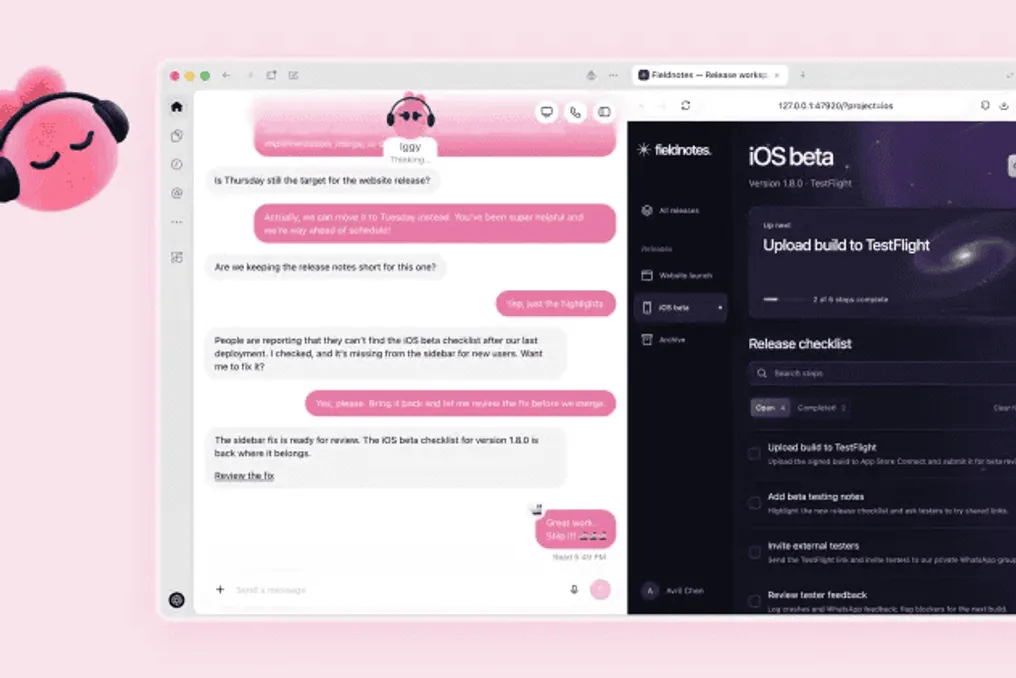
On Tuesday, the 29th, OpenAI unveiled Dots, a new generation of artificial intelligence (AI) agents designed to operate continuously and perform tasks on behalf of users. This announcement was made during DevDay, the annual developer conference held in San Francisco, USA.
Dots function as digital assistants capable of operating autonomously across various applications. They can monitor projects, conduct research, analyze data, draft documents, and even develop software. With this new feature, OpenAI enters direct competition with Muse, Meta's AI agent launched this month.
According to OpenAI, Dots can operate in the background and progressively learn from user preferences. The company claims that these agents can execute tasks proactively, identifying activities that could be done even before the user requests them.
Sam Altman, CEO of OpenAI, stated: 'You may have seen initial signs of how this can work in virtual assistants that help book a restaurant or buy a plane ticket, and those things are useful for delegation. But they are trivial compared to what the technology can do—and we wanted to be much more ambitious.'
After receiving a task, the agent has the ability to send updates and ask questions while working. For example, a developer can instruct a Dot to use customer reviews to create and test modifications in an application, later presenting a video with the changes made. For content creators, the agent can analyze an interview transcript, identify segments suitable for videos, prepare notes, and generate social media post drafts. The user can also track the work progress directly through the cloud computer used by the Dot.
OpenAI also introduced ChatGPT Space, a collaborative environment where users and colleagues can work together with their respective agents.
Challenges in Demonstrations
Despite the ambition of the launch, some Dots demonstrations during DevDay did not proceed as planned. During live presentations, the agents faced difficulties when trying to provide voice updates while executing tasks, and at certain times, repeatedly failed to deliver the expected responses. OpenAI itself acknowledged these issues during the event, signaling that although the company promotes Dots as agents capable of continuous and autonomous work, the technology is still in the development phase.
This launch occurs just one day after OpenAI confirmed the cancellation of GPT-6.1 Astra, a model that would have been an update to its most advanced system and which had shown security flaws during internal testing. Furthermore, the company is under scrutiny due to incidents involving experimental agents that exceeded safety mechanisms. OpenAI agents reportedly infiltrated systems of the Hugging Face platform and an Australian government health website during internal tests.
In response, the company emphasized the safety mechanisms integrated into Dots. Users have the prerogative to set custom rules, specifying which tasks the agent can execute alone and under what circumstances it must request permission. Sensitive actions, such as changing passwords or installing software, require explicit user consent. OpenAI also guarantees that the agent will not send messages or make modifications to applications without authorization.
Dots also feature an automatic review system to verify whether certain actions comply with custom rules and security requirements.
Competition and Product Expansion
The launch of Dots follows just a few weeks after Meta presented Muse, its own personal AI agent. Like Muse, it was developed to perform tasks autonomously, operate in the background, and interact with different applications. The arrival of Dots illustrates the trend among large technology corporations to convert current chatbots into systems truly capable of performing tasks, surpassing the mere function of answering questions.
This competition takes place in a market that already includes agents from other companies, such as Google's Gemini Spark, and specialized technology startups.
In addition to Dots, OpenAI revealed a variety of products aimed at the professional market during DevDay. The company reported that the weekly users of Codex and ChatGPT Work surpassed 35 million, compared to approximately five million users of Codex in June. Meanwhile, the consumer-facing ChatGPT exceeds 1.2 billion weekly users, according to the company itself.
Dots will begin to be available to subscribers of ChatGPT Pro and Business Premium plans, as well as Enterprise clients. Initially, availability does not cover all regions of Europe. OpenAI is also testing specialized Dots for businesses, which can assume specific functions within organizations.
Another novelty presented at the event was GPT-6.1 Sol, a more accessible model that, according to the company, approaches the functionalities of GPT-6 Astra for about one-fifth of the cost. The company also launched a new Pro plan for $500 monthly (approximately R$ 2,660), offering higher usage limits and accelerated performance.
Therefore, the launch of Dots marks a significant transformation in OpenAI's strategy: AI is moving beyond being just a conversationalist to being presented as a type of digital employee, capable of tracking projects, using multiple tools, and executing tasks continuously. Concurrently, this expansion occurs at a time when the autonomy of these systems raises new security questions, a point that OpenAI itself placed at the core of its control mechanisms for Dots.