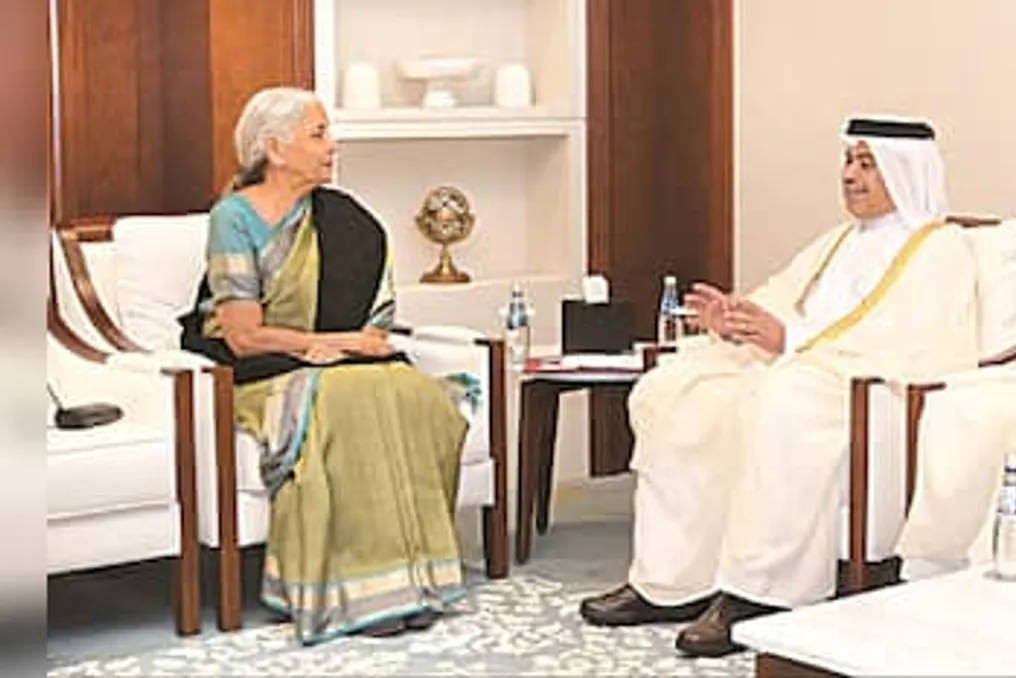
India's Finance Minister Nirmala Sitharaman concluded her three-day visit to Doha on Tuesday, where she held meetings with Qatar's Finance Minister Ali bin Ahmed Al Kuwari and State Minister for Foreign Trade Ahmad bin Mohammed Al Saed. During these meetings, she discussed finalizing the proposed Bilateral Investment Treaty (BIT) and accelerating negotiations on the Free Trade Agreement (FTA) between India and Qatar.
Furthermore, the two finance ministers examined the possibility of expanding the Unified Payments Interface (UPI) payment system in Qatar, as India seeks to deepen financial and economic ties with the Gulf nation.
The Ministry of Finance reported in an X post that the leaders discussed several key points: expanding Indian UPI payments across Qatar, implementing Qatar's commitment of $10 billion in investments in India, interaction with the National Infrastructure and Investment Fund, and completing work on the Bilateral Investment Treaty. The issue of the Double Taxation Avoidance Agreement was also addressed as a strengthened basis for ensuring tax certainty, trade, and investment.
In her meeting with Qatar's State Minister for Foreign Trade, Sitharaman emphasized the importance of restoring normal trade between India and Qatar, as well as with other Gulf countries, including unimpeded maritime shipping and trade through the Strait of Hormuz. The parties agreed to accelerate the FTA negotiation process.
Sitharaman also attended the Business Roundtable of the Qatar Business Association (QBA). She highlighted new business opportunities in India and urged the association to actively seek partnerships in trade and investment to strengthen bilateral economic ties.
In addition to meetings with Qatari ministers and industry representatives, Sitharaman held discussions during the annual meeting of the Asian Infrastructure Investment Bank (AIIB) in Doha on Monday and Tuesday. Anuradha Thakur, Secretary of the Department of Economic Affairs, accompanied her during the visit.
In a conversation with AIIB President Zhou Jie, Sitharaman stated that AIIB could expand its activities beyond financing physical infrastructure to include new areas focused on Artificial Intelligence (AI), SMEs, and upskilling. The Ministry of Finance noted that SMEs are the backbone of the Indian economy, and assistance in AI adaptation and workforce training can support these enterprises.
During her visit, Sitharaman also conducted bilateral meetings with the finance and economy ministers of Saudi Arabia, Jordan, and Nepal.
Discussing the strengthening of bilateral investment ties following the successful conclusion of BIT negotiations between India and Saudi Arabia, Sitharaman met with Saudi Arabia's Finance Minister Mohammed Al Jadaan. Al Jadaan expressed interest in attracting investment from India.
With Nepal's Finance Minister Swarnim Waggle, Sitharaman discussed Nepal's priorities in recovery and revitalization after floods. The ministers also reviewed the early operationalization and use of a fast payment system to facilitate digital payments between the two countries.
With Jordan's Minister of Planning and International Cooperation, Zeina Zaid Toukan, Sitharaman discussed food security, fertilizers, trade, and investment. Sitharaman noted that India is Jordan's fourth-largest trading partner and set a goal to increase bilateral trade to $5 billion by 2030.