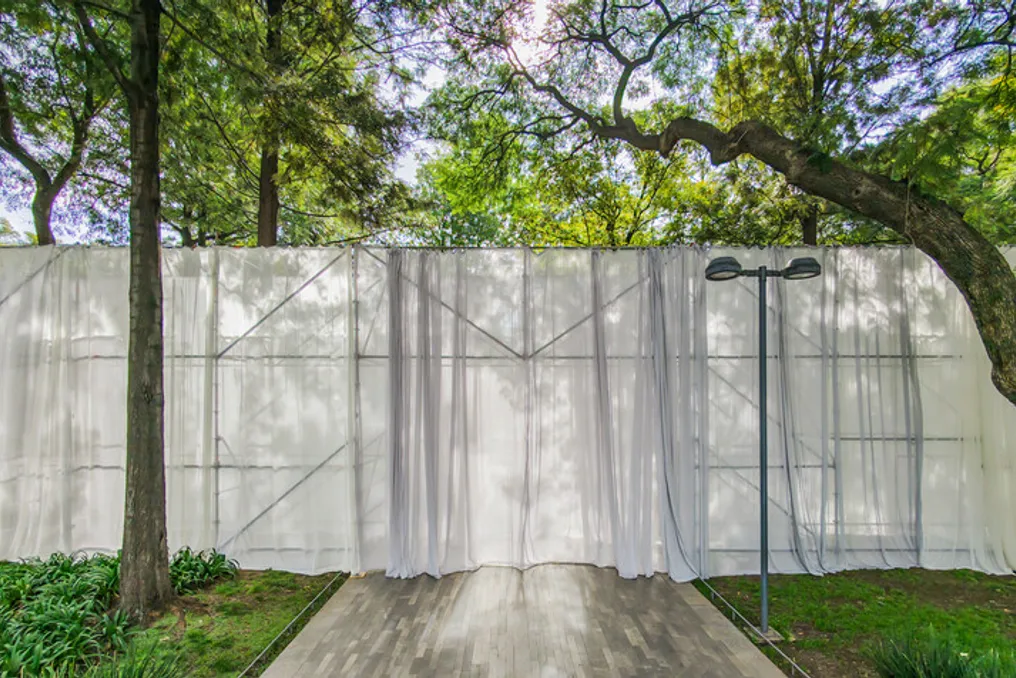
The El Muro Pavilion, the result of the collaboration between ARQLIQ architecture, Entremeios Arquitetura, Márcio Flávio Motta, and Ismael Torrano, was the winner of the 28th edition of the contest promoted by Arquine magazine for the MEXTRÓPOLI Festival 2026, which will take place in Mexico City.
The project's concept is based on a simple idea: a line that cuts across Alameda Central. Located near the Mercury Fountain, this wall intercepts three avenues, transforming an element traditionally associated with separation and division into a point of meeting, passage, and connection.
Structurally, El Muro is approximately 6 meters high, 2 meters thick, and 56 meters long, constructed with multi-directional scaffolding. Its two longitudinal faces are covered by three types of fabrics, each presenting distinct shades and degrees of transparency.
At first glance, the structure appears to be an uninterrupted surface, a large wall obstructing the path. However, upon getting closer, this initial perception dissolves, as the fabric allows light, people, trees, and the movement of the Alameda to pass through, gradually revealing what was hidden. Thus, what initially seemed like a barrier transforms into a pathway.
The essence of the work lies in this duality of being a wall, but not entirely a wall. It establishes a kind of interval within the park, a place where paths cross, allowing one to stop, observe, transit, and experience the space from a new perspective. Instead of merely blocking flow, the wall introduces a pause in it.
Considering short-duration architecture as a testing environment, where the idea is confronted with reality, this wall is built from this experience. Its structure acts as a vast canvas that captures the light, shadows, bodies, and movements of the Alameda, documenting, even if temporarily, the events around it.
Thus, the wall transcends its function as a mere object placed in the park, coming to integrate with the environment. It becomes an artifact of intersection, traversed by various flows and encounters, configuring itself as a space of transit, permanence, and possible moments of enchantment.