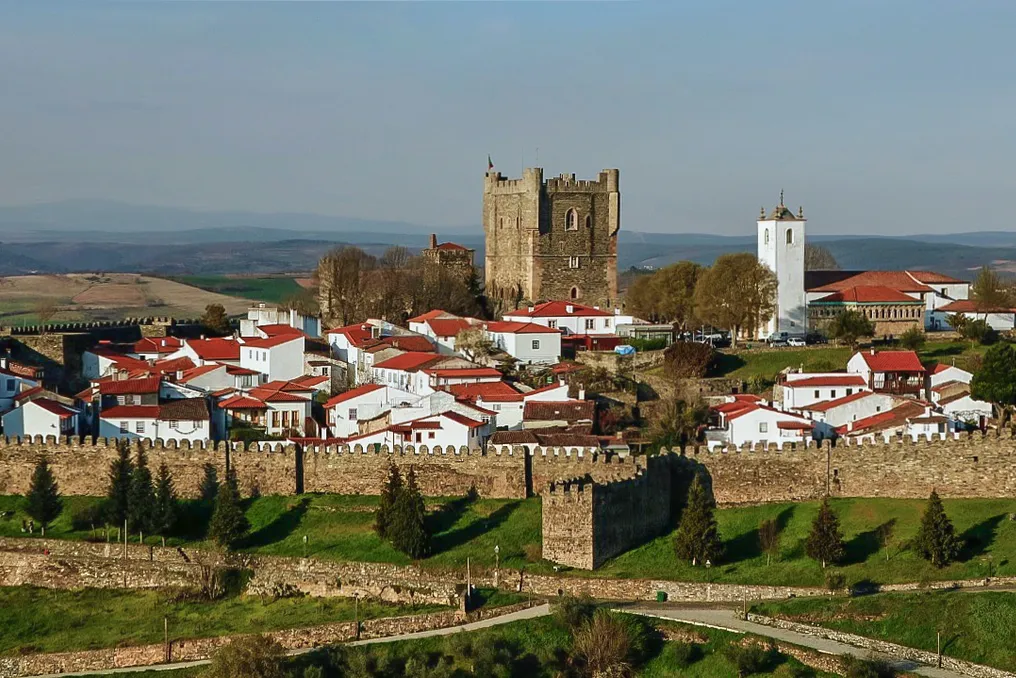
Although relatively accessible, the city of Bragança, located in the far northeast of Portugal and with just under 35 thousand inhabitants, remains outside the main tourist circuit due to its distance from large urban centers. From Lisbon, the bus journey takes about six hours, while from Porto it is approximately three hours. It is important to note that there is no rail connection to the city.
Situated in the historic region of Trás-os-Montes, on the border with Spain, Bragança gained notoriety recently precisely because it is not an overly frequented destination. This place offers an alternative for exploring Portuguese history in an area often neglected in the country's internal itineraries.
The Castle of Bragança
Founded in the 12th century by King Sancho I, the Castle of Bragança constitutes one of the most emblematic points in the city's historic center. Recognized as one of Portugal's best-preserved fortifications, this citadel was declared a National Monument in 1910, featuring robust walls reinforced by fifteen towers.
Keep Tower
The Keep Tower, dated to 1430, is the main structure of the fortress and the greatest symbol of Bragança. The completion of this construction is credited as the milestone that led to the locality being elevated from a village to a city during the 15th century.
Furthermore, there is mention of the Princess Tower, where figures such as Dona Leonor, wife of the fourth Duke of Bragança, were held (supposedly unjustly) for adultery and subsequently murdered by her husband, Dom Jaime. This story may have served as inspiration for the local legend about an orphaned princess who rejected suitors proposed by her uncle, opting instead for a humble knight, which resulted in her imprisonment in the tower.
Inside the fortress, the Domus Municipalis stands out as a unique architectural attraction. This pentagonal structure historically served as a cistern and, on its upper floor, hosted meetings of the Bragança municipal administration. It is considered the only remaining example of Romanesque civil architecture in the entire Iberian Peninsula, displaying medieval characteristics with references to Roman and Byzantine constructions, which usually only survive in religious temples.
The Bragança region is world-renowned for the tradition of the 'caretos', recognized as Intangible Cultural Heritage of Humanity since 2019. In this event, people dressed in masks, colorful costumes, and bells on their waists parade through the streets to celebrate the end of winter, coinciding with Carnival's Entrudo. Although the tradition exists throughout the area, it is more prominent in the locality of Podence, located about half an hour south of Bragança.
More details about this cultural practice can be found at the Iberian Museum of Mask and Costume, which exhibits elements of local caretos and also of similar festivities held in the Spanish district of Zamora, across the border.
When heading towards the border with Spain, those seeking to learn about other aspects of local culture should visit the famous 'raiana' villages (where 'A Raia' designates the entire dividing line between the countries). Among them, Rio de Onor deserves special mention: this small settlement, with fewer than a hundred inhabitants, keeps the 'rionores' dialect alive, a specific type of Portuguese-Spanish spoken in the region. The village was even elected as one of the 7 Wonders of Portugal, in the 'Villages' category.
For nature lovers, the Bragança side offers the Montesinho Natural Park. This park covers 75 thousand hectares in the northernmost part of the region, providing mountainous landscapes reaching altitudes close to 1.5 thousand meters.